
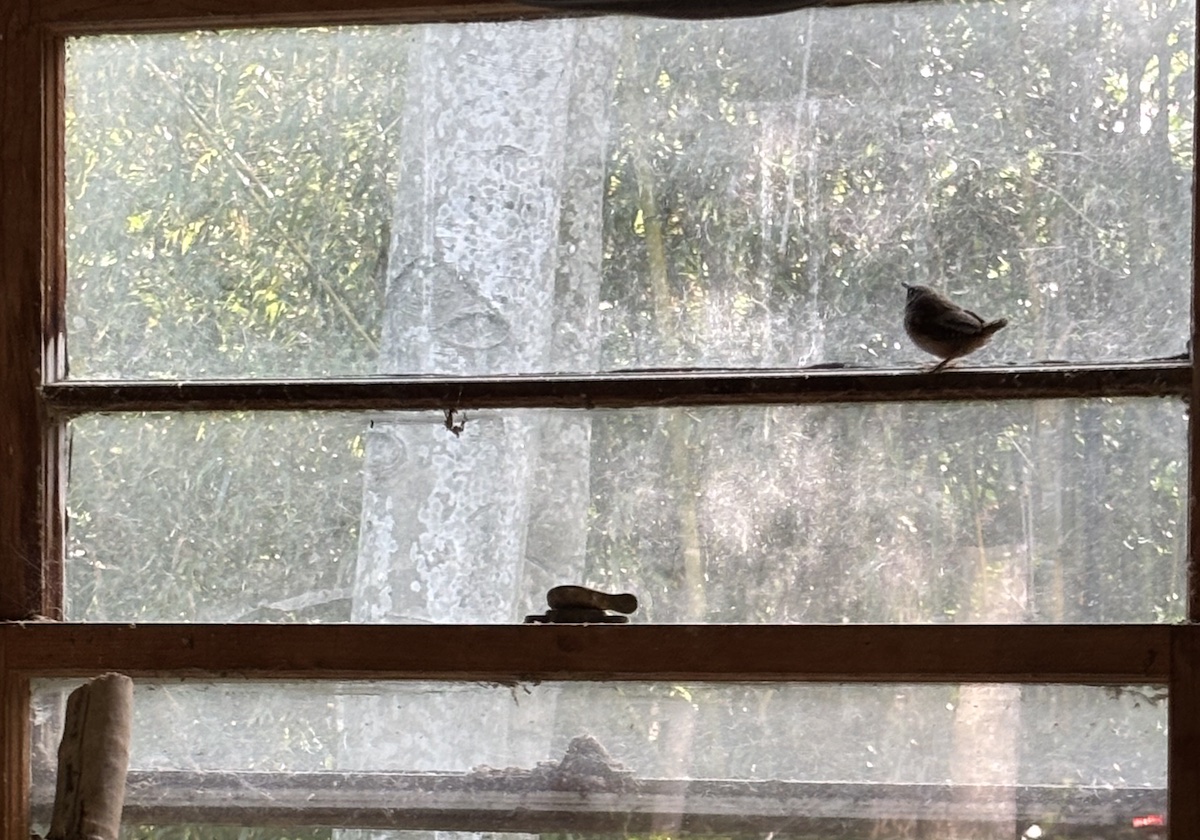
House wrens are small, brown, and brisk.
They are not shy of humans and are open-minded about where they construct their nests.
In his 1974 book, “Birds of New York State,” John Bull underscored this: “The nest is placed in a variety of situations such as tree cavities, upturned tree roots, stone walls, birdhouses, tin cans, coat pockets, iron pipes, mailboxes, old shoes, fence posts, and once in a human skull,” he wrote.
(Note: Scattering human skulls about is now discouraged.)
A pair of house wrens recently moved into a birdhouse located under the eaves of our garage and I’ve watched them with interest.
Conclusion? These birds are personable, noisy, and hard-working. They’re also evil little control freaks.
Males pile twigs, sometimes hundreds, into potential nesting cavities throughout their territory. These 3-D twig puzzles serve as advertisements to the female house wren, which chooses her favorite. She uses the twigs as a base to build a cup nest softly lined with things like moss and spider egg sacs.
However, the wren couple dosen’t like neighbors.
The “dummy nests” not chosen remove housing options for other species by clogging cavities. I once opened an unused nest box filled tight with twigs. If other cavity nesting birds, such as tree swallows or bluebirds, do happen to nest nearby, the aggressive wrens might remove their nests or poke holes in the eggs. I once saw a pair attack a chickadee nest in my yard. The chickadees, overmatched, looked helpless and dejected.
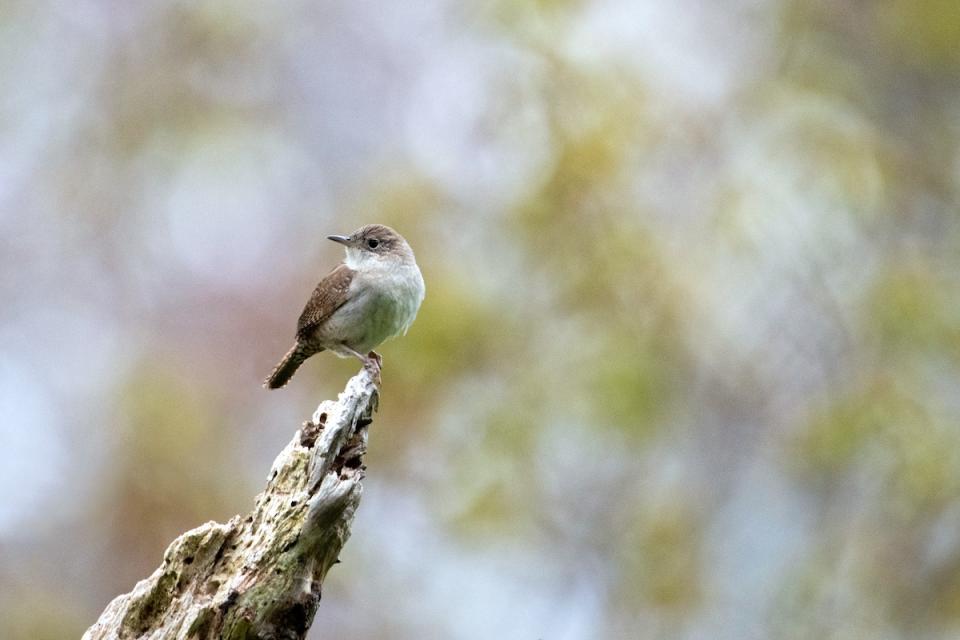
House wrens use their spasmodically-repeated skidding and complex song to announce their arrival in mid-April. They bounce around the yard, exploring every nook, fearless, touching everything: bistro lights, a vine, the rim of a red pot, any skull.
I once saw one enter a hole and never surface.
In short, they’re entertaining.
We didn’t know they had moved in until we heard the squeaks of nestlings. After that, they became impossible to ignore.
Around this time, I developed habits involving liquids, which helped inform my wren research: in the early morning I would drink coffee from a nearby chair; in the evening, I’d enjoy an uncaffeinated beverage.
I like to think they got to know me. I was part of their environment, like a bush, or a skull: broken guy on chair.
House wren parents (the sexes are indistinguishable) split labor. They’d search for food, chattering continuously, to share their location. Once, a parent caught a large, winged, insect and landed on a spicebush near me bragging about its hunting prowess.
About once every two minutes a parent would land on the nest hole. From inside, the baby birds would burst into begging. I came to associate these squeaks with applause. The parent would dip in, drop food, and quickly get the heck out of there to find more.
They used every microhabitat in our backyard, diversifying their hunt. According to allaboutbirds.org, house wrens eat spiders, beetles, caterpillars, earwigs, daddy long legs, flies, leafhoppers, and springtails.
They had a routine. After gathering enough, a parent would land on the driveway, survey the scene, pause, flit into an andromeda bush below the box, pause, and then suddenly appear at the nest hole.
TA-DA! The babies would break into their rapturous applause.
Then, as quickly as they’d entered, they’d leave. The nestlings would slowly quiet into silence as the parent again collected insects in the yard.
If the parents took too long, I’d get anxious. The nestlings too. They’d softly ask, “Chuh? Chuh?” like, “Mom? Dad?” They’d always return.
Sometimes the parent would exit carrying something in its mouth: a fecal sac, turns out. This was sort of a gross revelation but made sense.
For a week, I sat watching and was watched. A wren would land on a bayberry, tail taut, and scold me before diving into an unplanned mixture of ferns, goldenrod, and violets, disappearing completely, chattering all the while.
I got a bit lost in the pattern and cadence of their work. Silence. Applause. Silence. Applause.
I canceled plans with friends. One day I spent two hours before sunset, hoping to discover if the parents slept in the box.
The monotony became relaxing.
Silence. Applause. Silence. Applause.
The setting sun turned the tops of the oaks orange. Feeding continued. Night fell. Lightning bugs flashed on and off. Quiet except for a catbird, a robin, and car tires on Ferry Road.
If the parents entered the nest that night, I missed it.
The next day, it rained. I got busy with work. For three days, I fell out of my habit of watching the wrens. I forgot about my sessions sitting rapt and waiting to be touched by Something Meaningful.
If I was touched on those days, it was by boredom. I was unthinking, rushed, and sort of angry. That’s the truth.
It passed.
The next evening, I was back out there sitting with the babies fattening in their nest box.
I noticed a pattern change. For two minutes, a parent sang husky morse code from the top of a fencepost. It seemed like a lullaby, or an invitation, and was about as soft as a wren vocalization can get. Over in the house, all was quiet. I sensed the babies were listening.
Later, a parent called to the box from 20 feet away, a staccato “chutchutchut” and the baby bird chorus answered back, excited, as if they expected food. But the parent stayed away.
She called again, calling them to her. The babies weren’t ready. Their applause would brighten then fade. Brighten then fade.
It went on like this. Night took over. Then silence. Some minutes later the parent entered and this time, didn’t exit.
That was the night before they fledged. They all slept together.
The next morning, at sunrise, the whole world opened up. Fledglings spread like spilled marbles across the front yard. One got stuck in the garage. Another visited my neighbor’s yard where it surely came into contact with some noxious chemical and died.
A stray cat crossed my yard. In my pajamas I chased it away. Another neighbor saw me while walking his dog. “You see a cat?” I asked. “No,” he said, shaking his head.
It was chaos. I heard little birds everywhere. I hope for a second brood.