
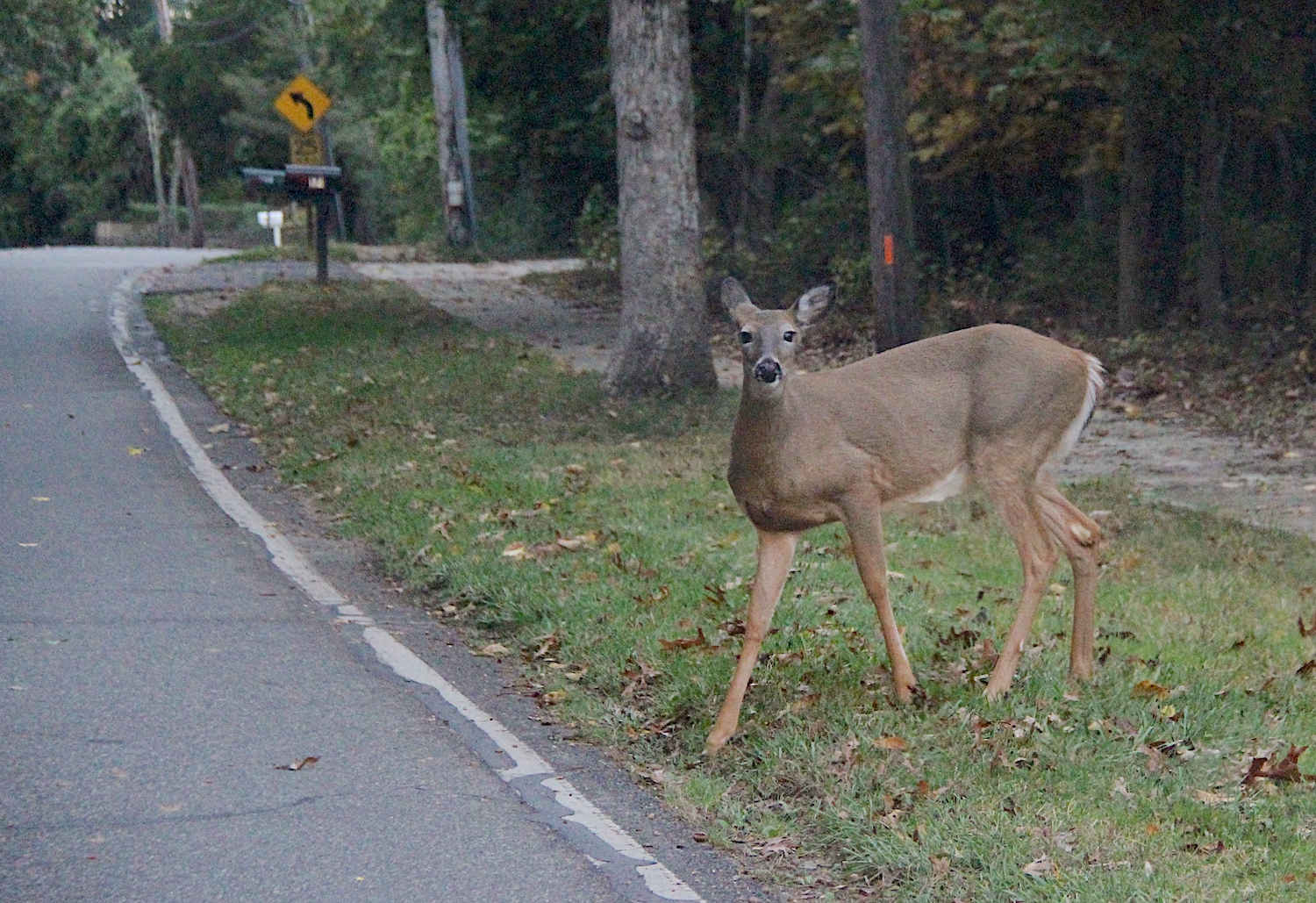
The other day in East Hampton, a doe did something I will never forget.
After being struck by a vehicle, she did not disappear into the woods. She did not die where she fell. Instead, in shock and unimaginable pain, she dragged herself away from the road and made her way to the only place she believed was safe.
She came to my property.
Out here, deer are part of everyday life. You see them at dawn and dusk, moving quietly through the trees, crossing roads that were never meant to cut through their world.
But there is something people do not always understand until they have lived alongside them for years. Deer remember. They recognize patterns. They recognize places. And sometimes, they recognize people.
Over time, this doe came to know my yard as safe.
She would step within a few feet of me, near enough that I could feel the trust. Not because I ever tried to tame her, but because she learned the sound of my storage container and what it meant. She learned that when she heard it, I would be putting out cracked corn, oats, and minerals, simple things, but important support through the seasons.
More than 20 deer now frequent the property. They arrive quietly. They linger. They return. They are part of what makes the East End feel like home.
When I found her, she was lying behind my shed. I stepped outside and instantly knew something was terribly wrong. But what I was not prepared for was what happened next. The moment she saw me, she lifted her head. Her eyes locked onto mine.
And then, without being able to stand, she started pulling herself toward me. It was slow. It was painful. It was quiet. She did not run because she could not. She did not fight because she had no strength left to fight. She just dragged herself forward, inch by inch, through the dirt and the leaves, coming closer and closer as if she had made a decision with what little strength she had left.
It felt like she was not just coming toward me. It felt like she was coming to me.
As she got closer, I saw the injuries clearly. Both rear legs were broken so severely that bone was exposed. Her hooves were broken off at the ankle. She could not stand. She could not escape. She could not even adjust her body without pain.
And still, she kept coming. Until she finally reached my yard, her safe place, and sat down.
She sat there the way she had sat before, in a quiet, familiar spot, as if she had finally reached safety. As if she believed the worst was over simply because she had made it to the place she trusted.
In photos, you can see her family nearby. They stayed. They did not scatter into the woods the way people assume wildlife always does. They stood at a distance and watched, silent, still, and present. It looked like they were standing guard. Like they could not leave her. Like they did not understand what had happened, but they understood she was hurting. I do not think I will ever forget that.
It is one thing to witness an injured animal. It is something entirely different to stand in your own yard, looking at a living being you recognize, watching her struggle, watching her family watch her, and realizing you cannot help her the way your heart is begging you to help her.
I started making calls immediately, to multiple places. Some never answered. Others told me, “You have to call the police.” But I could not accept that as the first answer. And I could not accept it because I already knew what that experience can look like.
The one time in the past that I did call for police help, the officer did what he had to do, and I do not blame him for it. But it took three shots before the deer finally lay still. After the first two shots, the deer jerked in a way no person should ever have to witness. The officer had to fire again to end the suffering completely.
That moment stayed with me. So this time, I kept trying.
I stayed in contact with the Evelyn Alexander Wildlife Rescue Center, and I want the community to know this. They were caring, compassionate, and responsive from the very beginning. They did not dismiss it. They treated this deer like a life that mattered. They sent volunteers to my property, and they were outstanding. Calm. Kind. Gentle. Professional.
Even though they were restricted by current regulations, they did the most important thing they were legally allowed to do to reduce fear and suffering. They sedated her. And in that moment, I felt something I can only describe as gratitude.
Because at least her last moments were not terror. At least her last moments were not panic. At least she was not forced to endure unimaginable pain fully awake and afraid. She was calm. She was finally still.
Still, I searched for another option, something that would not end in a police firearm. A family member urged me to call a local veterinarian. We were willing to pay out of pocket, whatever it cost. We were not looking for charity. We were begging for a humane option.
The veterinarian was kind and apologetic, but he told us he was not allowed. Under the current rules, he was not licensed to euthanize wild animals.
Think about that. A suffering animal is lying in a yard. A rescue team is on site. A veterinarian exists. People are willing to pay. And yet there is no legal medical pathway to end that suffering.
So the final call still had to go to law enforcement. And the police had to shoot her. Not because the police wanted to. Not because the rescue team did not care. Not because anyone there was heartless. But because this is how the system is structured right now.
She is gone now. And yes, she is no longer suffering. But something in me changed that day.
I do not believe this was just another sad incident we are supposed to shrug off as “part of nature.” I believe this was a moment of clarity, a moment that made it impossible for me to look away. I feel, in my bones, that this has become a calling, to help build a humane system where suffering is met with mercy, not red tape, and where the people who are trained to help are legally allowed to help.
We need a lawful, D.E.C.-approved protocol that allows licensed veterinarians, under proper oversight, to respond to catastrophic deer injuries. If euthanasia is the only humane option, it should be performed quickly, medically, and discreetly, without forcing police to be the default solution.
Because if a deer can drag herself to the place she trusts in her final moments, then surely we can build a system that meets her there with mercy.
Randy Zlobec lives in East Hampton. He has studied memoir writing in a workshop with Andrew Visconti.