
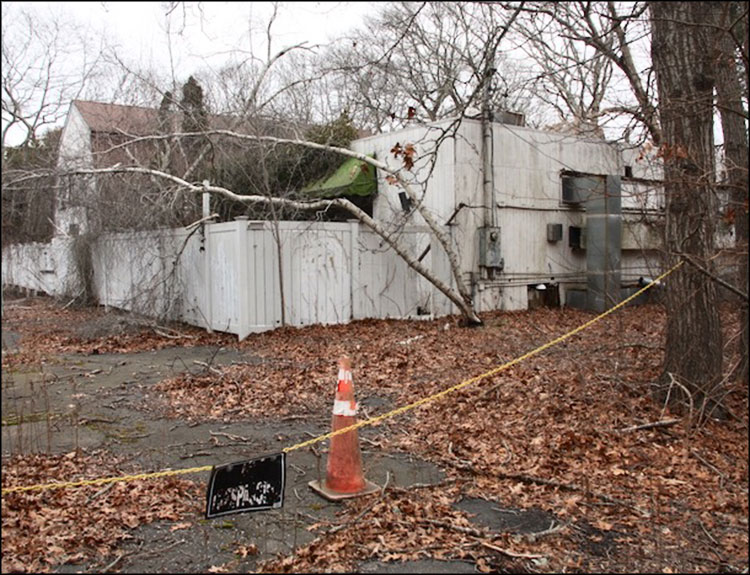
Memorializing the former Swamp disco and Annex restaurant site on Wainscott’s 1.1-acre highway parcel is a misguided idea. Why should the land on which a gay bar once stood be memorialized? Memorials are traditionally reserved for events, people, or places of lasting public consequence — not for commercial nightlife venues, in particular one that isn’t worthy of a monument of any kind.
Nothing heroic happened there. The Swamp didn’t stand for anything noble or enlightened. There was no L.G.B.T.Q. solidarity. To pretend it was representative of the L.G.B.T.Q. community is a huge misrepresentation of what the Swamp was really like.
I was a regular at the Swamp for years. I was one of the so-called “Dirty Dozen” who sat at the bar almost every night, through the winter, and had a drink with the usual crew. I could romanticize it as being a gay “Cheers,” but it was not. Neither was it “woke.” It was a place where cocaine was available to purchase in the bathroom, and where there was a long mirror above a communal trough in the men’s room. There was a small outdoor section, called the “enchanted garden,” where men had sex behind a fence that was only five feet from the highway. When AIDS became prevalent, although many customers and staff members got sick and died, I don’t remember one fund-raiser that was sponsored by the Swamp for any AIDS charity or for the East End Gay Organization.
It’s important to note that Bill Higgins, the owner, did not like lesbians, and he didn’t want them in his bar. This caused a huge schism between gay men and lesbians that never healed. Higgins thought the presence of women would kill the sexual vibe between men. One night after counting 60 women in the disco, he decided to put a stop to it. He told a journalist, “If we let women in, suddenly we’re Bobby Van’s.” Higgins put up a sign at the entrance to the club that said in large red letters, “This Is a Gay Men’s Club.” He also started charging women $10 at the door to discourage them from coming in.
In 1979, when a woman and her partner were each asked to pay $10 at the door a shouting match ensued and one of the women took a swing at Higgins, who put her in a headlock, dragged her to the parking lot, and threw her down on the pavement. He braced himself for a lawsuit but none came.
Higgins was eventually brought before the State Human Rights Commission by a woman named Judith Portnoy for discrimination, a charge that so amused the oblivious regulars that a drink named Portnoy’s Complaint was named after her. Astonishingly, the Human Rights Commission dismissed the charges, and a group of angry women staged a sit-in at the bar. It ended with the lesbian community boycotting the place for good, with bad feelings all around.
At their zenith in the early 1980s, the Swamp disco and Annex restaurant in Wainscott were one of the most famous resort bars in the world and the hippest, most festive nightclub on the East End. On summer nights cars were parked up and down the highway for a mile in either direction.
But it doesn’t warrant claiming that the lot on which the Swamp once stood is hallowed L.G.B.T.Q. ground.
The plans that were reported for the highway acreage in Wainscott included a pink pyramid, figures that look like giant Gumby dolls, and a raised deck in the footprint of the old dance floor so people can have parties there. Since this is 300 feet of prominent highway frontage, we will all see it and live with it every day.
If a bar’s clientele is enough to justify a memorial, where does that logic end? An Italian bar, a writers’ bar, a musicians’ bar — none are typically treated as sacred ground simply because of who gathered there. The Swamp wasn’t the Stonewall. It is wholly inappropriate that the town allow the park to be memorialized as something gay. If you must, why not dedicate the park to “Love Wins,” or to Edith Windsor, the woman who fought for marriage equality all the way to the Supreme Court and won, and who lived in Southampton?
I had a brief conversation with her widow, Judith Kasen-Windsor, who was unhappy to hear the property might honor a club that excluded gay women. I told her that I hoped everyone in East Hampton could step back and stop naming streets after celebrity residents or parks after gay bars.
Steven Gaines’s books include “Philistines at the Hedgerow: Passion and Property in the Hamptons” and “One of These Things First,” a memoir. He lives in Wainscott.