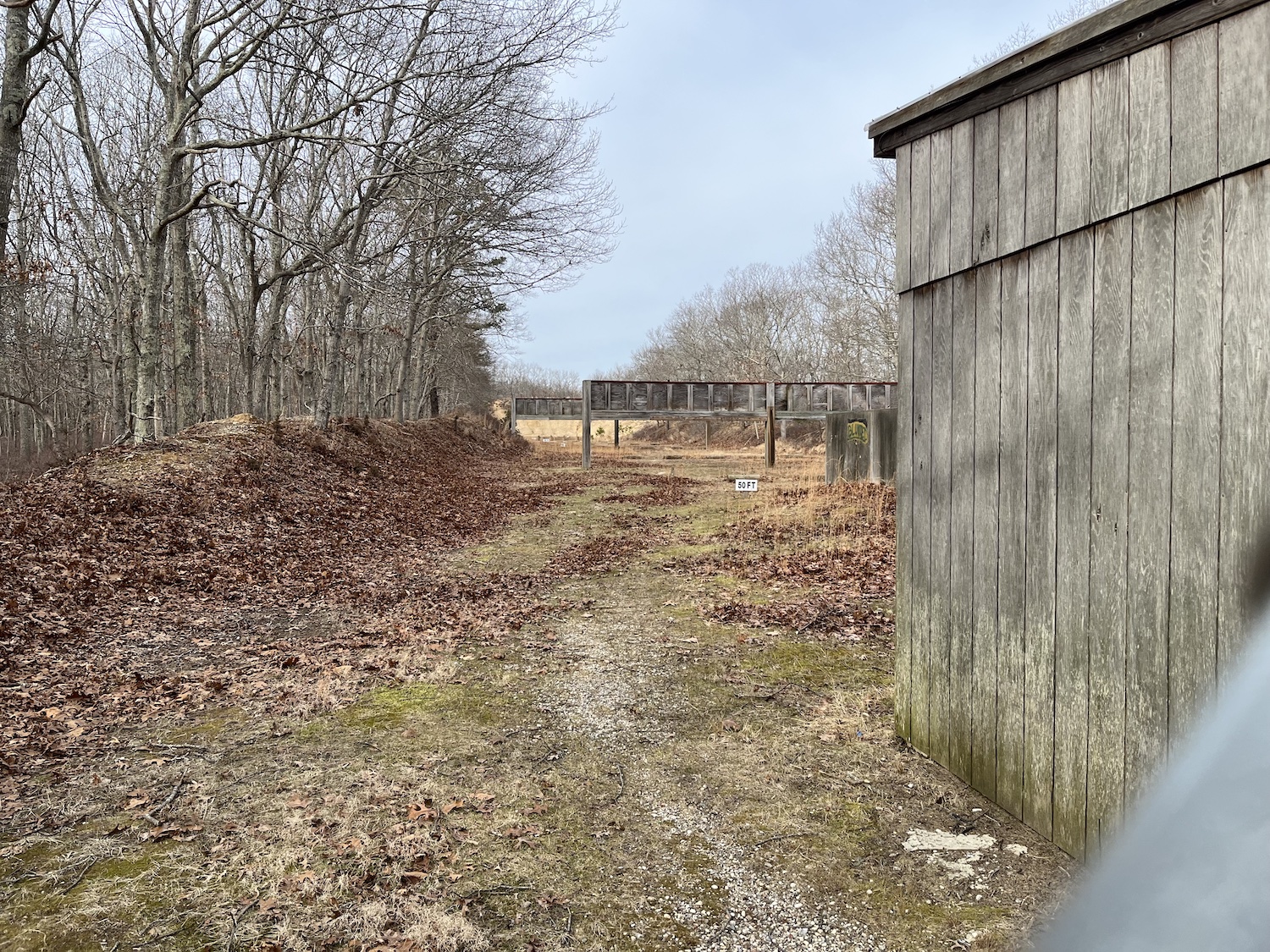
Aircraft and firearms, two things America has more of than any other country in the world by a wide margin, are causing frustration to boil over in Wainscott, if the hamlet’s citizens advisory committee’s meeting on Saturday is any indication.
The former are responsible for excessive noise and both are to blame for pollution, members of the committee said, yet affected residents are powerless due to a still-to-be-executed lease for which the Maidstone Gun Club has a right of first refusal for the 97 acres it leased from the town for 30 years, and a temporary restraining order that has maintained the status quo at East Hampton Town Airport since its May 2022 imposition and which the town board’s liaison to the committee suggested makes a mockery of the word “temporary.”
The town’s planned purchase of a 13.5-acre wooded parcel at 549 and 550 Wainscott Northwest Road for affordable housing was brought into the discussion by way of criticism over its environmental impact when, some argued, acres of already-disturbed land — at the gun club site — exist elsewhere in the hamlet.
As she has previously stated, Councilwoman Cate Rogers told the committee that no lease has been signed with the gun club to date.
But “the interest in reopening the gun club seems to be about some mysterious skeet shooting,” Barry Raebeck said, “because all of the shooting, including police practice, can easily and safely happen in an indoor range. So the town board is reserving 97 acres of public land for private skeet shooting in a now-residential neighborhood.”
The town, he said, “is preparing, perhaps, to bulldoze 13 acres of woods and natural habitat on Wainscott Northwest Road for affordable housing, which the town — we — recently bought for $4 million, when just down the road, we already own 97 acres, 20 acres of which has already been illegally cleared, at the former gun club site. This is grossly irresponsible, fiscally, environmentally, and in terms of protecting our citizens.”
Mr. Raebeck also charged that a range that gun club officials said would be dismantled has in fact been improved. “I know that as a fact,” he said, without elaborating. Members of the committee continued to advocate for affordable housing and/or a solar farm on at least a portion of the site.
There is frustration within the gun club’s membership, Kirby Marcantonio said, given “they’ve been paying dues for being a member of the gun club but they haven’t been able to shoot a gun in three years, four years.” But his research, he said, indicates that a prefabricated indoor gun range could be brought to the site and installed on around two acres and would cost around $2 million. Even adding recreational space for social activities, “I doubt you need more than maybe 10 acres out of the 97,” he said.
Other uses on the remaining acres could surely be monetized, Mr. Marcantonio said. “It would basically pay for the indoor range for the gun club, so that they don’t even have to make an investment in it, if they were willing to take themselves back to a smaller section of the property and then let the town decide what the rest of the property might be.” If a new lease is still being negotiated, “there are things that could be put on the table that might help to move things along and make for a better outcome for everybody.”
“During a historic drought with wells in this hamlet closed by contamination,” said Ilan Rosenthal, a neighbor of the 549-550 Wainscott Northwest Road parcels who filed a lawsuit challenging the acquisition, “the town is spending $4 million, nearly $300,000 an acre, to buy one of the largest swaths of uncleared, intact aquifer protection land left . . . when it already owns land nearby at and around the airport,” 20 acres of which, he said, are already cleared and “contaminated with decades of lead seeping toward the water every well draws from.” Remediate those 20 cleared acres, he recommended, and “build the housing on 15 of them.”
Regarding the airport, Marc Frons of the committee said that according to JPXWatch.org, the public data platform he built to independently track every flight in and out of the facility, aircraft operations are up by a third, year to date, over last year. Violations of the voluntary 10 p.m. to 7 a.m. curfew are also up sharply, he said, and while helicopters tend not to fly in the curfew period, “they do cluster, and what is most disturbing for people living under the flight path is the clustering of helicopters.”
Mr. Frons referred to Independence Day weekend and his personal observation of “five operations in 10 minutes,” each helicopter over his property for 30 to 40 seconds, which he called the “fall of Saigon effect,” a reference to the U.S. military’s helicopter airlift to rescue American personnel and at-risk South Vietnamese civilians as it exited Vietnam in 1975. “The more we can surface this data, the better I think it will be,” he said, “because we have to prepare for that time when the T.R.O. against the town is lifted and we can make some procedural and operational changes and work with regulatory bodies like the F.A.A. to do things to make it more livable out here.”
He and Mr. Raebeck told the group that they had spoken, separately, with officials of the federal General Accountability Office, which provides auditing, evaluative, and investigative services for Congress and is examining state and local efforts to reduce or mitigate helicopter noise in response to congressional mandates. Ms. Rogers said that she, Supervisor Kathee Burke-Gonzalez, and Jim Brundige, the airport manager, had also met with G.A.O. officials.
“They’re going to collect all this data and file an official report,” Mr. Frons said. This, he said, should result in “some relief from the F.A.A.” with respect to the Airport Noise and Capacity Act of 1990, which dictates how and when local airports can restrict aircraft access or operating hours.
“We made it very clear in our discussion with the G.A.O.,” Ms. Rogers said, “that the town is basically, at this point, left with only one option to consider, which is the nuclear option, which is to close the airport. And that is a result of the inability to manage a publicly owned property that exists within our town.”
Mr. Raebeck suggested a better description for closing the airport is “the wildflower option,” because “to me, it’s a totally positive option.”
But, Ms. Rogers added, “I don’t even want to say to people ‘once the T.R.O. is lifted,’ because there is absolutely no regulatory time frame for these judges to have to rule. So a temporary restraining order can be indefinite.”