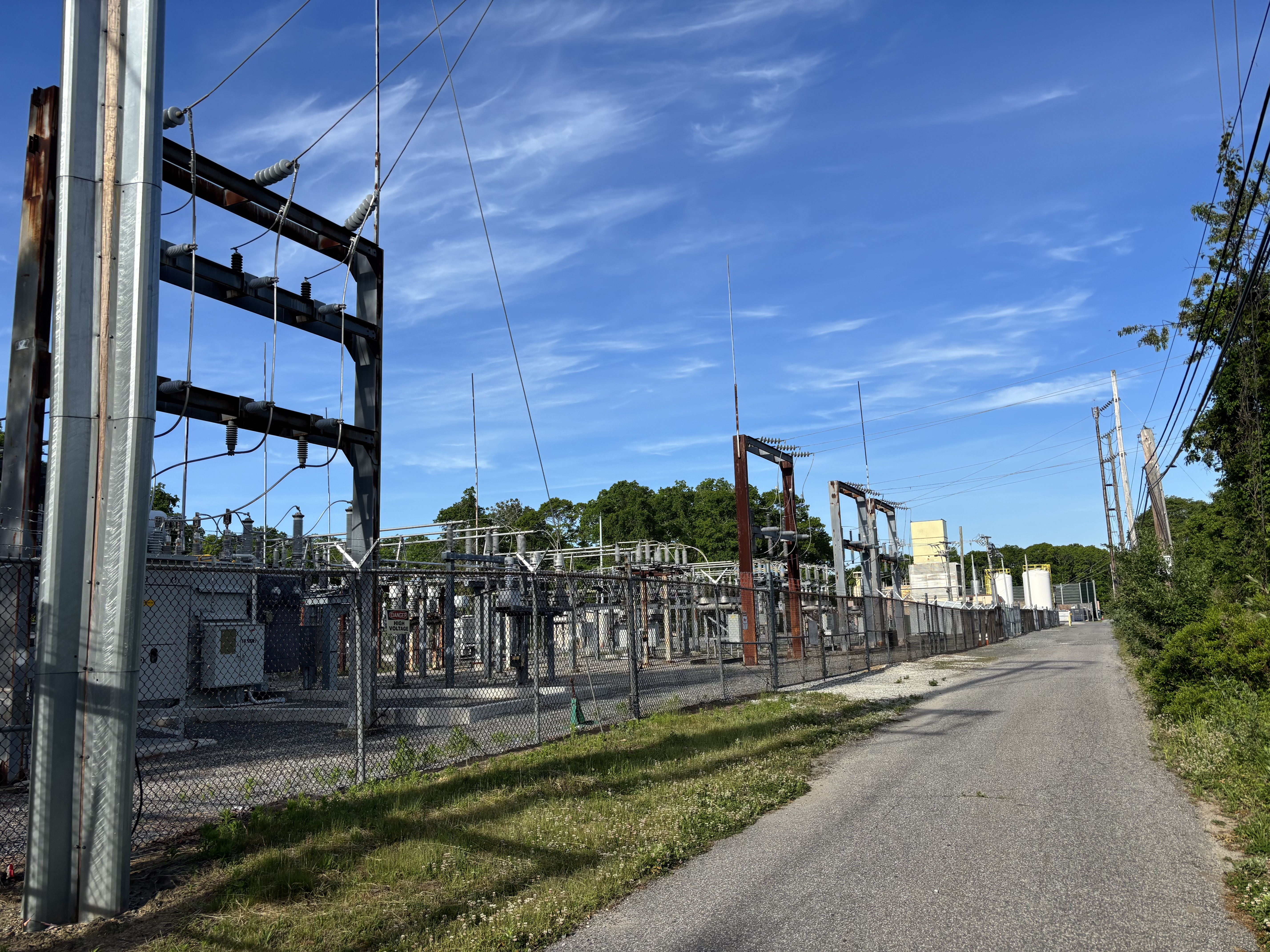
Two Suffolk County Water Authority drinking wells close to the intersection of Cove Hollow Road and Montauk Highway have been contaminated by so-called "forever chemicals" from the nearby East Hampton Energy Storage Center, alleges a civil suit filed by the water authority against the storage center, LG Chem, and LG Energy Solution on May 29 in the United States District Court for the Eastern District of New York.
In response, the water authority has removed the two wells from service and restricted the use of two others nearby.
Patrick Derenze, the town's public information officer, said Friday that approximately 30 private wells will need to be tested as well.
The Suffolk County Department of Health Services will be offering free testing, he said. "They already sent out letters" last week "to those they think could have been affected. They are also knocking on doors . . . to inform people and offer the free testing."
At Tuesday's town board meeting, Supervisor Kathee Burke-Gonzalez described a joint task force she coordinated and a phone call Monday between the governor's office, the state's Department of Environmental Conservation, the county executive, both the state and county Health Departments, and the county water authority.
"Those calls are now planned to occur weekly," she said. The task force will share data, seek to expedite sampling and make replacement water available, and work to remediate the full contamination in the ground.
"I refuse to ask families to wait years for a court to decide who is to blame before their water is protected. Accountability matters, but a lawsuit does not test a private well or groundwater, nor does it ensure that enough water is available. That work has to start now," she said.
Because two wells were now offline, she said conservation was important and encouraged residents to water their lawns only every other day, with odd-numbered houses watering their lawns on odd-number days, and even-numbered houses on even days.
"I will keep pressing every level of government until this is resolved," she added.
Mayor Jerry Larsen said he met with both the Suffolk Health Department and the water authority on Tuesday, but the number of private wells affected within the village has not yet been determined.
Mr. Derenze said the town had also not been told which houses had been affected, adding that the state has testing wells north of the site and those hadn't been impacted. The lawsuit says groundwater in that area of town flows north to south.
The lawsuit specifies that the wells in question are known as the Bridgehampton Road Wells 2B, 3, 4, and 5A and that they're approximately 2,500 feet south of the energy storage facility. They contribute 7 percent of the water for the S.C.W.A. Zone 23 pressure zone, but their treatment "is not capable of effectively removing [East Hampton Energy Storage Center] contaminants, including ultrashort-chain PFAS."
The chemicals are said to have tainted the water wells after a fire broke out at the facility on May 31, 2023. The water used to extinguish it was allowed to travel off its 13.9-acre campus and seep into the ground, the suit alleges, ultimately reaching the groundwater that feeds the well.
The wells draw their groundwater from the upper glacial aquifer, from depths between 125 and 150 feet.
The water authority "brings this action to recover the substantial costs necessary to protect the public and restore its damaged drinking water supply wells, which are contaminated with the chemical perfluoropropionic acid (PFPrA), among potentially other chemicals, which were released during a fire at the East Hampton Energy Storage Center," the lawsuit reads.
The storage center is a lithium-ion battery energy storage system (known as a BESS) that provides energy to the Long Island Power Authority. During the fire, according to the lawsuit, "battery casings opened and released their contents." The large amount of water necessary to fight the fire "ran off of the facility and onto the dirt road and undeveloped area south of" the storage center, "conveying chemicals from its batteries."
The facility was built between 2017 and 2018, and operations began in August 2018.
During the fire, its fire suppression system ran for approximately 30 hours and could have released over 2.2 million gallons of water, according to court documents, but it was not equipped with facilities to contain that amount of water.
The water authority says that the forever chemicals, specifically PFPrA, have now been detected in nearby wells at levels above the state's "maximum contaminant level."
"There is a growing body of evidence of the toxicity of ultrashort-chain PFAS, including those detected in the Bridgehampton wells," according to the lawsuit. The water authority says that chemicals may continue to seep into the groundwater and that it is continuing to sample, monitor, and test its wells.
Outside of the Bridgehampton wells, PFPrA has been detected in only five of the water authority's active supply wells and at much lower levels than it says it found in East Hampton.
The water authority is seeking compensatory damages, punitive damages, and other relief.
—
This article has been updated since it was first published.