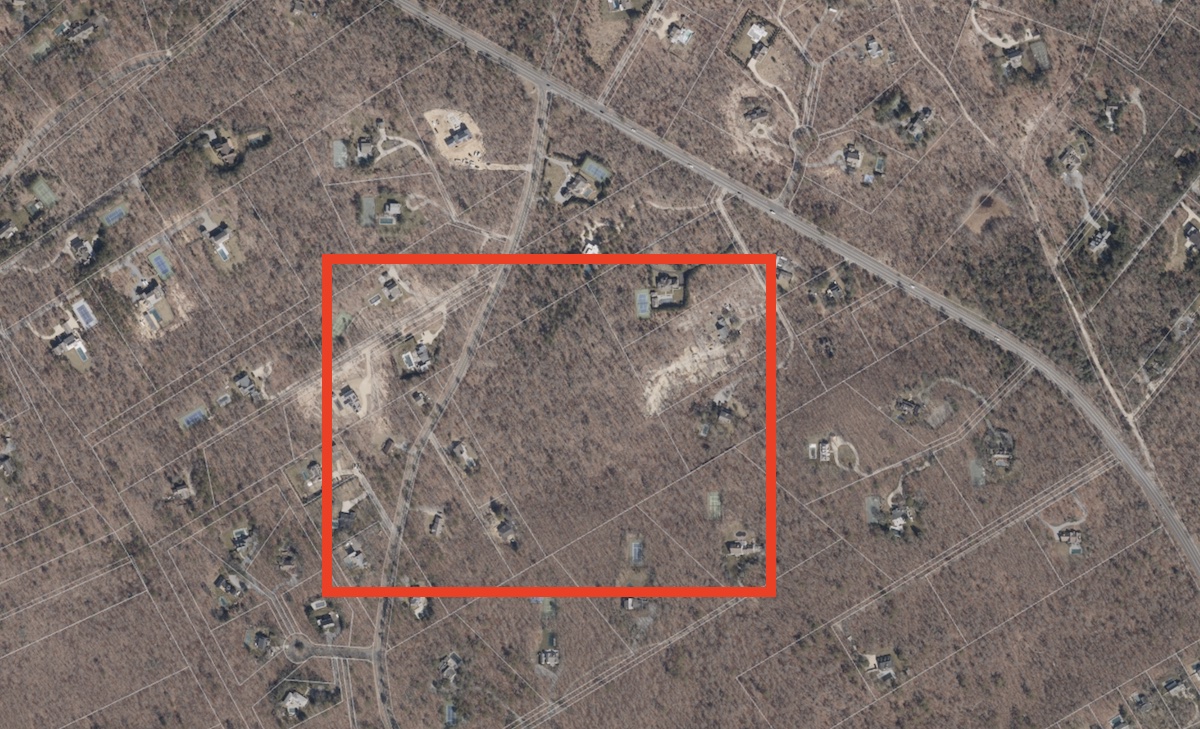
Suffolk County Justice James F. Quinn issued a temporary restraining order this week preventing East Hampton Town from closing on its controversial purchase of 549 and 550 Wainscott Northwest Road in Wainscott.
The 13.5-acre parcel quickly became the center of dispute after a May 7 public hearing brought out a contingent of neighbors opposed to the development of affordable housing on the lot. They have sued the town, and their attorney, Jon Tarbet, is pushing the court for a permanent restraining order, which would prevent the purchase altogether.
Justice Quinn, in a June 1 show-cause order, indicated he will rule further next Thursday, after he has more time to review the files.
The town board has hoped to purchase the lot with $3.975 million in community housing funds. Members noted during the hearing that they had no specific development plan for the land as yet. Using C.H.F. funds, however, compels its eventual use as affordable housing.
The board resisted requests from the audience to make a thorough review of possible environmental impacts, despite the potential presence on the wooded lot of the federally endangered northern long-eared bat, as well as the lot's inclusion in a water protection district.
Mr. Tarbet has argued that the town cannot put off the environmental review, enshrined in law as the New York State Environmental Quality Review Act, even though there are no specific plans yet. Using C.H.F. funds is tantamount to building housing, he said.
Yesterday, the neighbors' lawyer alerted Justice Quinn, via letter, of case law from 2009 involving the town's attempt to partner with Suffolk County to purchase 28 acres from Boys and Girls Harbor for parkland. The county attempted to avoid environmental review, limiting it "to the acquisition alone, deferring environmental review of the park's planned development to a future stage."
The judge at that time said that was improper, and that "the County had failed to consider related actions 'to the fullest extent possible.' Mr. Tarbet argued the decision "confirms the illegality of the town's SEQRA segmentation."
In granting the temporary restraining order, Justice Quinn seems to have rejected the arguments of James Rigano, an attorney hired by the town for the case. Mr. Rigano maintained that a segmented environmental review was warranted "whenever segmentation is no less protective of the environment." A full review, he said, would be conducted after the land was purchased and development plans created.
"No site plan has been prepared," Mr. Rigano wrote. "No unit count has been established. No building typology has been selected. No impervious surface area has been calculated. No drainage plan has been designed. No traffic study has been conducted. Without those inputs, a meaningful environmental analysis of the development cannot be performed. SEQRA does not require agencies to speculate; it requires them to analyze. Analysis requires defined inputs. There are none here."
"If the Legislature had intended to require development plans and environmental review as a precondition to every land acquisition, the fund would be incapable of serving its stated purpose," he added.
Adding more pressure for the town, Bonnie Lawston, the attorney for the Estate of Chamberlain, delivered to the board on May 19 what is known as a "time of the essence" letter, stating that the board's original contract to purchase, executed on March 16, requires the closing to occur within 60 days.
Since it has not closed, and no extension has been offered, Ms. Lawston stated that if the town does not close by June 25, it will be deemed a breach of contract, and her clients will pull out of the sale.
There are four beneficiaries of the trust that controls the land, two siblings and the two children of a deceased third sibling. One of two surviving siblings, Claudia Chamberlain-Zohorsky, has previously accused the town of misrepresentation in its dealings. She called in to a May town board meeting to say that had she known a housing project was planned for the land -- which she said she thought would be preserved as woodlands -- she would never have supported the sale to the town.
If the land goes back on the market, it's possible that two large homes could be built on it, said Mr. Tarbet. It is not clear if the town would consider using the C.P.F. funds to preserve it as woodlands instead.