Tuesday's town board meeting was dedicated to the 250th anniversary of the signing of the Declaration of Independence, also known as the (take a breath) semiquincentennial.
No fewer than 11 local historians representing their historical societies visited the board that day. Councilman David Lys, who takes a keen interest in East Hampton's history and cemeteries, tried to make it all relevant to 2026 by announcing a social-media "challenge" to locate historical markers throughout the town.
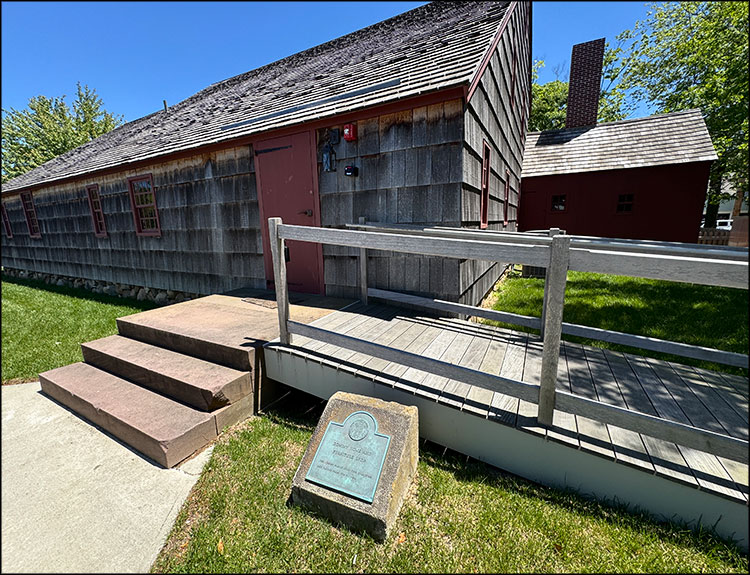
Back in 1976, for the nation's 200th, the town had a bicentennial committee that selected 25 locations where significant historical events occurred, scattered from Long Wharf in Sag Harbor to Montauk Point, and commemorated them with bronze plaques.
The twist in 2026? Two have been lost to time. "I do not know where they are," said Councilman Lys, "but there might be someone that does." He asked for help locating them so lost history could be brought back.
In short order, he said, informational signs containing a QR code will be placed at the remaining markers. He encouraged people to visit them, take a selfie showing the marker, and post the image to social media with the hashtag "easthampton250."
Those brave enough to dodge the springtime ticks and rich enough to burn the gas required to visit each site by July 31, will win a commemorative T-shirt.
"We're just trying to draw you to some of the town's history in a very active little fun way," Mr. Lys said. An interactive map on the town's website shows the locations of the markers.
Councilman Lys and Chelsea Winslow, a legislative secretary (who sang the National Anthem to start the meeting) shared images of some of the markers and discussed their history. Camp Wikoff in Montauk, the Parsons Blacksmith Shop in Springs, and the Jeremiah Conklin House in Amagansett were a few.
The history of the Conklin House is particularly jarring. In 1780, the story goes that British soldiers fired through its door and windows as they searched for deserters. Mr. Conklin hid his children in the oven. "You do whatever you do to save the family," said Mr. Lys.
"When we first started talking about this a couple months ago, we were trying to think of ways to encourage more people to visit these markers," said Patrick Derenze, the town's public information officer. Mr. Derenze is usually hidden behind the scenes, but he indulged on Tuesday in a rare moment at the podium.
Little shards of East Hampton's history, some surprising, all interesting, were shared by the local historians.
"A lot of attention was turned to Montauk, and how to preserve the livestock and keep it from being stolen by the hungry and rapacious British," said Mia Certic, the executive director of the Montauk Historical Society, noting that on Montauk, which had "all of the livestock," there was widespread fear. Houses had been destroyed, women attacked, and the hamlet was a specific target. The British were anchored just offshore. "There were people very nearby who wanted to get their hands on our sheep and our cattle."
"David Mulford was the first person to receive a copy of the Declaration of Independence on the East End," Stephen Long, executive director of the East Hampton Historical Society, told the board. "He read it to the men in his militia, on July 24th."
Dr. Georgette Grier-Key, executive director of the Eastville Community Historical Society, acknowledged those who continued to be enslaved for another 100 years after the nation gained independence. "We recognize the free labor and enslaved bodies. Many remain nameless and denied dignity," she said.
On the eve of the revolution, she noted that about 11 percent of Suffolk County's population was enslaved, approximately 1,400 people. "While patriots fought for independence from Britain, Black Long Islanders fought a second revolution for freedom from chattel slavery."
In the year 1783, she continued, thousands of Black loyalists gathered at docks. Over 3,000 boarded boats bound for Nova Scotia. "This is the largest mass emancipation in North America at that time, and it happened right here in our backyard," Dr. Grier-Key said.
Supervisor Kathee Burke-Gonzalez, reading from prepared remarks, said, "As we prepare for America 250, I hope this presentation today encourages all of us to visit these markers, read them, talk about them, as well as support and attend the programs offered by our local historical societies and organizations who are here with us today and help pass these stories on to the next generation. Because when we understand the history beneath our feet, we feel a deeper connection to this place and we remember that part of America's story is written right here in East Hampton."
Speaking of under our feet, on July 4, the town board plans to bury a time capsule. It won't be opened until July 4, 2051, America's 275th anniversary.