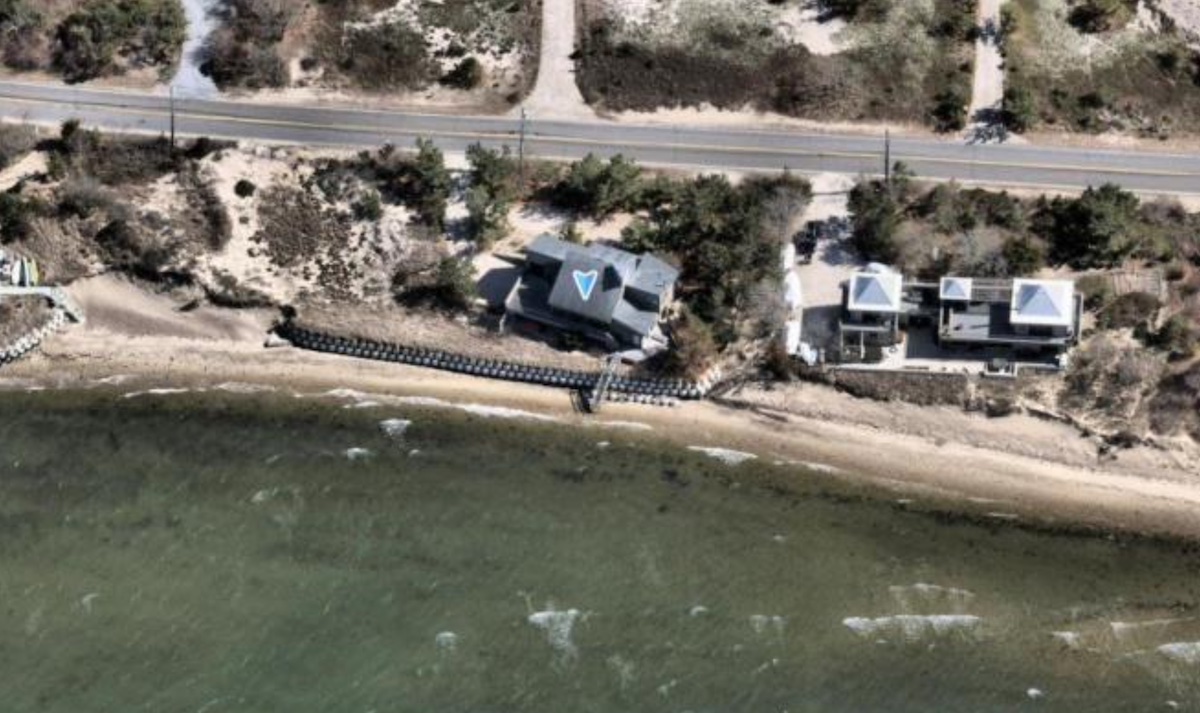
A 185-foot-long wall of geocubes in front of a house at 393 Cranberry Hole Road, washed for over eight years by the rising and falling waters of Gardiner’s Bay, could soon be removed from the shoreline.
The removal is proposed in an application to move (not rebuild) Nigel Curtiss’s house roughly 20 feet back from the dunes. First, the applicant requires a natural resources special permit from the East Hampton Town Zoning Board of Appeals, which held a public hearing on it at its April 28 meeting.
The application has a long history. Mr. Curtiss installed the wall of car-sized sandbags in 2018, under a temporary emergency permit, which was extended. He eventually applied to have the wall remain indefinitely, but in 2021 the zoning board denied that request. The year after, the State Department of Environmental Conservation’s permit for the wall expired.
Mr. Curtiss sued the town and lost. The current application, to remove the wall and relocate the house, is a result of a settlement with the town.
In assessing the application in December, Brian Frank, the town’s assistant planning director, wrote that “the revetment has and continues to have adverse environmental impacts along the shoreline and the Planning Department supports the landward relocation of the residence, the removal of the entire geocube revetment and restoration of the shoreline as soon as possible.”
“The town wants these removed, the landowner wants them removed, and that’s why we’re proposing to relocate this structure, to facilitate the ability to remove them,” Andy Hammer, the attorney representing Mr. Curtiss, told the zoning board. “Hopefully, when the residence is relocated, we won’t have the same erosional exposure that we do in its current condition. The hope is that we find some kind of erosional shadow.”
“There are geocube structures on both sides of this property right now that remain unaddressed, to my knowledge, by the town,” he added. “It’s just we’re the ones in front of the board seeking approval to do this tonight.”
In fact, Karen Hoeg, a lawyer speaking for Lewis Saul, who owns the house immediately to the west at 383 Cranberry Hole Road, urged that updated information about the current conditions of the bluff be presented before Mr. Curtiss’s cubes can be removed, lest Mr. Saul’s property be damaged.
“The schematic provided stops short of Mr. Saul’s property, and there’s no information provided about how the dune will transition to the surrounding grade on the westerly side of this property,” she said. “The concern for my client is the timing of the restoration and ensuring that his property, which has suffered severe erosion, is immediately restored.”
Mr. Hammer acknowledged the concerns, but said that “there’s no way to access these things until we get the house moved and out of the way.”
Board members agreed that it was likely beyond their jurisdiction to dictate what happens beyond Mr. Curtiss’s property lines, even if his project impacts his neighbors.
Mr. Curtiss will have to gain D.E.C. approval once again before the house can be moved back. “They [the D.E.C.] were saying, ‘It doesn’t meet wetland setbacks,’ but nothing meets wetland setbacks,” said Mr. Hammer, adding that he believes the state will in the end approve the move. In its new location, the house would also meet Federal Emergency Management Agency elevation standards.
Billy Mack, owner of First Coastal Corporation in Westhampton Beach, explained how his company will remove the cubes. An excavator will enter the property, expose the geocubes, and then, basically, pick them up and shake the sand out of them. (There may be more than one row of bags, and Ed Johann, the Z.B.A. vice chairman, worried that “I’m not sure what’s buried down there in the surf.”)
“We’ll slice the bags open, pull the plastic out, and all we have to do is let the sand exit these geocubes,” Mr. Mack said. “That sand is beach compatible and will remain, and we’ll reutilize it to stabilize the eroded bluff.”
During the process, he said, the sand will be stockpiled landward of the cube wall before the shoreline is reshaped and its “angle of repose” modified. That could require another 200 cubic yards of sand, Mr. Mack said. Then beach grass will be planted.
Originally, Mr. Curtiss wanted to relocate the residence to the eastern part of his property, but the Planning Department recommended the western side, a directive he followed.
“I’ll commend the applicant for taking the Planning Department’s recommendations sincerely and seriously,” Mr. Frank said. “The most important elements of this application are the residential relocation, the removal of the geocubes, and the restoration of the shoreline. And if that area of duneland gets temporarily disturbed, then that’s the price of making an omelet in this case.”
The board closed the public hearing.