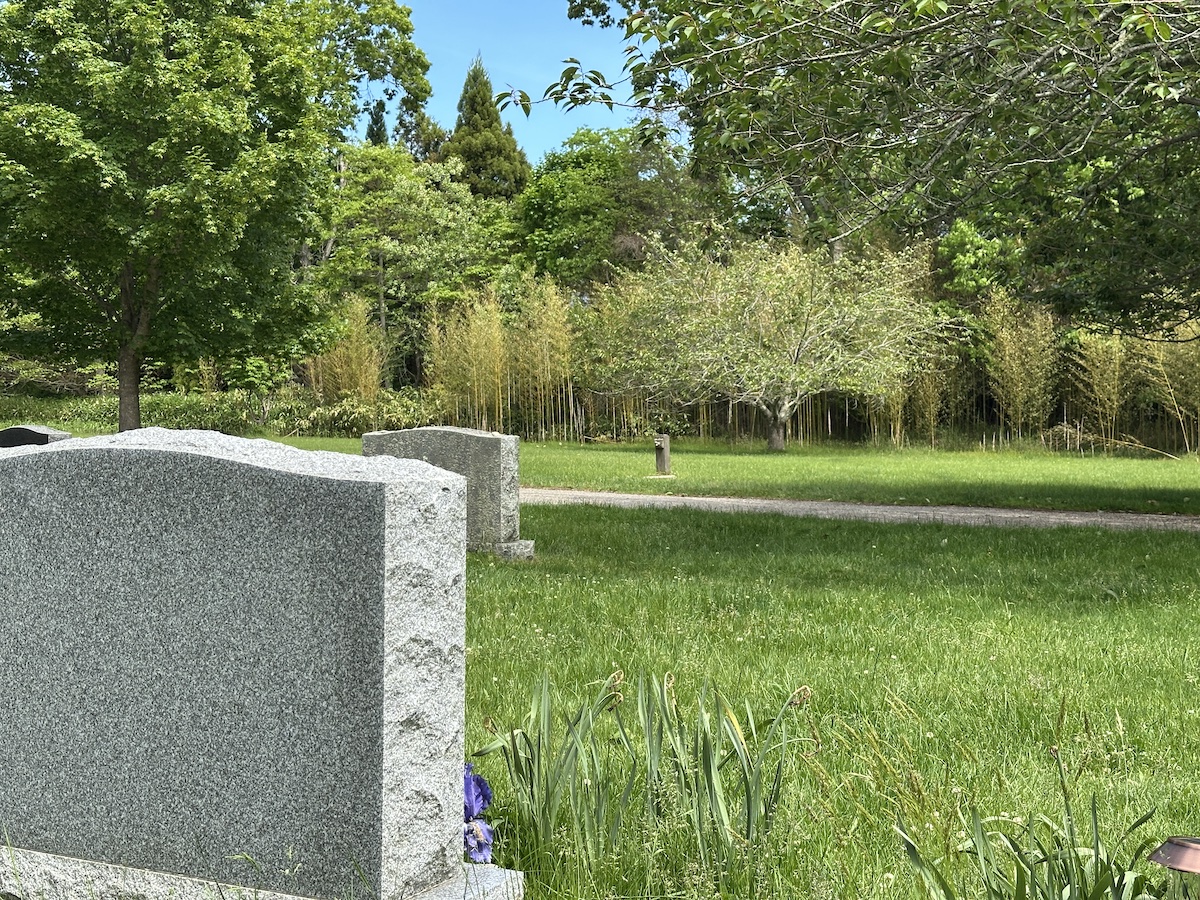
Bamboo and cemeteries make terrible bedfellows, and Most Holy Trinity Cemetery on Cedar Street has a burgeoning bamboo problem.
“It appears that the adjoining neighbor planted the bamboo and giant cane. I don’t know when, but a couple years ago,” Patrick Hines said on May 6, in speaking for Most Holy Trinity Catholic Church, the owner of the cemetery, before the East Hampton Town Planning Board. “Whenever they did, it creeped, and it’s creeping into the burial plots at the cemetery. So, it’s kind of serious.”
Lara Sweeney, the executive director of the LongHouse Reserve, which shares a long border with the cemetery, said there have been no new bamboo plantings in recent years. “The bamboo that’s there was planted by Jack Larsen in the 1990s,” she said by phone. “He loved the aesthetic of Japanese gardens. We work very hard to manage the collection.” She added that she has been in touch with the cemetery.
The intrusion is so serious that in an application made in March, Mr. Hines wrote that the bamboo was already inside the cemetery in an area where plots were proposed. There was an even greater danger “to any existing grave plots where people are already buried. If the bamboo or giant cane grow into existing gravesites, it could engulf the gravesites and be very tragic. It may require digging up bodies, or exhumation.”
“We have to go into that 20-foot non-disturbance buffer to stop it from spreading. That’s really the main issue,” he told the board.
As such, he requested that the board allow the church to modify the special permit that allows it to operate the cemetery. The modification would allow the removal of the invasive plant before it also becomes an exhumer.
The 39-acre cemetery, which sits in a Suffolk County groundwater protection area, is partially cleared. In 2005, approval was granted to clear land that would allow the cemetery to expand by four acres, with the existing irrigation system extended and new roadways added.
The same approval officially documented the buffer area that was not to be disturbed, Will Edwards, an environmental technician in the town’s Planning Department, told the board. Given the situation, he said the department recommended that the covenants be modified.
Modifying the buffer involves changing a covenant or restriction of the original approval, which means a public hearing must be held.
“It’s a beautiful setting. It’s quiet. It’s peaceful. It’s the final resting place for a lot of notable former residents,” said Reed Jones, a planning board member. He was in favor of the modification and even said he was comfortable waiving a public hearing, but the board does not have that ability.
Lou Cortese, another member of the board, noted the importance of the groundwater protection area and wanted to be assured that no herbicide or chemicals “that would seep into the groundwater with the removal process” would be used.
“I know very little about gardens, maybe herbicide is needed,” Mr. Jones said.
“There really are no herbicides that are completely safe,” said Ed Krug, the board’s chairman.
“Would you be willing to agree to the condition that you won’t use herbicides?” Mr. Cortese asked.
Mr. Hines said they would: Condition added. The modification will now be the subject of a public hearing on June 17.
There is nothing in either the East Hampton Town or Southampton Town codes that prevents the planting of bamboo, despite its aggressive and invasive nature.
The villages are stricter — it’s banned in both East Hampton and Sag Harbor. If it encroaches into a neighbor’s yard, the owner of the property where it originates is responsible for its removal.
Andy Drake, a senior environmental analyst in the town’s Department of Land Acquisition, later said there are “numerous locations where bamboo is an issue” in the town. “The biggest stand I know of may be adjacent to Montauk County Park, off of East Lake Drive.” There, over an acre of the invasive is spreading.