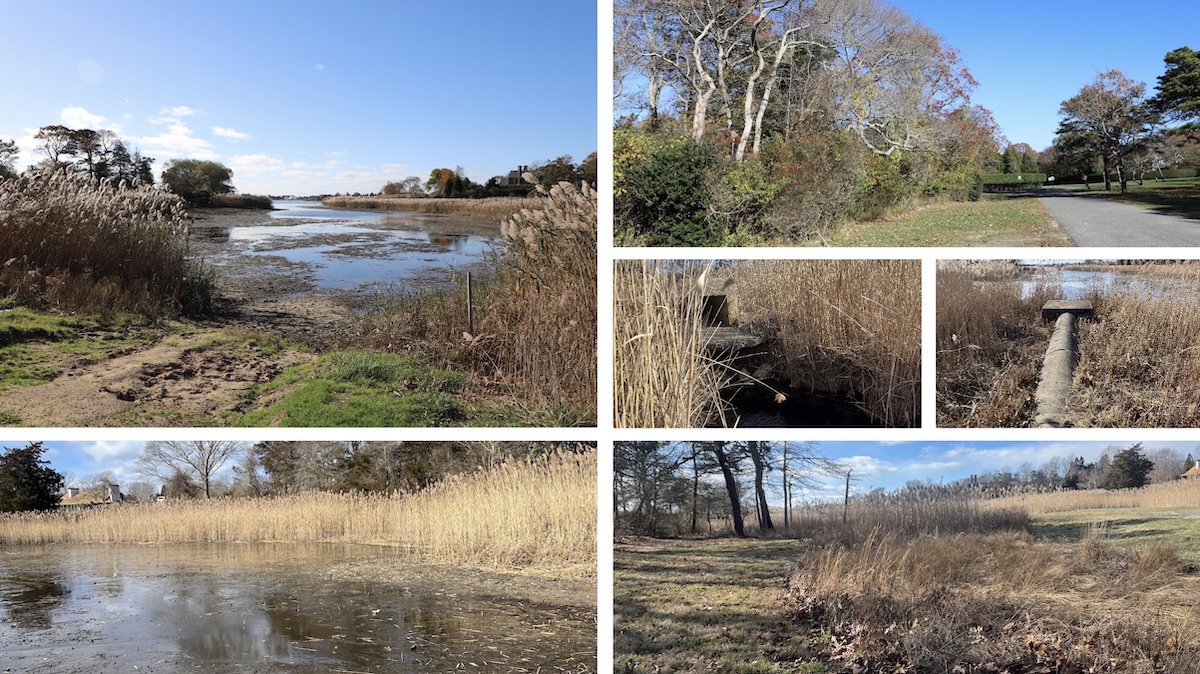
It has been a very long process, but implementation of a plan to reduce the flow of stormwater entering the 24-inch pipe that drains into Georgica Pond at the terminus of Cove Hollow Road in East Hampton Village, and improve the quality of that water entering the pond, was unveiled on Friday. Construction could happen after the 2027 summer season.
At Friday’s meeting of the village board, Mellissa McCarron, East Hampton Town’s principal environmental analyst, and Ryan Winter of the VHB consultancy presented a final design and said the project can go out to bid once a permit from the State Department of Environmental Conservation is issued.
The project was included in the village’s water quality improvement plan and incorporated into the town’s community preservation fund project plan in 2016 to assess the conditions of the pipe and complete an engineering review with recommendations for improvements. VHB performed an assessment of the pipe’s capacity and water quality of the existing stormwater system at Cove Hollow Road in 2020. The town issued a request for proposals in 2022 and hired VHB to design a constructed wetland to improve the quality of water entering the pond.
The approximately 7,300-foot-long pipe, which originates at the Long Island Rail Road trestle near Route 114, was designed and constructed in the 1930s to alleviate flooding from farmland runoff, Ms. McCarron told the board. Stormwater flowing to the pond represents a source of nutrients, sediment, and bacteria, among other pollutants, that can contaminate Georgica Pond and impact its water quality. The pond, she added, has historically suffered from macroalgae and blue-green algae blooms fed by excess nitrogen and phosphorus loading.
A camera inspection showed that the pipe was in “relatively good” condition given its age, Ms. McCarron said, and needed repairs have been made.
The outfall from the pipe system into Georgica Pond is currently “right against the water line,” Mr. Winter said. “Our proposal is to pull back that primary outfall closer to Georgica Road and incorporate a surface treatment there for the water that comes out of that pipe, so it’s not going directly into the pond. It has the capability to infiltrate and treat the water before dispersing into Georgica Pond.”
“We’re creating new wetland,” Mr. Winter said, in which water will “traverse the site and either infiltrate or eventually work its way into the pond.” Along with moving the outfall pipe to the northern end of the site, two sediment bays will be created just outside of it, where sediment from the stormwater will be collected. A second “micro-pool” on the other side of a gabion weir, a permeable barrier, will allow for more infiltration and storage of stormwater runoff.
“There’s going to be low and high marsh,” Mr. Winter said. Phragmites is prevalent in the area, and a revegetation plan will include removal of the invasive species, allowing native species to re-establish and take hold.
A permit from the federal Army Corps of Engineers has been secured, Mr. Winter said. The D.E.C.’s 15-day public comment period ended last Thursday. Assuming no or few comments, “we can hopefully have a permit in hand from D.E.C. within the next couple of months,” he said. “The next step is to take these drawings and put them to construction level, put out bid documents, and then probably be looking at construction sometime in 2027, after that summer season.”
Construction will cost an estimated $2.1 million, Mr. Winter said, with the community preservation fund or grants anticipated to finance the project in full. A formal, site-specific management plan will be developed. “The plan would be to work with the D.E.C. to continue a monitoring and management program beyond the scope of this permit,” he said. “There are areas beyond this along the shore of Georgica Pond, and Georgica Cove specifically, that have phragmites issues, so this could be a good case study or jumping-off point to look at other ways to control the phragmites around this area in addition to this immediate vicinity.”