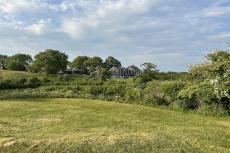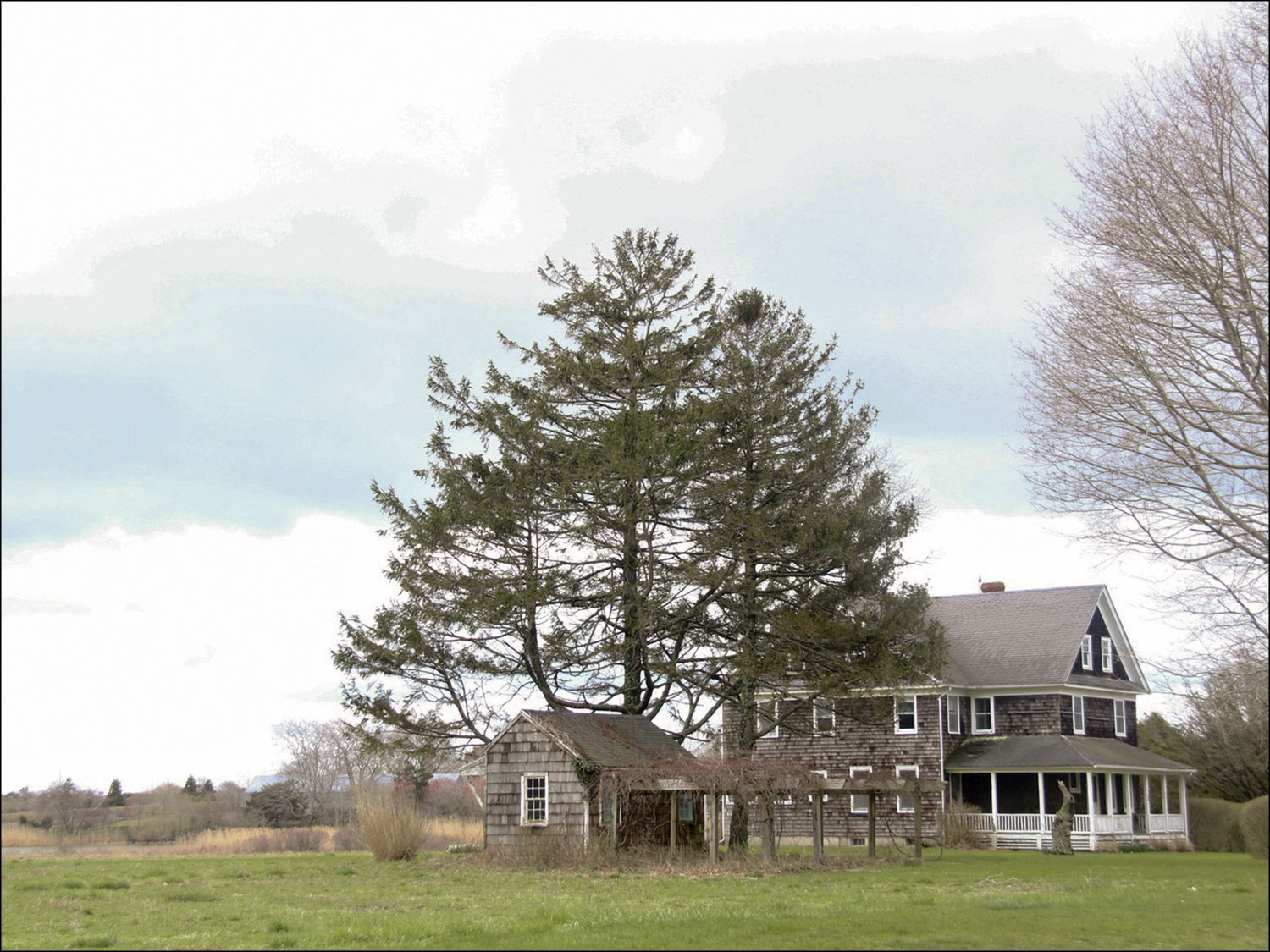
It was a struggle of the sexes Tuesday as the East Hampton Town Board held a post-public hearing discussion and debated details of the draft management plan for the John Osborn Homestead at 66 Main Street in Wainscott.
The board has discussed the plan in work sessions since January, held a public hearing on March 19, and will soon make it the subject of a resolution that will likely be adopted, with the three male members of the board — Councilmen David Lys, Ian Calder-Piedmonte, and Tom Flight — indicating they will vote for it as written.
Supervisor Kathee Burke-Gonzalez was stymied in her attempts to find points of compromise with the three. “We heard from dozens and dozens of community members about this management plan,” she said. “It boiled down to three things: agricultural use, the multi-use path, and the landmark designation.”
“I want to take it one at a time,” she said. “It sounds like Ian, David, and Tom all want to see agriculture here. Cate,” she said of Councilwoman Cate Rogers, “you mentioned ‘low-impact’ agriculture and no deer fencing. Could we come to a compromise? Would everybody be open to the management plan, rather than just saying that this land may be returned to agricultural use provided there is a sufficient buffer around Wainscott Pond? Could we all agree that it be low-impact agriculture?”
None of the male board members would budge.
“I support it as written,” said Councilman Calder-Piedmonte, himself a farmer. “I think we’ve already emphasized the two concerns are the vista and water quality. Any board considering the management plan would have to consider the impact of agriculture on those two features. I think if we try to get more precise, I think it’s dangerous.”
“I disagree. I’m for low impact,” Supervisor Burke-Gonzalez said. “This is a management plan. It’s a collaboration between the community and the board. We heard from the community, and management plans can be amended. At this point in time, I’m supportive of it being more pointed, and saying low-impact agriculture only.”
She moved on to another point of disagreement, a potential walking path, either to the pond and back, or a loop. The board was split on whether the path should be mowed grass, crushed stone, or asphalt. Land purchased using community preservation fund money must be open to the public.
“The community is advocating for a mowed trail only,” the supervisor noted.
Again, the three councilmen wouldn’t budge from the “as written” draft, which calls for a “multi-use path through the meadow that may accommodate a .5-to-.85-mile loop.”
Councilwoman Rogers said she supported “an A.D.A.-accessible, non-asphalt path.”
“Can we say no asphalt?” the supervisor asked, again searching for middle ground.
“I support it as written, because I think we can make — within the context of what is written — we can do something that’s responsible,” Councilman Calder-Piedmonte said of the management plan.
“Saying it has to be a grass path, it’s just potentially over-restrictive,” agreed Councilman Flight.
“I’m comfortable as it’s written, because no matter what, it’s going to be an expenditure, and that expenditure, at that time, will have to be debated here and voted upon,” Councilman Lys said.
“The last one, we put the historic landmark designation on the two structures,” Supervisor Burke-Gonzalez said. “The community is asking for full landmark designation,” i.e., designating the land along with the structures.
Again, the male board members did not support that. Councilwoman Rogers, like the supervisor, was pushing for the full landmark designation. Acknowledging, however, that they were the minority, Supervisor Burke-Gonzalez said, “It sounds like the majority wants to go with the management plan as drafted and heard. So I guess that’s a wrap.”
Councilman Lys sought to smooth things over. “Committees are supposed to be made up of differing opinions,” he commented. “Town boards are, also. Just because we have differing opinions doesn’t mean we’re not doing it for the same goal, which is for the benefit of the town’s residents.”
He then thanked the supervisor for her “transparent way of governing, by bringing this back for an open discussion, to allow us to express our opinions in an open session. I appreciate that.”