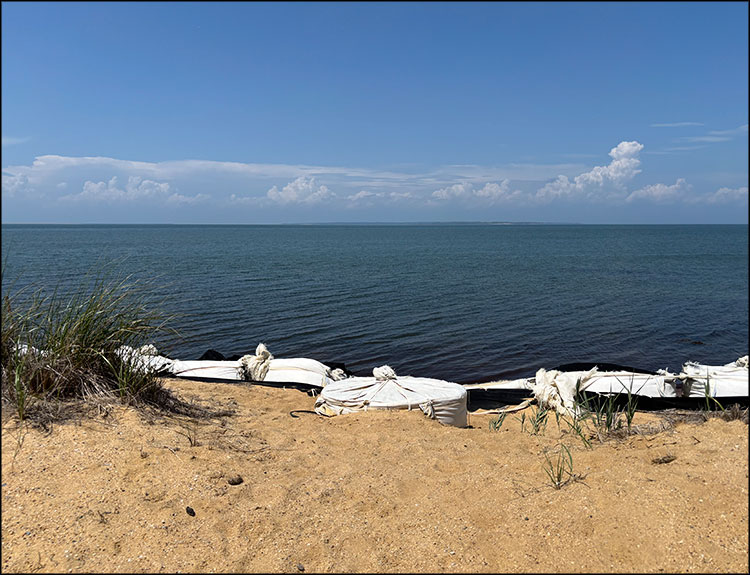
A house on Bay View Avenue in Amagansett, infamous for a temporary wall of beach-blocking geocubes that overstayed their welcome by years, was front and center before the East Hampton Town Zoning Board of Appeals last week, as its owners presented an environmental review of their plan to build a permanent 108-foot-long rock revetment.
The wall, which Nick and Diana Grecco, the owners of 117 BVA L.L.C., say will prevent further erosion, is forbidden by town code along their section of beach, which fronts Napeague and Gardiner’s Bay.
Board members, in short, agreed with Tina Vavilis LaGarenne, director of the Planning Department, and told the applicants that the review, known officially as an environmental impact statement, was incomplete and needed more work.
Apart from the rock wall, the Greccos also seek to demolish their existing house and build an 1,885-square-foot new one with 1,172 square feet of decking, surrounded on three sides by retaining walls.
They are asking for a variance from the coastal erosion overlay district regulations, which do not allow for revetments, but they also require a natural resources special permit and multiple variances from minimum wetland setbacks, pyramid setbacks, “and a litany of applicable regulations, at and around the site, which contains, and lies adjacent to, tidal and freshwater wetlands, beaches and surface waters,” according to a planning board document detailing the scope of their environmental review.
Brian Frank, the town’s assistant planning director, said the problems with the environmental review could be broken into three categories. First, he said, it is poorly organized. He recommended it follow the “adopted scope of environmental review,” from 2024. Second, the Planning Department is seeking better documentation of existing conditions on the parcel and its history.
“Instead of a summary of prior permits, it would be better to include the actual permits and prior zoning board determinations,” Mr. Frank said, “instead of paraphrasing them.”
Finally, and most importantly, the Greccos need to do a better job of “providing more of the substantive information in the analysis of the applicant’s preferred alternatives and other alternatives in a manner that efficiently allows for comparison.”
“It’s the alternatives that are in there already?” asked Brian Matthews, the attorney speaking for the Greccos. “You’re asking for a more wholesome analysis, or was there an alternative or other alternatives that were not included?”
“Frankly,” answered Mr. Frank, “an offshore breakwater is not a practical alternative for a single property. It’s not something that’s really permitted in New York State. It certainly didn’t do any harm in including it, but it’s not an example of something that’s realistic.”
“That level of detail should be provided for the project, which is the focus of the impact statement and the alternatives that are more viable,” he added.