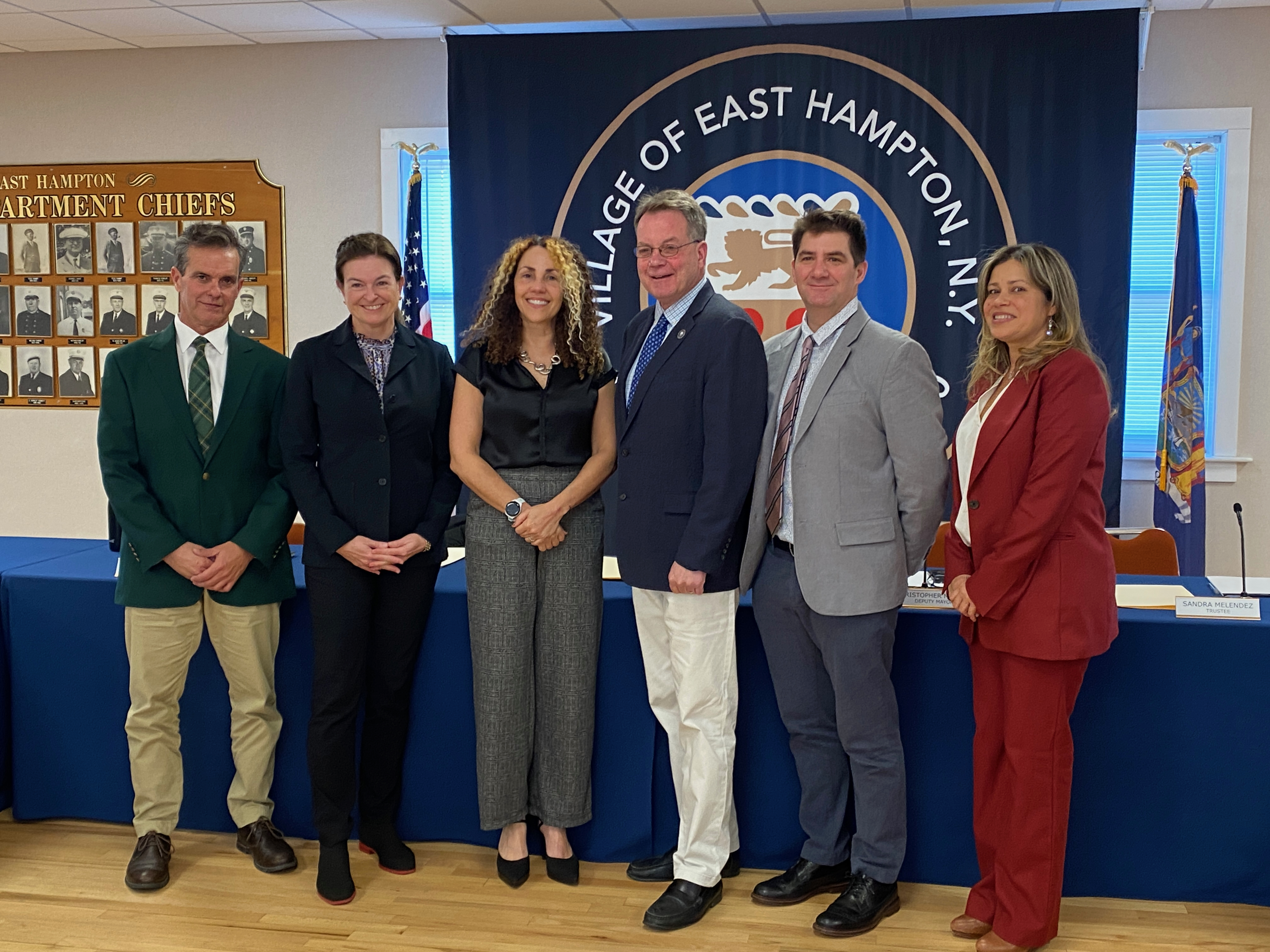
The East Hampton Village Board will hold a public hearing next month to consider establishing a new section of the village code to specify that village personnel will not participate in federal Immigration and Customs Enforcement actions, nor assist civil immigration enforcement efforts, nor will village facilities be used to detain people solely for civil immigration enforcement absent a judicial warrant.
The proposed addition to the code, the public hearing for which will happen on April 22, was endorsed by Mayor Jerry Larsen and all of his colleagues on the board, and was acknowledged with appreciation by Minerva Perez, executive director of Organizacion Latino Americana of Eastern Long Island, or OLA.
The proposal acknowledges the federal government’s authority to enforce immigration laws and that federal law pre-empts conflicting state or local laws. But it adds that village personnel “shall not use village resources, equipment, property, databases, or funds to investigate, detain, question, arrest, or transport any individual solely for purposes of federal civil immigration enforcement, except pursuant to a judicial warrant or as otherwise required by law.”
The proposed law also specifies that the village’s Flock license plate reader surveillance cameras “shall not be accessed, queried, or shared for purposes of federal civil immigration enforcement.”
The legislation, should it be enacted, would also create an advisory task force “to review public safety and peace and good order concerns relating to federal immigration law enforcement activities within the village, and transparency relating to same.” The task force would comprise the mayor, the chief of police, a village trustee, and a village resident to be appointed by the board, and would provide a quarterly advisory report to the board.
“I put this legislation forward because I feel very strongly about this,” the mayor said, acknowledging OLA’s role in recommending the proposal. “I agreed that we should have a law in place.” It “codifies what our Police Department is already doing,” he said, “but it reassures the public that we are doing the right thing.”
The move follows often chaotic immigration enforcement efforts in cities around the United States during the second Trump administration, particularly Minneapolis, where two American citizens were fatally shot by ICE agents in separate incidents in January. The mayor referred to the village’s February 2025 public information session “to try to reassure our Latino community that this department was doing the right thing. That was right after the federal administration changed what they were doing as far as immigration policies.”
A former village police chief, he said flatly that “the way ICE is reacting and entering our communities is not acceptable.”
“I think you’ve crafted it in such a way,” Carrie Doyle of the board told the mayor and Lisa Perillo, the village attorney, “that it really protects the rights of the village residents and addresses the concerns that everybody’s brought to the community.”
Sandra Melendez, another village board member, also endorsed the proposed legislation. “We’ve heard many times that people are afraid to get help,” she said of immigrants fearful of a run-in with ICE agents, “and that’s what makes our communities unsafe. Doing this, and assuring people that they can call 911, that our municipality is not going to be part of the craziness of ICE, and we’re going to try to — not prevent, because we’re not able to — at least keep them safe and make sure that the laws are being followed . . . is very important for our community.”
Christopher Minardi, the deputy mayor, and Jason Tuma, the board’s newest member, also endorsed the proposed legislation.
“I really appreciate the work that you’ve done and the time that you’ve taken,” Ms. Perez told the board. “So thank you for that.”
The village has heard “a lot of feedback” about the Flock cameras, the mayor said, and a concern that they could enable the federal government to track people’s movements and even immigration status. “So we went an extra step to make sure that our Flock cameras are not sharing information with the federal government,” he said. “If they need information from us, they’ll have to contact us directly. They can’t just enter our database, and we’ll be able to verify that it’s for criminal purposes and not for immigration purposes.”
The task force and chief of police will “audit all the information in Flock,” he said, “to make sure nothing is slipping by us and is being used for immigration purposes.”
He expressed hope that other municipalities would follow the village. “I know there’s been some resistance,” he said, but at a recent meeting with the East End Mayors Association, “they all asked for copies of our legislation. I’m hoping that that will be the motivating factor, maybe that one municipality does it, the others will follow.”