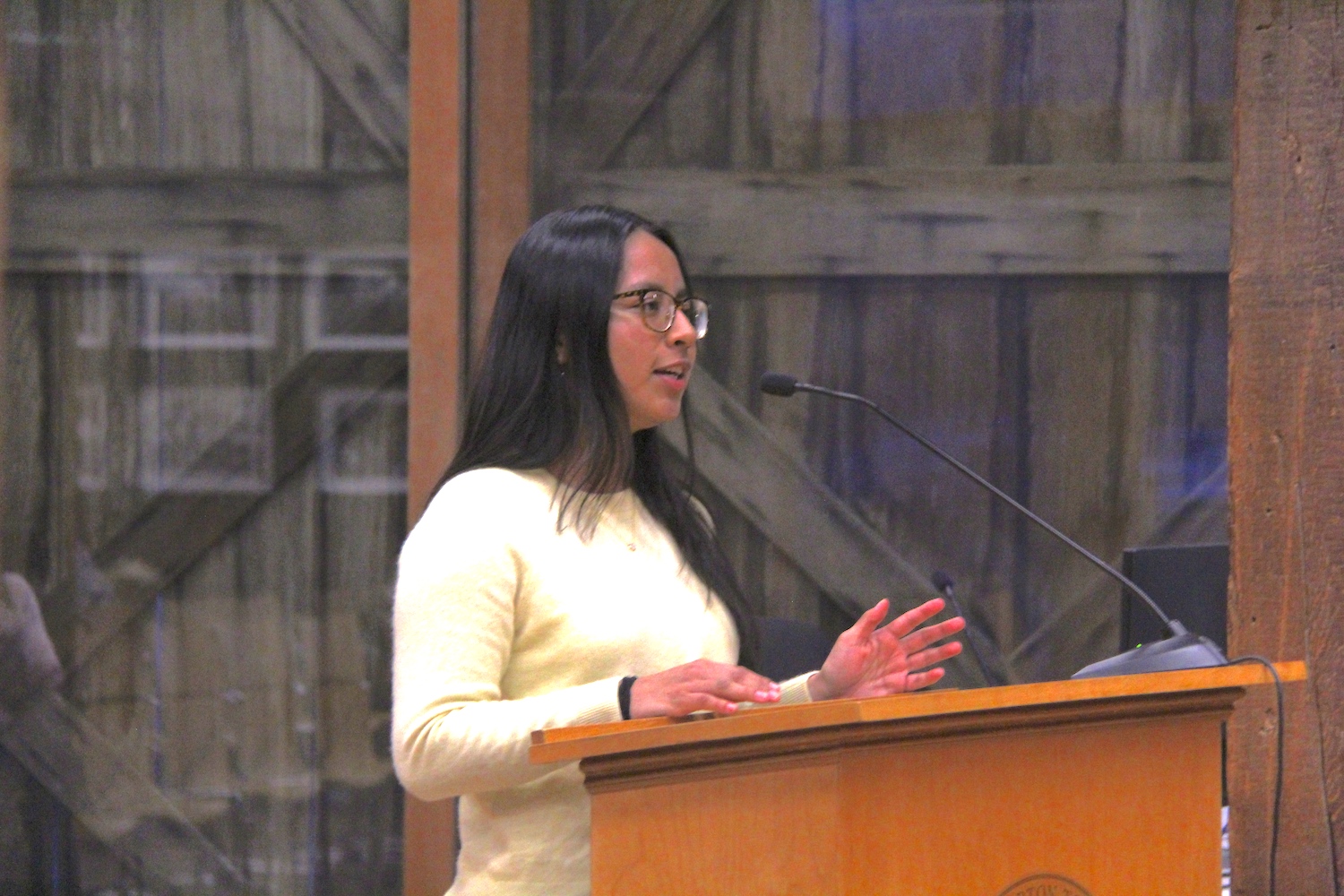
“We ask you to do the right thing,” Minerva Perez, the executive director of Organizacion Latino Americana, pleaded through tears to the East Hampton Town Board last week, as she pushed the board to discuss what’s become known as the East End Public Safety and Accountability Law.
The board heard her, and several members of the Latino advisory committee as well, who all urged the same.
And it has responded. On Monday, Patrick Derenze, the town’s public information officer, said the legislation will be discussed at the board’s April 7 work session.
Just as Ms. Perez and Latino advisory committee members petitioned the town board for stronger action, last Thursday the board itself sent letters to Senator Chuck Schumer, Senator Kirsten Gillibrand, and Representative Nick LaLota.
The letter, influenced by the East End Public Safety and Accountability Law, urged the federal lawmakers to “adopt a simple reform that would bring immediate clarity to families and communities when someone is taken into immigration custody. When an individual is detained during an enforcement action, federal authorities should notify the local police department within 12 hours of the person’s name and where they are being taken.”
“Immigration officers should be required to obtain judicial warrants before entering private property,” the board wrote. “Officers conducting enforcement operations should clearly identify themselves and display identifying information, and the use of face coverings during enforcement actions should be restricted so residents know who is operating in their community.”
“Sensitive locations must also remain protected,” the letter continued. “Schools, medical facilities, houses of worship, polling places, and courts must remain places where people can access essential services without fear that doing so could expose them to enforcement activity.”
“We also believe Congress should establish clear national standards prohibiting racial profiling, governing the use of force, and requiring the use of body cameras during interactions with the public,” the board added. “These basic accountability measures are standard expectations for law enforcement and should apply equally to federal immigration operations.”
As of Tuesday, neither senator had responded, but Mr. LaLota had written back.
In his reply, he sought to find some common ground, while laying the blame for the issue on the Biden administration and with Gov. Kathy Hochul’s sanctuary policies.
“We must be honest about how we arrived at the current crisis so that our nation does not repeat these mistakes,” he wrote. “Moreover, leaders of both parties must work together to address the consequences of this crisis for the safety and economic security of law-abiding American citizens.”
“With an estimated 20 million individuals in our country illegally and the federal government’s capacity to remove roughly 700,000 per year, we are incentivized to take a pragmatic approach,” he continued. “As we restore order and uphold the rule of law, deportation efforts should prioritize noncitizens who have committed crimes, as well as those receiving taxpayer-funded benefits such as housing, healthcare, and other public assistance. At the same time, efforts to ensure that only American citizens can vote in our elections and receive benefits from federal programs such as Medicaid and SNAP help remove incentives for illegal immigration while prioritizing American citizens.”
He didn’t address the board’s call for judicial warrants or the removal of face coverings during enforcement actions. He seemed open to reforming how Immigration and Customs Enforcement officers conduct their operations, aligning himself with the Trump administration.
“The administration has signaled openness to reforms that would improve how enforcement is conducted, including expanded use of body-worn cameras, clearer officer identification, reasonable limitations on enforcement in sensitive locations, and enhanced transparency and oversight,” he wrote.
Advocates like Ms. Perez hope that the East End Public Safety and Accountability Law will provide clarity that will help local governments and police departments respond if ICE agents conduct random raids on the East End.
“The aim isn’t to end all ICE actions or encroach upon federal powers,” Jon Lopez, a member of the town’s Latino advisory committee, told the board, “but to extend the power of local town and village authority. This local law focuses on what towns and villages can do to create effective emergency responses that better support schools, hospitals, day care centers, and elder centers during random ICE raids.”
Ms. Perez recounted ICE actions over the last six months that took place in Riverhead, Hampton Bays, Westhampton, and Greenport. “We are not interested in waiting until these damaging actions come to East Hampton to have a clear local law requiring local law enforcement to respond and report back to the supervisor as to the actions of masked persons holding weapons and commanding community members to submit to questions and submit to seizure,” she said.
“No permission is needed from the state or the county,” she continued. “This is not a sanctuary trigger. It is not opposition to ICE. It establishes a clear line that must be codified into law that all people of the Town of East Hampton should have the reasonable expectation to go about the most important areas of their life — children getting to school, doctor’s visits, emergency room visits — with a degree of confidence and safety supported by our town and our local law enforcement.”
When she was done speaking, Ms. Perez introduced Angie Castillo, an East Hampton High School student, who offered the board another perspective.
“It’s really scary to see everything that’s going on and just feel so incredibly helpless,” she said. “It’s always in the back of your head, like what’s going to happen? Is today going to be the day that something’s going to happen to my parents that’s completely unwarranted?”
After the town board discusses the law on April 7, it will be reviewed by the Latino advisory committee at its April 11 meeting before it moves to a public hearing.