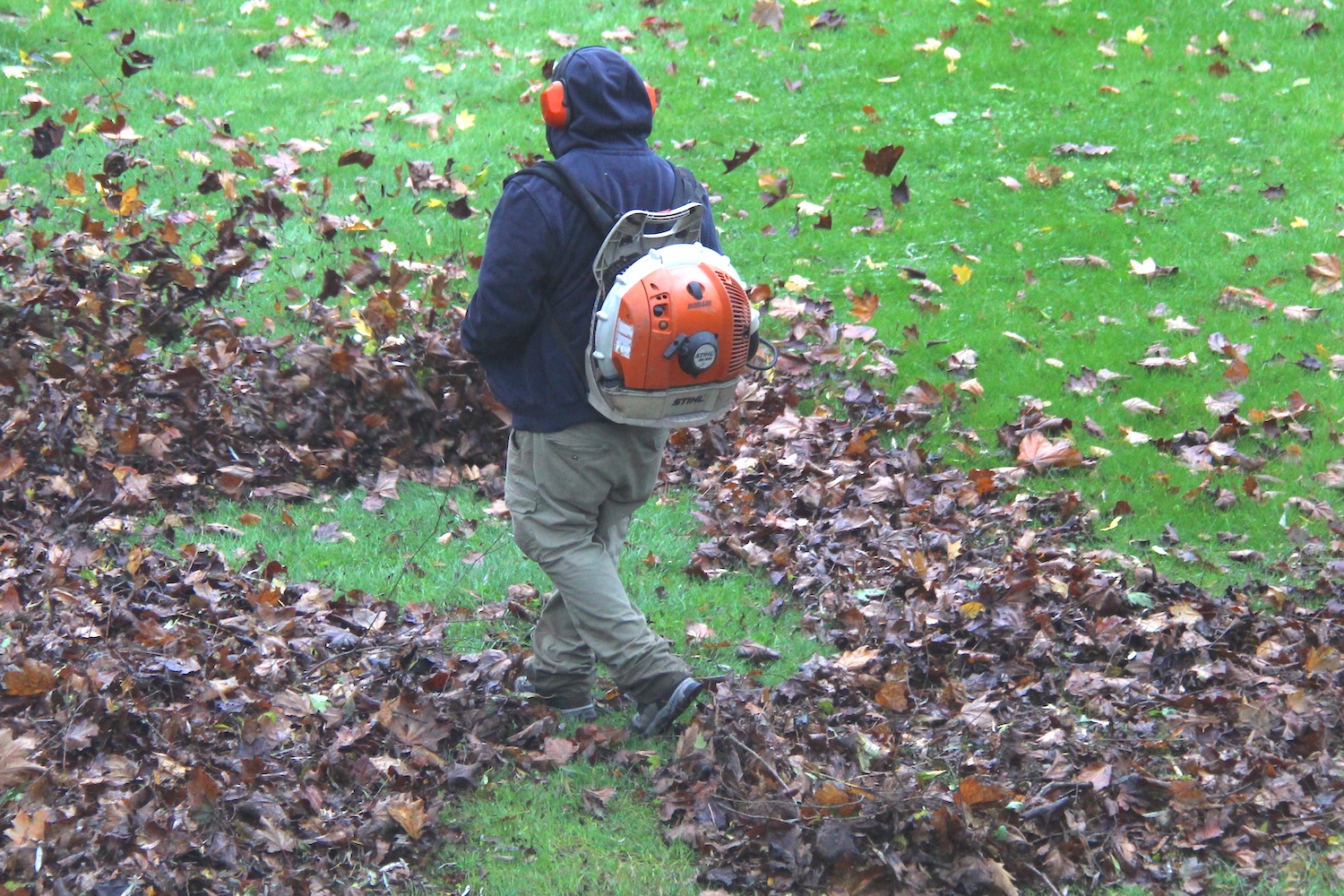
A new petition to ban gas-powered leaf blowers in the Town of East Hampton is circulating, at potentially the right time to gain real traction.
Gas prices are soaring due to the war in Iran. The technology powering electric leaf blowers, which are much quieter and less polluting than their gas-powered ancestors, has improved. Prices for electric equipment have come down.
New science out of Mount Sinai’s Icahn School of Medicine in Manhattan has confirmed that gas blowers are health hazards for everyone. Strikingly, scientists conclude they’re worst for children, who “inhale more of any pollutants that are thrown into the air.”
The petition was begun by an ad hoc group in January and then taken over by ChangeHampton, a community-based environmental organization. “At ChangeHampton, we organized initially about being driven insane by leaf blowers,” said Gail Pellett, a co-founder of the group, in a recent interview. “We expanded because we realized we couldn’t build a movement on ‘Ban the Blower.’ ”
The group now addresses sustainable lawn and yard-care maintenance in general — successfully lobbying, for example, for a grass meadow at Town Hall. “But every year,” Ms. Pellett said, “people just kept coming back and saying, ‘Why can’t we get rid of these things?’ ”
“When the town board banned gas blowers for the four months of the summer, they did so because they realized they’re dangerous, annoying, and spread toxic fumes and noise,” said Stephan Van Dam, the other co-founder of ChangeHampton. “The ban primarily protects summer and weekend residents from those health hazards. The question is, why would the board not afford locals, the folks who live here, who vote here, who pay taxes here, the same protection for the other eight months of the year?”
The petition has gained nearly 200 signatures, according to Ms. Pellett, who estimated that over 75 percent of the signers are locals. More names will be needed.
It won’t be easy. A recent Instagram post by the Concerned Citizens of Montauk supporting the initiative was flooded with angry comments, mostly from out-of-towners. It’s clear that there will be organized resistance to a year-round ban, from landscape industry professionals as well as anti-government-regulation types.
Conversations this week with members of the town board showed little support for an outright ban. Some, however, seemed open to extending the existing ban, which lasts only four months, from May 20 to Sept. 20. Spoken to individually, every one of the board members worried about the impact on landscapers.
“I think it’s great that ChangeHampton is bringing this conversation to the community,” said Councilwoman Cate Rogers, the town board member most supportive of extending the law. Even she, however, is against an immediate ban.
“Rather than a ban, we need to phase them out over years, to give businesses an opportunity to transition,” she said. “I would, however, be in favor of immediately adjusting the season that we allow them. If the purpose is leaf blowing, let’s adjust the time period for when leaves are down.”
According to last year’s New York State Fall Foliage Map, leaf color peaked on Long Island the week of Oct. 29, which means a ban until Nov. 1 (which is the law in the nearby Village of North Haven), makes more sense than Sept. 20. In fact, most leaves aren’t down until mid-November.
“Overall, there is nothing I find more annoying than when I’m trying to chill out in my yard and hear the drone of a gas blower,” Councilman Tom Flight said. “Personally, I use a rake. I don’t think blowers do much good. That said, I’m sympathetic to landscapers. A ban is something I could quite happily get behind, but the landscaping industry needs to be engaged.”
Some industry has already gotten on board. Whitmores, for example, has mostly transitioned to electric. Eco Harmony Landscapes, run by Paul Munoz, an East Hampton High School graduate, formed about 10 years ago around the idea of quiet, sustainable landscaping.
The fact that both run thriving businesses proves the concept can work, but not all are convinced.
Jeff Peters, the owner of JCP Landscaping, based in East Hampton, said his company owns 12 gas-powered blowers, which ran him about $650 each, or $7,800. To switch to electric, he estimated it would cost closer to $20,000. (However, a quick look at EGO Commercial, a top-rated commercial electric blower company, show prices similar to the gas blowers Mr. Peters quoted.)
“If you go electric, you have to outfit your trailer with a charging station,” he said. “Batteries run $200 apiece and only last about an hour. So, if you’re on a big property, you need to switch out. It gets time-consuming. . . . If we didn’t use blowers, we’d have to rake, and it would take longer. People would have to pay more money, and they won’t want to pay more money.”
Still, Mr. Peters understands the anti-blower sentiment (“They’re loud!”), and allowed that leaf blowing is unnecessary for much of the year.
“I’ve been doing this for 25 years,” he said. “I can’t compete with guys who come from UpIsland, don’t pay any town registration fees, don’t know the rules, and then have too many blowers at one spot. A lot of those guys are ruining it for the people who follow the rules. The town should crack down on these unregistered guys who have six blowers on a half-acre. It’s aggravating.”
David Lys, the deputy town supervisor, said a full ban would be a “tough sell.”
“I think it’s fairly effective where we’re at,” he said in a phone call. “I’m willing to listen to any organization that would let me know what the pros and cons are. If we wanted to extend into the shoulder seasons, we could. It might make more sense to incrementally phase things.”
Supervisor Kathee Burke-Gonzalez was cautious in her comments, offered in a written statement. “Right now, I do not believe there is consensus on the Board for a year-round ban, and I do not think we are ready to make decisions about a ban or an extension without hearing from both residents and the landscape professionals,” she wrote. “We have asked ChangeHampton to engage with the landscaping community to both educate and listen to each other. As for the current seasonal restrictions, I think their effect on quality of life depends on who you ask, which only reinforces the need for a fuller public conversation.”
“A big concern of mine is the industry,” Councilman Ian Calder-Piedmonte said. “We need input from them. I have heard a ton of opposition, but I think they need to be part of the conversation.” He also raised practical concerns, such as where to dispose of the batteries required for the electric blowers if landscapers are forced to switch, and indicated that enforcement of the current ban was already difficult. “I understand the noise concerns, but if we make rules, they have to be enforceable.”
North Haven, meanwhile, is moving forward. Not only does its ban last until Nov. 1, but it has recently ordered signs alerting landscapers of the law. The signs will be placed at strategic points during the last two weeks of April.
North Haven has also raised fines for infractions — now $500, and payable by the homeowner, not the offending landscaper — and has hired a new code enforcement officer.
“I don’t know anyone who is not in favor of this,” the village’s mayor, Chris Fiore, said by email.
While arguments can be made about environmental impact (ban advocates often site harm to insects, which are harmed by electric blowers as well); cost, health impacts (parents could, theoretically, keep the kids indoors), and efficiency, no one really argues about the noise.
A single commercial grade gas-power leaf blower can emit 115 decibels of sound, about as loud as a rock concert. And often, more than one is being used simultaneously. That creates dangerous levels of noise. Something called the “inverse-square law” shows that sound decreases by six decibels each time a distance is doubled. So, if at the source it’s 115 decibels, a meter away it’s 109; two meters away it’s 103, four meters away it’s 97, and so forth.
In practical terms, if you live in an area with half-acre zoning, it’s entirely possible you could be hearing many leaf blowers from several properties at once during either fall or spring cleanups. Even two-tenths of a mile away, the sound is still as loud as a vacuum cleaner (65 decibels).
Add it all adds up and it’s not only a racket that enters homes. If you’re outside, it overpowers birdsong (40 decibels) and rustling leaves in a tree (20).
“I just want the towns to all get on one page, instead of all these different rules,” Mr. Peters said.
A link to the petition follows this short ChangeHampton video about the call for a ban: https://vimeo.com/1171636685?fl=pl&fe=sh.