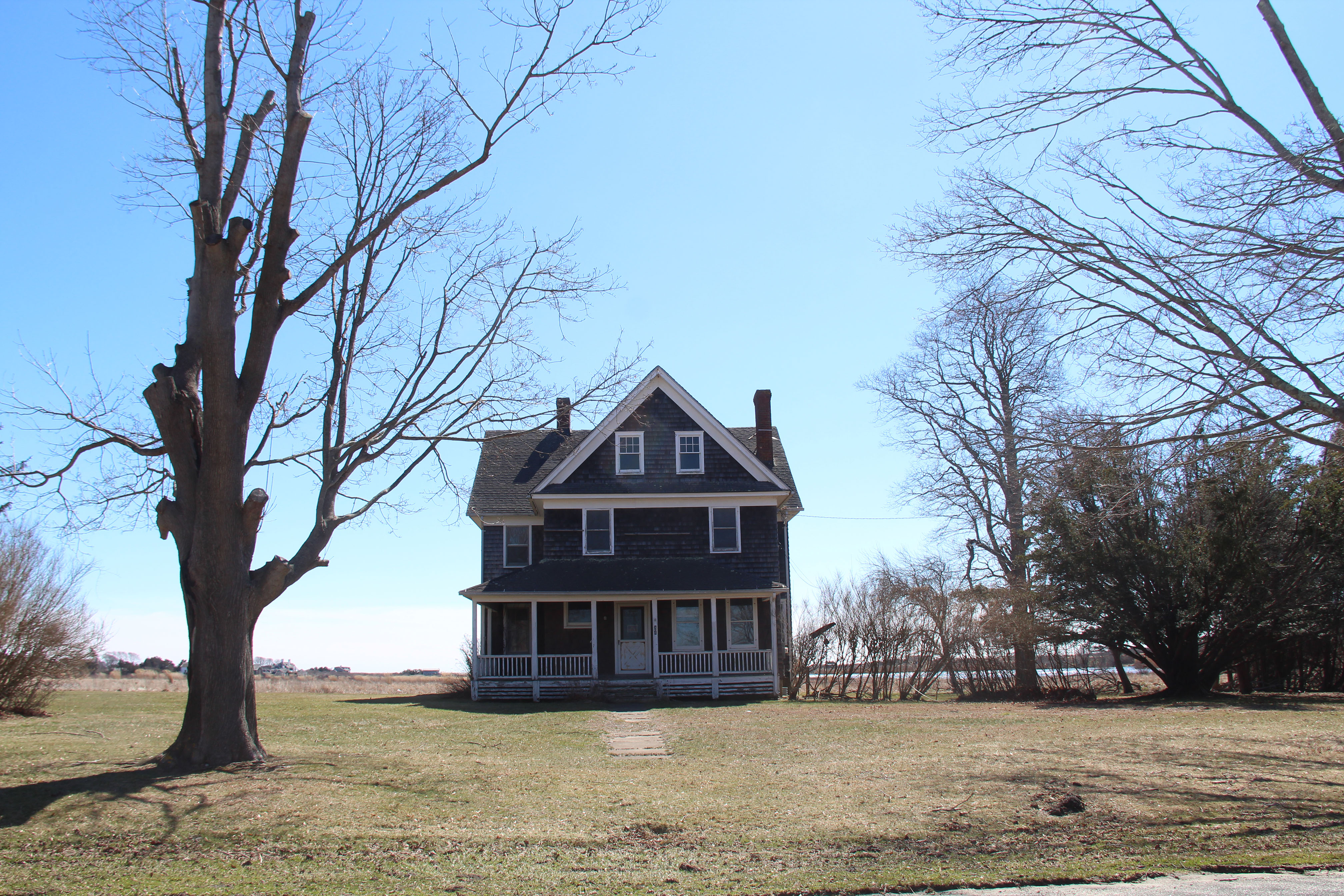
Familiar faces showed up at a public hearing last week in front of the East Hampton Town Board regarding 66 Main Street in Wainscott, also known as the John Osborn Homestead. Their message, to paraphrase James Carville’s famous advice to then-presidential candidate Bill Clinton: “It’s the view, stupid.” Oh, and also water quality.
The 30-acre property was purchased in December 2024 for $56 million using money from the community preservation fund. The hearing concerned a draft management plan for the land. When C.P.F. funds are used to purchase property, access to the public is guaranteed, and a plan must be developed for how the place will be maintained.
“This is not a place that needs to be reimagined,” wrote John Stoner, in a letter read by a fellow Wainscott, resident Bruce Wayne Solomon, “It’s a place that needs to be protected.”
Mr. Solomon read from his own letter as well.
“Every day thousands of people hurry past the field, trying to get somewhere, trying to beat traffic. But for a few seconds when they pass 66 Main Street, they get something rare. They get a view of open land, historic buildings, and a horizon that still looks very much like it did 300 years ago.”
“In a place that changes as quickly as the Hamptons, that brief feeling that you somehow stepped back into the 17th century is something special,” he added. “And once a view like that disappears, well, it’s not exactly something we can rebuild later with a permit, a ribbon cutting, and a few truckloads of asphalt.”
Since at least the early 1980s, the field has been maintained as a meadow, and not farmed.
Overwhelmingly residents spoke in favor of a mowed path on the property instead of anything paved, and said agriculture, if allowed at all, should be severely restricted. Members of the Wainscott Heritage Project showed up to make their continued request to landmark the entire site (at present only the structures are protected by landmark status) to preserve its “historical synergy.” Another theme was a desire to improve the water quality at Wainscott Pond.
Hersey Egginton, the chairman of the Wainscott Citizens Advisory Committee, focused his criticism of farming the land on how it would impact the adjacent and troubled Wainscott Pond.
“The W.C.A.C. respectfully suggests the plan be revised to eliminate the potential for active farming. Such a use would almost certainly have a detrimental impact on the water quality of Wainscott Pond as well as the open character of the viewshed,” he said.
His wife, Quincy Egginton, argued for giving the entire parcel a historic designation, “In order to ensure the historic structures retain their proper, original intended setting and that the historic viewshed be protected in perpetuity.”
Esperanza Leon, president of the Wainscott Heritage Project, spoke also about preserving the entire parcel with a historic designation.
“The John Osborn Homestead is not merely a collection of old buildings,” she said. “It is a rare, intact survivor of our community’s early settlement period.”
“A historic home does not exist in a vacuum,” she continued. “Its significance is inextricably tied to its setting. The homestead identity includes the spatial relationship between the house, the outbuildings, and the surrounding acreage. To landmark only the structures while leaving the ground beneath them unprotected, is to preserve a shell while losing the story.”
Jaine Mehring described a report on the water quality of Wainscott Pond, given by Christopher Gobler, a water quality expert with Stony Brook University’s School of Marine and Atmospheric Sciences.
“He used one of my favorite ‘Spinal Tap’ references. He basically said, ‘This pond is at 11 now, all year round,’ “ she said.
Kim Quarty, the executive director of the Friends of Georgica Pond Foundation, said her organization did not support agricultural practices on the property that would increase nitrogen loading. She offered a couple of “emerging agricultural models that minimize or eliminate nutrient runoff.”
“Examples would include apiary operations, hydroponic systems, and even novel practices such as snail farming,” she told the board.
The next step for the management plan is that the board will hold a post-hearing discussion, likely soon. Then it will either make adjustments or adopt the plan as is.