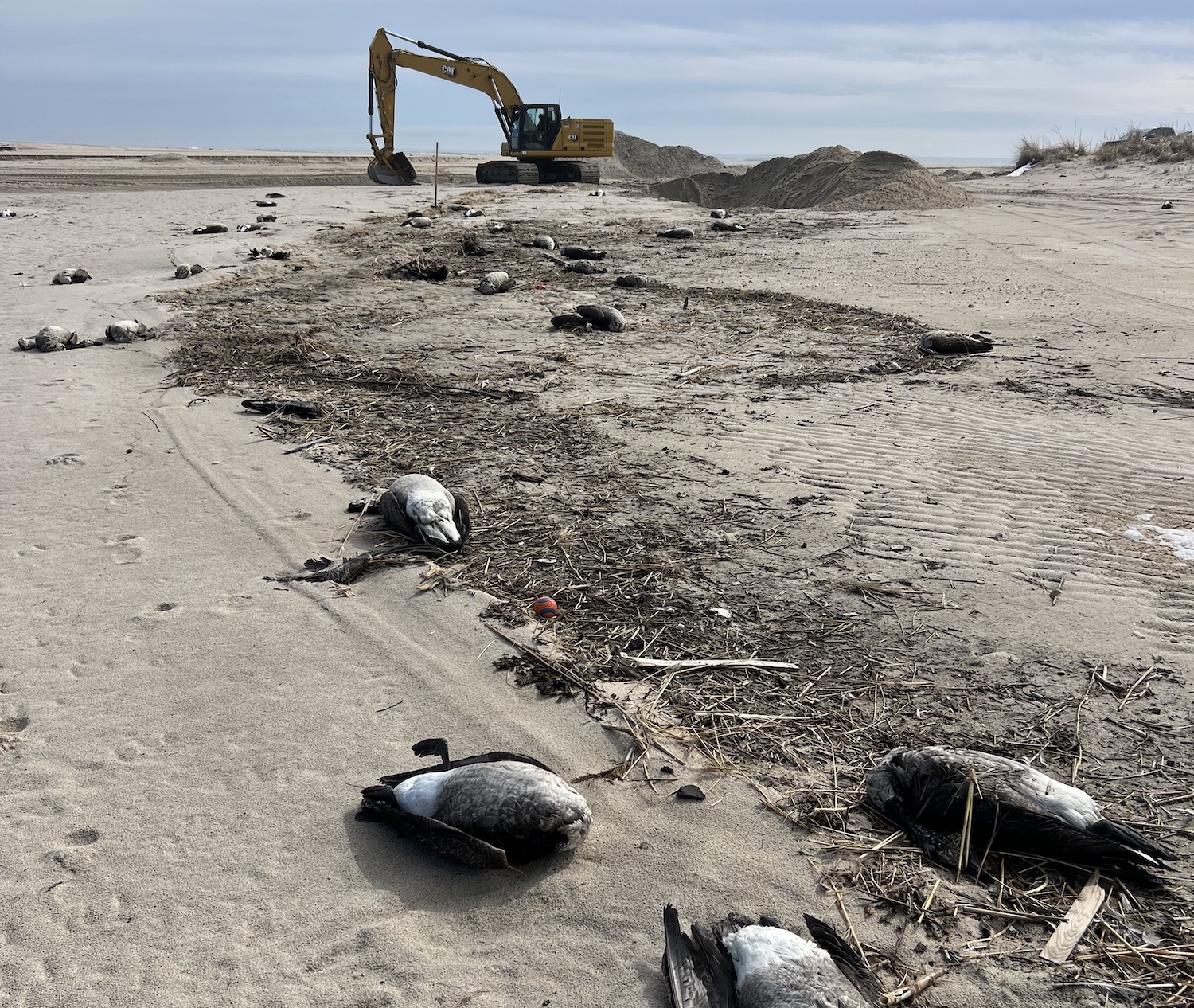
According to numbers provided by the New York State Department of Environmental Conservation, the majority of the almost 700 geese found dead in and around Georgica Pond over the last couple of weeks, the victims of avian flu, were buried on the East Hampton Village Department of Public Works property on Accabonac Road.
A spokesperson for the D.E.C. said the East Hampton Town Trustees reported 687 total buried birds, with 457 going to the 12-acre village Department of Public Works/Highway Department maintenance yard and another 230 buried “at the southwest corner of Georgica Pond.” The D.E.C. approved of the burial methods at both locations.
Apart from the geese, three bufflehead, three common mergansers, two greater scaup and one mute swan, one hooded merganser, one cormorant, one black scoter, and one gull were buried as well.
To use the village Highway Department property, which is located on town land, Jim Grimes, an East Hampton Town Trustee whose landscaping company disposed of the geese at the trustees’ behest, coordinated with East Hampton Village Mayor Jerry Larsen.
“We buried around 400 of them,” Mayor Larsen said Monday morning. “We’re burying 10 more today. The village doesn’t own the beaches” — a portion of Georgica Pond is within village limits — “but we were certainly willing to assist them, because they couldn’t get assistance from their own town. The Highway Department had space and the equipment needed to bury them.”
Councilman David Lys said the town was asked only to confirm if a photo sent by Tim Treadwell, the head harbormaster, showed the geese in the jurisdiction of the town or the trustees.
“The pictures were of the headwaters of Georgica Pond and the beach,” Mr. Lys said in a phone call this week. He said the town was asked to collaborate “if this becomes something bigger” but then the trustees “took action” themselves.
Village employees used an excavator to bury the geese. The village is also tasked with burying diseased elm trees from time to time.
Mayor Larsen added that the village had contacted the D.E.C. before accepting and burying the geese.
“Burying birds makes them unavailable to scavengers like eagles, hawks, crows, raccoons, and foxes, reducing the likelihood that they will be infected by feeding on the carcasses,” a D.E.C. spokesperson said. “The virus in buried carcasses will eventually be inactivated during carcass decomposition, although the precise timing is unknown due to multiple factors unique to each situation.”
When asked if the carcasses could pose a risk to the pond’s waters, Christopher Gobler, a water quality expert with Stony Brook University’s School of Marine and Atmospheric Sciences, offered the following perspective via text:
“Two thoughts: One is that flow from the beach is into the ocean, not the pond. Two, septic tanks are located within 100 feet of drinking water wells on the South Fork, and they retain viruses and bacteria.”
Mr. Grimes, who was sort of like a first responder to the mass die-off, took care to bury many of the first geese he encountered in place. When he realized the scope of the grisly and dangerous work was beyond what a single trustee could accomplish, he brought in some employees from his company, who completed the work the following day.
At Monday night’s East Hampton Town Trustees meeting, the board agreed to pay him $5,600 for his quick action.
Despite his best efforts, however, pictures of piles of geese in trenches on the beach haven’t sat well with many. The conversation surrounding the geese and their disposal has taken many turns since the popular Instagram account Kook Hampton first questioned the beach burial method. For example, some have asked why the birds hadn’t been incinerated. Mr. Grimes did not return a request for comment this week.
Councilman Tom Flight, who is the town board liaison to the Sanitation Department, said the town doesn’t own an incinerator (neither does the village) and while he’s exploring the feasibility of renting one, he said it was “unlikely we would incinerate, ourselves, at this point.”
“While D.E.C. guidance has technically been followed in burying the birds at a level of three feet (or more), there is concern that interaction with the shoreline and erosion risks re-exposure,” he said in a text. “Longer term if we see a significant number of birds die off in similar geographical areas, the town approach would more likely follow alternative D.E.C. guidance to work with licensed haulers to take the carcasses to a licensed waste-to-energy facility. To date, most of the carcasses have not been on town land; however, given the evolving nature of the situation it remains a possibility. We will look to partner with other municipal entities to help manage the situation across the town accordingly.”
“While municipalities are not legally obligated to remove carcasses, local governments may choose to remove or bury carcasses to reduce constituent and domestic animal exposure to, or interaction with, diseased wildlife,” the D.E.C. said.
“D.E.C. guidance for proper disposal of [highly pathogenic avian influenza]-infected bird carcasses for municipalities includes incineration, composting, landfilling in accordance with D.E.C. medical waste guidelines, and burying. Carcasses may be buried on site no less than three feet depth, above mean high water, and should be covered by no less than three feet of sediment. Municipalities should ensure the location does not conflict with wetland or other environmental regulations.”
Mr. Treadwell said in a text Tuesday that the body count was “tapering off.”
“Last week we had a few here and there, but unknown for certain if it’s the avian flu on those.”