Around 15,000 of the 20,000 cubic yards of sand for the dune reconstruction project at Ditch Plain Beach in Montauk has been deposited, the East Hampton Town Board was told on Tuesday, as the initiative to protect the landward residential neighborhood moves toward completion.
With a series of photographs and videos that illustrated the peril of extreme weather to the popular beach and adjacent neighborhood, as well as the rapid progress of the project, Councilman David Lys and Brian Frank, the town’s assistant planning director, updated the board as to a dune restoration “that would meet the criteria for federal reimbursement under the Stafford Act,” a federal law that authorizes assistance to local and state governments in the event of an emergency or disaster, Mr. Frank said.
“That required designing a dune of engineered dimensions,” he said. “It can’t just be a one-time dune replenishment.”
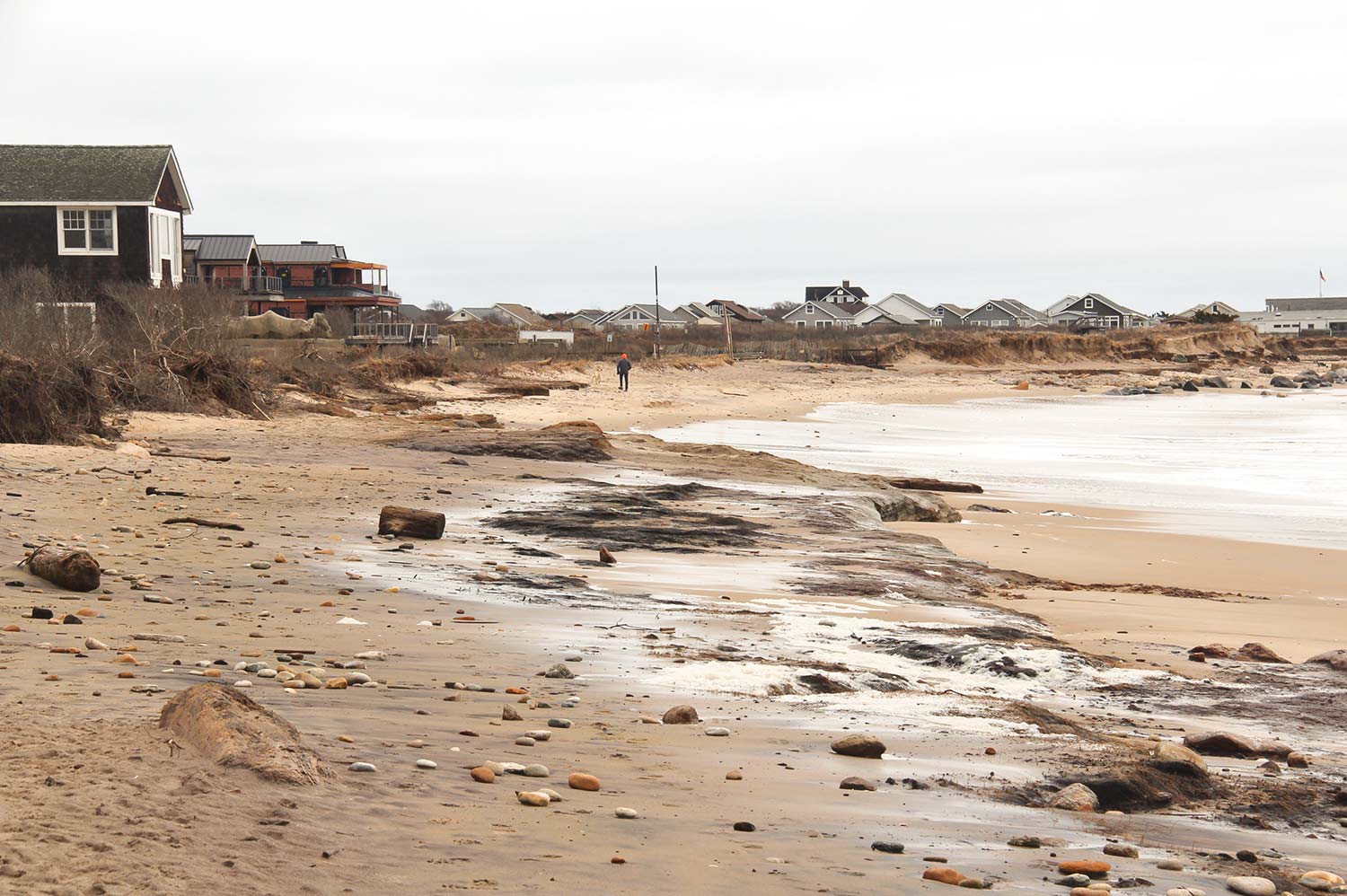
The beach “has been a known erosional hotspot for years,” he said, “and it really took a beating in 2023 into 2024, where the dunes that had protected that area were greatly diminished in size and nearly eliminated” by a series of northeasters. The neighborhood saw flooding, the beach itself was reduced to hard pan, and “if that area were left to recover naturally, I’m not really sure how long it would take, if ever.” Ditch Plain Beach is “not protected by high bluffs like the properties that it’s flanked by on either side.”
Coastal Science and Engineering, a South Carolina firm that has extensive experience on Long Island, is the project’s contractor.
“The footprint of the dune has been staked out at the heel,” the landward side, “as well as the toe,” the seaward side, Mr. Frank told the board. “We had to make sure that the dune was designed to stay above the mean high-water line.” This required “some updates along the way,” he said, as “the beach builds up a little bit and elevation decreases, and as that happens the location of mean high-water changes. You want to place sand above the mean high-water line so that it’s not going into the littoral zone of the ocean, and you’re also not losing it upon placement.”
The constructed dune, at a height of 16 feet above sea level, crests with a 15-foot-wide plateau “and is sloped both landward and seaward accordingly,” Mr. Frank said.
Mr. Lys cycled through a series of photographs taken before and during the project, most recently on Monday, which depicted the constructed dune taking shape. “What you’re starting to see at the top of the dune is . . . the aeolian process of the windblown sand,” he said. “It blows, and you lose inches of sand a day, at times.” The contractor has been asked for a proposal for placement of a burlap covering “to try to hold the sand in place” until beach grass is planted and takes root, “because a lot of sand is blowing.”
Beach grass serves as a natural windbreak, Mr. Frank said. “Beach grass is evolved to trap sand. It’s in the plant’s name,” Ammophila breviligulata. “Ammophila means ‘sand loving,’ ” he said, and “that will help hold some of the sand with or without any type of matting on the surface.”
Sand fencing will be placed at the toe of the new dune, Mr. Lys said, and “we’re also investigating putting it at the heel of the dune.” The dune “is anticipated to interact with the water at some point,” he said, “and there will be a slumping and a natural reformulation of the dune system that is anticipated.”
Mr. Frank said his office has fielded several calls expressing concern about the quality of the sand. “I haven’t seen any sign of silt or mud or gravel or anything other than high-quality beach sand,” he said.
Going forward, the rest of the dune must be shaped and fenced, Mr. Frank said. Signs advising people to stay off the dune will also be erected, Mr. Lys said.
“It’s very vulnerable right now, until it naturalizes,” Mr. Frank said. “It’ll compact naturally over time. Dunes are fragile in general, but certainly when the sand is freshly placed like that.” The project will be completed by year’s end, he added.
It is important to manage the public’s expectations, said Councilman Tom Flight. “It’s a sand dune. It will evolve over time. It will interact with the ocean. . . . But over all, for the security of this neighborhood from its risks to sea flooding, I think this is an outstanding project.”