
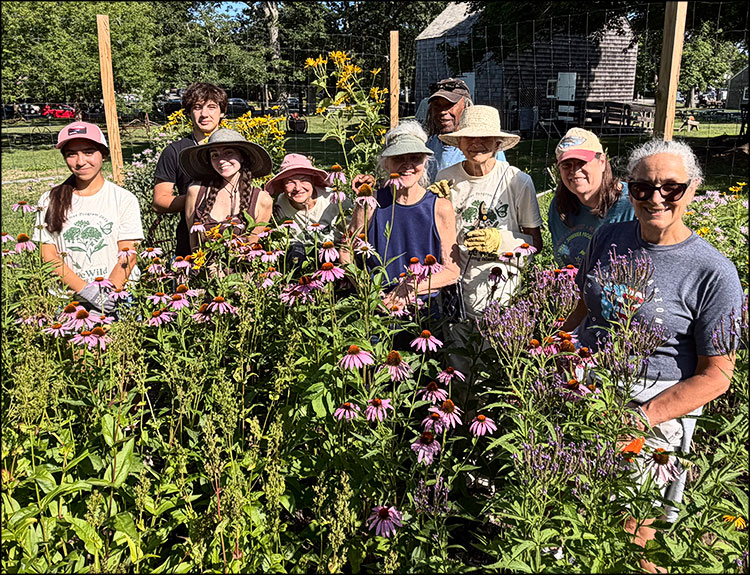
On a sunny Thursday afternoon, Matthew’s Garden at the East Hampton Historical Farm Museum was buzzing with hummingbirds, bees, butterflies, and volunteers, all working together for the local environment. The people, in particular, were members of the South Fork chapter of ReWild, a nonprofit that works to protect and improve biodiversity and health ecosystems across Long Island, with a focus on native plants.
Rayan Castrati, a rising junior at East Hampton High School and a ReWild summer intern, was in charge of weeding.
“There’s a bunch of mugwort and other weeds,” he said. “I get to see new types of plants I’ve never seen in East Hampton before . . . If you see mugwort on its own, it looks like a plant. But now I know it’s not a plant, instead it’s a weed. It’s kind of cool knowing that stuff. All the flowers here are really beautiful and it’s really cool to see them in person.”
The garden is named for Matthew Lester, an E.H.H.S. student who got approval from the town in December 2016 to create a pollinator garden as his Eagle Scout project. Matthew tragically took his own life a month later, at age 17, and never got to see his garden bloom.
“He started researching native plants, plants that the bugs and butterflies in this area needed. He built a plan and figured out all of the plants he wanted in it,” recalled Dana Lester, his mother. “He wanted to do plants that bloom from March to November. There was a section for herbs and berries.”
About a year after Matthew’s death, the garden was planted in his memory — but eventually fell into disrepair. That changed in the summer of 2024, when ReWild got involved.
“We came out and looked at the garden and thought it would be a wonderful fit and we’d love to help with revitalizing and restoring it,” said Len Green, one of the founders of ReWild’s South Fork chapter. “We helped get a ReWild community garden grant and got a crew to help weed it and prepare the ground using the lasagna method — laying down cardboard and mulch and letting it sit for a while to suppress the weeds. By the time spring rolled around we had the plants and put them in the ground, and you see the garden today is really looking beautiful.”
The summer internship program started four years ago with nine students and has grown steadily since. There are now about 37 students working across various projects.
“It’s been a tremendous experience for me,” Mr. Green said, looking around at the gardeners of all ages. “I’m a retired university professor, but working with younger people these days is just so rejuvenating. You can see here, at this garden today, we have, how many different generations? You have people like me well into retirement. You have young people still in school and people in their 20s and 30s. It’s really a good community-building process we’re involved in.”
Christina Colucci from Long Beach was part of the group. While camping at Hither Hills on vacation, she said, she looked up local volunteer opportunities.
“I love getting involved in the community and I love being by the beach. I wanted to meet people in the area and do something,” she explained. “It’s amazing. I love everyone that I’ve met and it’s beautiful. I’ve been shearing the catmint, and I’ve learned I can take some home as a gift for my cats.”
Working in Matthew’s Garden is one of several activities the ReWild interns participate in each week. Danett Gonzalez, also a rising junior at the high school, is one of the youth organizers who sets the summer schedule. They volunteer at the East Hampton and Springs food pantries, the East Hampton shellfish hatchery, and several local pollinator gardens and farms, including Amber Waves and Share the Harvest. They also do composting, beach cleanup, and recycling.
“I joined last year as an intern and I wanted to continue doing this, so I came back as a youth mentor,” Danett said. “We started organizing for this summer in February. Having as many opportunities as possible for people to help with the community — that’s the most important part.”
“We help with the food pantry, which is one of my favorite things that we do,” she added. “We do family bags — bags for kids per family, and those are delivered. We do a lot with our native gardens, which help a lot with the native insects and the animals that are here, especially because we’re seeing a lot of decline in certain insects such as the Monarch butterfly, which is really important to our community.”
Rayan, for one, didn’t need any additional community service hours, but joined the summer program because he’s passionate about biology.
“It’s really fun. I feel like I’m helping the community out and it’s really nice to do as much biology-related things as I can,” he said. “I’ve always had a really profound interest in biology, so it’s really cool to be able to see firsthand how plants and animals interact within the environment.”
Seeing the students interact with each other in her son’s thriving garden brings Ms. Lester a sense of peace.
“To see them develop and change and make friendships through this garden, makes my heart happy,” she said. “Matthew would love to be involved with these youngsters, he really would.”