
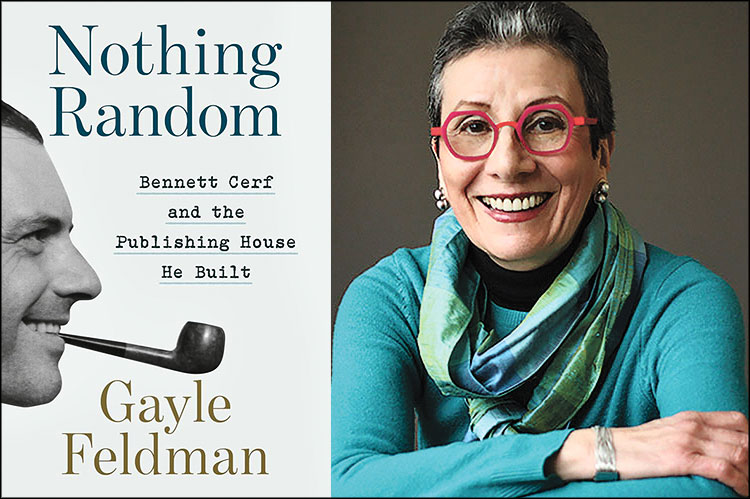
“Nothing Random”
Gayle Feldman
Random House, $40
Once upon a time, authors were superstars. Publishing houses flourished; those in service to the book industry — publishers, editors, agents, P.R. professionals, even reviewers — wielded power. The biography “Nothing Random: Bennett Cerf and the Publishing House He Built” by Gayle Feldman hearkens back to that heady era, not so long ago, in the mid-20th century.
Among stellar book professionals in his orbit, Bennett Cerf was uniquely dynamic, excelling as a publisher, best-selling writer, witty personality, TV star — and world authority on old jokes. Yet, those who remember him most likely feel a nostalgic ping for a popular game show, “What’s My Line?” Cerf was a regular panelist — along with Arlene Francis, Dorothy Kilgallen, and others — guessing the identity of mystery guests.
Remembering this charismatic giant for TV stardom would be enough. But Gayle Feldman, a part-time Sag Harbor resident and a longtime contributor to Publishers Weekly, has much more to say in her smart, deep dive on this figure. In this doorstop of a tome, each page is an exhilarating read featuring back stories galore on the authors Cerf championed, including James Joyce, Ayn Rand, and Gertrude Stein, to name a few.
The book begins with an 11-page Key to Major Characters, as if this were a Russian novel, with attention to the famous people he published or palled around with, plus family. A prologue then describes his star-studded “fun funeral” on Aug. 31, 1971, an oxymoron framing the biography.
On his origins: Bennett Cerf was in fact Jewish, and in fact named Benoit. Born in 1898, he grew up an only child in the upscale New York neighborhood of Harlem and went to school with debutantes. Feldman is very good at limning his rise on the social ladder as well as in publishing. A founder of Random House, and a creator of the Modern Library imprint, Cerf was a Big Daddy of a publisher.
With an eye to talent, he was also a fixer: His accomplishments included fighting the court case that allowed “James Joyce’s previously banned ‘Ulysses’ to be legally available in the America of 1934” and publishing “Ralph Ellison’s ‘Invisible Man’ in the America of 1952” and “Philip Roth’s ‘Portnoy’s Complaint’ in 1969.” Think of a famous literary work, and most likely it saw light under his auspices. To top off all this exceptional work, as Feldman reports, he played a pivotal role in some famed literary lore.
A clever chapter called “Glamour Girls” juxtaposes Cerf’s attention to the formidable, “grand” Gertrude Stein and mustachioed Alice B. Toklas with the truly glamorous actress Sylvia Sidney — the only major female star in the reigning Paramount firmament who was Jewish, and with whom Cerf had a brief if humiliating marriage.
Hungering for literary immortality and to be lauded for her writing as well as her person, Stein reluctantly agreed to a lecture tour in America, a strategy Cerf devised to promote her books many deemed unreadable. With Stein’s books of experimental prose soon featured in bookstores all over the country, Cerf’s strategy worked.
Wooing Sylvia Sidney, even at an inn in Montauk, not so much. They wed, planning life as a bicoastal Hollywood and Manhattan couple. Soon, he wrote to Stein, “You must be possessed of some psychic power. . . . This marriage, for which I had hoped so much, came to grief almost immediately . . . the sickening realization came that I had fallen in love with an illusion.”
Cerf loved showbiz as much as books. Meeting Frank Sinatra in late autumn 1942, he added the performer, then at the pinnacle of his career, to his inner circle. Soon the Cerfs — Bennett was now married to Phyllis, a.k.a. “the General” — were wined and dined, feted and privately flown to Palm Springs.
“To an autodidact ashamed of his lack of formal education, Bennett was about as intellectual as it got, a cultural force,” observed Mia Farrow, Sinatra’s then-wife. With Bennett in the room, it was like “stepping into sunlight.” When Sinatra served Mia with divorce papers after her work on Roman Polanski’s “Rosemary’s Baby” caused her to halt a movie she was to star in with her husband, she came crying to Bennett.
Ayn Rand was tough, a match for Cerf. At first, she mistook him for a Communist, something she could not abide. Still, he won his bid to publish “Atlas Shrugged,” if she would edit her novel down to 1,000 pages. Hearing him out, she responded: “Would you cut the Bible?” In the end, her contract stipulated she would pay for the extra pages. After some strongly negative reviews (“crackbrained,” “grotesque”), the book had legs, selling millions of copies unabated for decades. She inscribed a copy to him: “To Bennett Cerf, the ideal publisher I had never expected to find.”
Even though we know this story, Feldman is surprisingly suspenseful in the chapter on Truman Capote’s writing “In Cold Blood” — from The New Yorker assignment to cover a brutal crime in a farmhouse in Holcomb, Kan., to the hangings of the drifters who had murdered a family. Capote, anxious for an ending for his book as the death penalty was delayed, nevertheless had become entwined with the lives of the murderers, especially with Perry Smith’s. After justice was meted out, he called Bennett as he boarded a plane in Kansas City, sobbing. The chapter ends with Capote’s famous Black & White Ball, and Phyllis Cerf’s observation, “He never really recovered from that book. That book started the unsettling of his life.”
A celebrity drawn to celebrities, Bennett Cerf led an eminently entertaining, tabloid-worthy life with intelligence and integrity. You may wonder: What would today’s world be like if books and their makers were king? Fitting, even after detailing Cerf’s death, that Gayle Feldman goes on to the empire he created: Although changed, folded into corporate conglomerates, the Modern Library and Random House — the publisher of this biography — still exist. She ends, “The books remain.”
Gayle Feldman will sign copies of “Nothing Random” at the East Hampton Library’s Authors Night fund-raiser on Aug. 8 in Herrick Park.
Regina Weinreich, author of “Kerouac’s Spontaneous Poetics,” editor of “Kerouac’s Book of Haikus,” and co-producer/director of “Paul Bowles: The Complete Outsider,” lives in Montauk and Manhattan. She teaches at the School of Visual Arts and publishes culture criticism on Gossipcentral.com, a diary of the arts.