
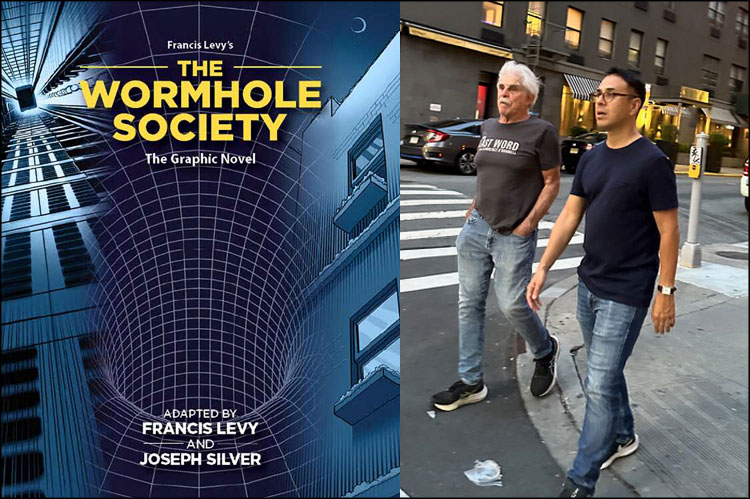
“The Wormhole Society: The Graphic Novel”
Francis Levy and Joseph Silver
Cogito, $21.99
As someone who lived in the East Village in the early 1980s, I know something of the existential angst and sexual recklessness of that place and time. Francis Levy’s book “The Wormhole Society” places his protagonist, Rusty, in the heart of the East Village at a slightly later time period, still, Levy’s portrait of the neighborhood, with its junkies, prostitutes, and ethnic mix of intense characters, creates the same crazy, bleak, and confusing vibe.
Levy has produced both a novel and a graphic novel with the same name, the latter drawn by his collaborator Joseph Silver. The books tell the story of Rusty, a sex-obsessed millennial living in a fifth-floor walkup on First Avenue between Fourth and Fifth Streets. The source of Rusty’s angst is his erectile dysfunction, a condition he seeks to remedy by engaging in S&M sessions with sex workers he procures from Dial-a-Slave.
The descriptions of these encounters are raw (and maybe not for every reader!), but they are also darkly funny and absurd. It is no surprise Rusty gets no real satisfaction, and, after first humiliating and then banishing a submissive named Sophie, he realizes he needs help — not just for his E.D., but help to figure out how to have a normal, healthy relationship and to become better person.
His quest for redemption soon leads him to an organization called the Wormhole Society that promises its members they can be transported into parallel universes. Rusty finds his portal to the multiverse in the sandwich board outside his favorite Mexican restaurant.
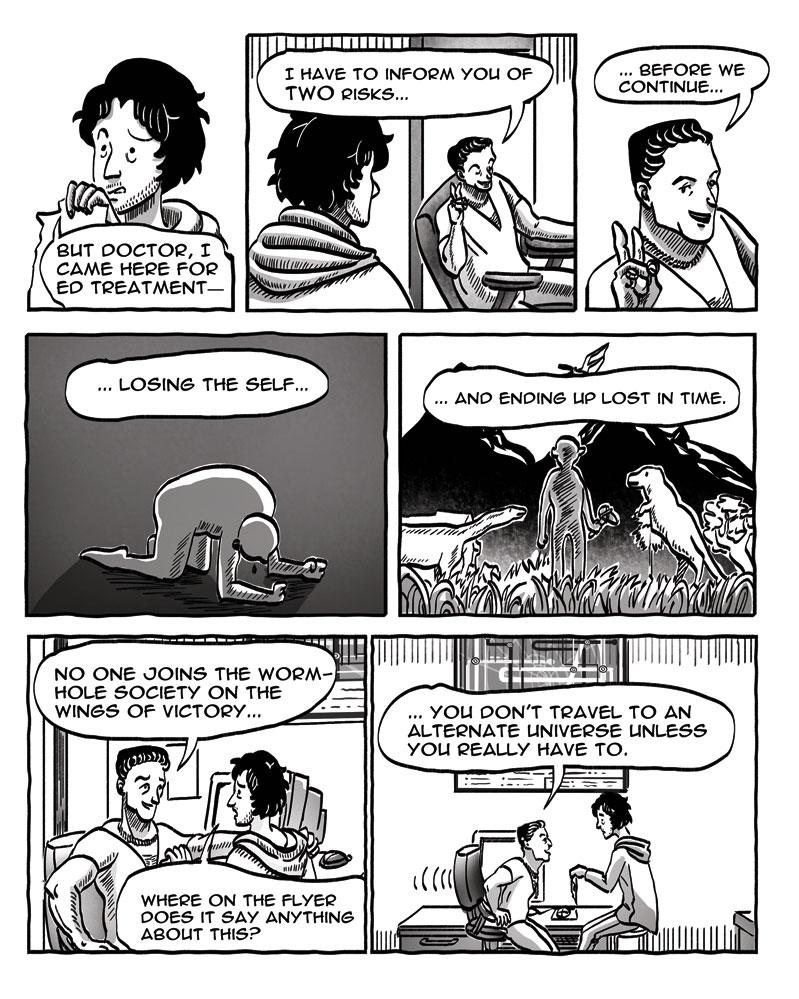
Both the book and the graphic novel then journey backward in time, where Rusty has various adventures, including pairing up with Lucy, a female from the species Australopithecus afarensis from 3.2 million years ago. He finds sex with Lucy erotically animalistic and gratefully uncomplicated, with the added bonus that he has no trouble being able to perform. “Homo erectus indeed!” he thinks to himself.
But of course, once he gets what he wants, he wants more, and leaves Lucy to make more wormhole voyages, including one to the moment of the Big Bang itself in an effort to understand the beginning of it all. He also journeys to King Arthur’s Court to try to learn about chivalry and romantic love, and worms into other encounters seeking a sex death wish, by entering the lives of Attila the Hun, David Carradine, and Nelson Rockefeller — the latter two (perhaps the first one too?) who died during sex acts.
Rusty bounces through the portal back into Manhattan frequently, where he attends meetings of the Wormhole Society. Levy uses heavy doses of satire to mimic the language of 12-step programs in the wormhole meetings, where Rusty seeks to self-actualize. He tries and fails to make amends with Sophie, who is now in recovery herself, going to the same meetings. He also tries to have a normal date with a girl named Muriel that backfires when he makes a lame joke that sexually objectifies her. He just can’t learn!
Rusty’s adventures in and out of the wormhole continue throughout the narrative, but the self-awakening he seeks never seems to quite materialize. Black humor moves the story along, and in the graphic novel, drawn masterfully by Joseph Silver, the story is propelled by dynamic and skilled drawings that play with perspective, depicting sweeping bird’s-eye views as well detailed close-ups. The range of scenes Silver illustrates includes depictions of both the cosmic Big Bang and the gritty interior of the Big Bang sex club on the Lower East Side, all done with artistic finesse.
The story jumps around at a dizzying pace, and it is hard to know what conclusions we are to make. When Rusty enters a fantasy universe where he gets a second chance with Muriel, who is now receptive to him, he compares it to seeking an apartment, finding a cool possibility after days of looking, but hesitating to sign a lease because something better may be around the corner. He thinks of the wormhole program’s warning “to not give up before the miracle.” He tries to find meaning in giving money away and in writing down his fantasies instead of acting them out. And when he finally reconnects with Sonya outside of the multiverse, she has a new boyfriend from the program.
In the end, Rusty never really finds either fulfillment or redemption, but you hope he’ll keep trying. The book jacket lists Nietzsche’s Doctrine of Eternal Recurrence and the Infinite Monkey Theorem as drivers of the narrative, so perhaps the takeaway message here is that we should remember there are endless possibilities within the (multi)universe, and, also, that we need to relearn what we already know — over and over again.
Jennifer Cross is an artist living in Springs. Her exhibition “Going Through and Not Around” is on view at the Sara Nightingale Gallery in Sag Harbor through Dec. 15.
Francis Levy of Wainscott is the author of the short fiction collection “The Kafka Studies Department” and the novels “Erotomania: A Romance” and “Seven Days in Rio.”
Joseph Silver is the creative director of Designomotion, an animation company based in New York City. He produced the animated version of Francis Levy’s “Erotomania: A Romance.”