Two significant anniversaries will be observed by Bridgehampton Chamber Music’s summer series: the 250th of the adoption of the Declaration of Independence, and the 50th of the arrival in the U.S. of the festival’s founder and artistic director, Marya Martin, from her native New Zealand.
Thirteen concerts in four weeks will “celebrate the sound of America” with an emphasis on American composers, along with some nods to Martin’s roots, and all of this will be grounded in the staples of the cherished chamber music that BCM is renowned for.
Opening night on Sunday highlights Aaron Copland’s celebrated “Old American Songs” and Antonin Dvorak’s Piano Quartet No. 2 in E flat, composed at the time of his life-changing trip to the New World.
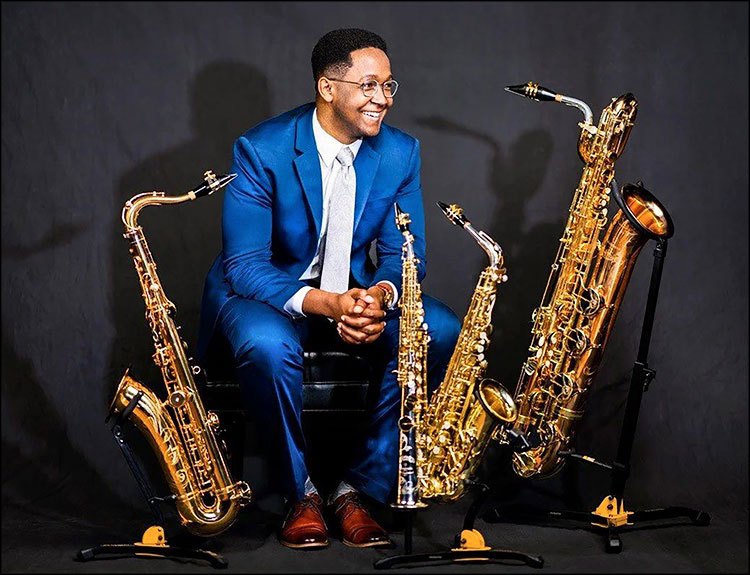
The centerpiece of this program is the New York premiere of a work by Steven Banks, “to be free.” Banks, a saxophonist and composer, is working to bring the saxophone into the center of the classical music world, and this is his first appearance with BCM, both as a composer and a performer.
“With America in general, it’s a common thing for us to be struggling with the idea of freedom,” Banks said last week. “It seems like something that we are constantly struggling with, from our founding until now.”
One of the influences for “to be free” is Nina Simone (1933-2003), the legendary Black American jazz singer, pianist, composer, and civil rights activist, who ironically always wanted to be a classical pianist but felt that was something she couldn’t pursue during her time.
In addition to soprano saxophone, flute, violin, viola, cello, bass, and piano, there is a part for voice — a part known as vocalese, which means it has no words but is just sung on a vowel. Banks said it symbolizes the idea that Simone never really wanted to sing, and wasn’t free enough to do what she really wanted.
Jennifer Johnson Cano, a mezzo-soprano who has sung with the series several times before, will be the singer for both the Copland and the Banks works.
With BCM as the lead commissioner, “to be free” is co-commissioned by Chamber Music Northwest and La Jolla Chamber Music.
When planning the series, the theme of anniversaries gave rise to an idea for a number of pieces that might be called musical love letters. These are strewn throughout the festival in a number of short pieces for solo piano. On opening night will be Michael Stephen Brown’s “Pour Angeline,” written for his partner and performed by the composer.
Other musical love letters, placed alongside some of the standards in various concerts, are Paul Moravec’s “Nancye’s Song,” in memory of Marya Martin’s mother, and three of Leonard Bernstein’s “Seven Anniversaries” — for Stephen Sondheim, William Schuman, and Aaron Copland.
In a similar vein, another personal touch will be Kenji Bunch’s “Ralph’s Old Records” for piano, flute, clarinet, violin/viola, and cello, in which he fondly remembers his father.
On Wednesday, Mendelssohn’s youthful Piano Quartet No. 3 in B minor begins the evening; we will also hear the New Zealand composer Salina Fisher’s “Mata-Au,” the Maori name for the Clutha River, meaning “surface current.” American composers will be represented by William Grant Still’s “Summerland” and “Mother and Child,” and Paul Schoenfield’s “Cafe Music.”
The annual benefit concert will be at the Atlantic Golf Club in Bridgehampton on July 25, when Baroque music will fill the air, with C.P.E. Bach, Jean-Fery Rebel, and Vivaldi, played by 10 instrumentalists in the ensemble.
Mozart’s perennial “Eine Kleine Nachtmusik,” now in a new arrangement for strings and wind instruments by Martin, and Copland’s acclaimed “Appalachian Spring” in its original 13-instrument scoring, are the bookend works for July 26. In the middle is Arvo Part’s entrancing “Spiegel im Spiegel (Mirror in Mirror)” for cello and piano.
On July 30, the serenity of Gershwin’s “Lullaby” contrasts with Brahms’s impassioned Piano Quartet in F minor.
Two giants, Haydn and Beethoven, will be heard on Aug. 2, in the Symphony No. 104 and the Piano Trio in D, respectively. The Beethoven piece is nicknamed “The Ghost” because of its eerie middle movement. Spicing up the palate will be a work by a New Zealand composer, Gareth Farr, inspired by the gamelan — a traditional Indonesian ensemble featuring a variety of percussion instruments. “Kembang Suling” offers three musical snapshots of Asia, and is scored for the timbre-rich combination of flute and marimba. Ian Rosenbaum will play both the timpani part in the Haydn “London” symphony and the marimba part on “Kembang Suling.”
Two more masterpieces follow on Aug. 6, with Mozart’s Piano Quartet in E flat and Shostakovich’s Piano Quintet in G minor.
Do you want a change from the classical classics? An evening called “Everybody Loves the Guitar” features the guitarist Jason Vieaux on Aug. 9, with a Luigi Boccherini quintet in D major nicknamed “Fandango” after the lively Spanish dance that inspired it, and Robert Beaser’s “Mountain Songs” for flute and guitar.
Closing the evening will be “100 Greatest Dance Hits” by Aaron Jay Kernis, which affectionately deconstructs and reimagines 1970s dance music with guitar and string quartet. Its title notwithstanding, the playful piece has only four movements.
The annual concert in memory of Wm. Brian Little on Aug. 14 abounds with “foot-stomping tunes from around the world and across the centuries,” according to a release, including tunes from Appalachia and Louisiana.
Highlighting an iconic bit of Americana, a string quartet will close with Jennifer Higdon’s contemporary and contemplative take on “Amazing Grace” — which is where the banner for the whole summer series comes from: “How Sweet the Sound.” The evening under the sky in the sculpture garden of the Channing Daughters Winery includes food and drink.
To close out the series on Aug. 16, the sounds of the U.S. will be heard in Samuel Barber’s Canzone for flute and piano and Copland’s “Hoedown” for violin and piano. The verve of British composer Huw Watkins’s String Trio No. 2 and the French charm of Gabriel Faure’s Piano Quartet No. 1 will be the final sweet strains of the summer.
(The festival also has two limited-seating shows with a wine reception at the Madoo Conservancy in Sagaponack, and one at the Bridgehampton Museum, but these are already sold out.)
Most concerts are at the Bridgehampton Presbyterian Church at 6 p.m., except as noted. Most tickets range from $35 to $85, or $10 for students. The evening at Channing Daughters is $175. Information and tickets are at bcmf.org or 631-537-6368.