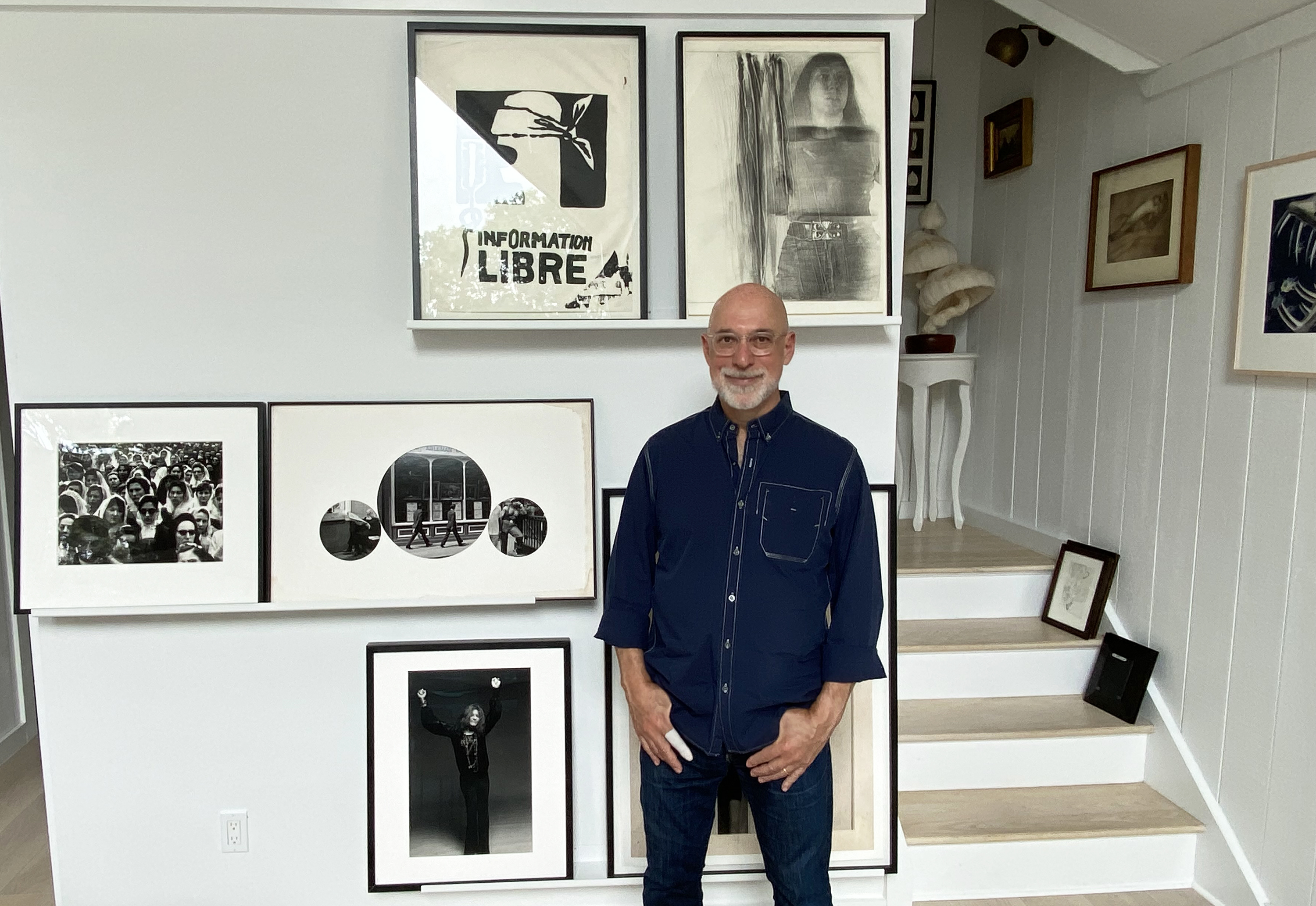
Steven Kasher has been a painter, sculptor, photographer, and art dealer, "and all of that time I was writing," he said during a conversation at his house in Springs. "So that has been kind of a through line."
While that might not seem especially unusual, the back stories connected to all of his endeavors are so rich, so loaded with insightful observations and friendships with creative people from John Chamberlan to Lou Reed to Gunter Grass, that a book might seem more in order than a profile.
And there is such a book: "Memoir of a Collection: Finding Meaning Through Art," which was published by Abbeville Press in April. The collection is Kasher's, and it is eclectic and, above all, personal. "A lot of it is not necessarily what I would have shown at the gallery," he said. "I tried to not make judgments of quality or value."
Showing a visitor a vintage photograph of Broadway and 103rd Street, near where he was brought up, he said, "I would probably use this picture as an occasion to talk about that time in my life, which kind of sums up the book. It's not about art history, or who took that picture, it's really a way of personally connecting to the images in your life as a way of exploring yourself and finding some other wisdom. That's the approach to art I'm trying to get to in the book."
Born on the Lower East Side, Kasher was brought up on Central Park West until his parents separated when he was still very young. "My father lived downtown, so a lot of my childhood was going back and forth on the West Side Highway." From 2005 to 2013, Kasher represented Reed as a photographer, and the book includes "The Past," from 2005, a photograph by Reed of that highway.
What triggered that connection was a billboard in Times Square that said, "Photos From Magnum, Curated by Lou Reed." Kasher had the idea of asking Reed to curate a show at his gallery, but Andrew Wylie, a famous literary agent, told Kasher that Reed was a serious photographer and arranged for them to meet.
"I really liked his photographs, so we decided to do a show." A number of other shows followed, mostly at different galleries in Europe. "That was the best time to have with Lou because we traveled together. We installed the shows, opened the shows, and they were not connected to his music. I got to see the art side of Lou. He was a genius."
A career in the arts was almost preordained for Kasher, as both his parents were steeped in culture. An emigre from Germany in 1938, his mother wound up with a job at ACA, a well-known print gallery, and subsequently partnered with the dealer Marian Goodman to launch Multiples, which continues to this day.
As for his father, his entrepreneurial nature eventually led him to film and theater. He opened the Van Dam Theater on the Greenwich Village street of that name and produced plays there. One of his father's closest friends, Harry Saltzman, had the rights to all of Ian Fleming's James Bond books along with Albert (Cubby) Broccoli. Kasher's father partnered with Saltzman on the work of another writer, Len Deighton, and they co-produced "The Ipcress File," which launched Michael Caine's film career. His father also had several successful stage plays on London's West End and on Broadway.
Kasher attended Horace Mann, a prep school in the Bronx. After his junior year he traveled around Europe, spending a lot of time in Italy due to his interest in classical and Renaissance art. He liked Florence so much that he returned there after graduating from high school and went to several different art schools.
He returned to New York and attended the Studio School. At the time he was working figuratively, doing mostly still-life paintings. Among the teachers there was Philip Guston, who figures prominently in Kasher's book. At the time, Guston had just made his controversial transition from Abstract Expressionism to "figurative comic-book kind of work."
After returning from Italy, Kasher and an artist friend found a loft on East Ninth Street between Avenues C and D. "It was a wilderness then, it was a burnt-out street, with a lot of drug merchandizing." From there he moved in 1977 to a large loft on North Moore Street in TriBeCa.
While there, he shifted from painting to sculpture, working mostly with poured and carved white plaster. "I saw them as kind of a combination of ghosts or banshees and mushroom clouds," he said, adding that he was involved at the time in the anti-nuke movement.
He began to arrange the sculptures, which were large, "a la Brancusi. I began to think that their interaction and the light and the space were as important as the sculpture itself." It was photographing the work that led him to photography as a career. He took classes, built a darkroom, and began photographing art for galleries, museums, and artists.
He also had a paper-making company that lasted for a number of years, working with artists like Robert Ryman, Claes Oldenburg, and George Segal. When that petered out, he sold the equipment to Rutgers University, where, because he wanted to teach, he enrolled and earned a degree in photography.
It turned out teaching wasn't an option, as tenured positions in the arts were all but nonexistent. His focus on photography led him to a job at Black Star, a photography archive founded by German Jewish photography editors who came over from Germany and started the agency when Life magazine was founded. They became a feeder agency for Life, as they represented both European and American photographers.
Once hired and acquainted with the company's archives, he proposed an exhibition of photographs from the civil rights movement. "It was the 30th anniversary of the March on Washington, and Black Star had sent many of their photographers there." Instead of organizing a show of the work at a gallery, he convinced two dozen store owners on Fifth Avenue between 14th and 23rd Streets to hang blowups in their front windows. The show received a lot of attention, but after it was over he was let go.
Not satisfied with that show, he approached Howard Greenberg, an adventurous photography dealer, with an idea for the show on the civil rights movement that would include work by photojournalists, photographers connected to the movement's organizations, and artists who would bring a different point of view to the subject, among them Richard Avedon, Robert Frank, and Henri Cartier-Bresson. The exhibition was such a success, receiving a full page of coverage in The New York Times, that over the next five years it traveled to 17 museums.
With a taste for the gallery world after working with Greenberg, he opened his own gallery in his loft in 1995 and eventually decided to rent space on 23rd Street in Chelsea. "The gallery was self-sustaining," Kasher said, "and it grew physically and in terms of staff and how many shows we did each year. Each had to be something that was really interesting to me, and one that would at least break even."
However, after 13 years, he began to lose interest in running a brick-and-mortar venue. When it first opened, there was no internet to speak of, and there was plenty of foot traffic. But by 2008, museum curators were the only people who actually came to the gallery. Most other buyers never crossed the threshold; almost everything was seen and then purchased online.
He has continued to do business from his house in Springs, and has had shows on his website of such photographers as Joan Lyons, Fred McDarrah, Wendy Ewald, Teju Cole, Bob Colacello, Brett Weston, Vivian Maier, Andy Warhol, and Reed, among many others. Reed also curated a show for the gallery in 2007.
After the Chelsea space closed, Kasher was hired by David Zwirner, "but it was not a good fit for many reasons, because I was very uncomfortable following the routine, which was much more corporate than I thought it would be." After leaving Zwirner, he wondered what to do next. Until the pandemic hit.
"I thought, 'I'm really lucky, I don't have to deal with this pandemic with a gallery.' " He realized he could move out to Springs, which had been mostly a weekend home. He is able to do private dealing from a room in the house, and his wife, Susan Spungen, a cook, food stylist, recipe developer, and cookbook author, can also work from home.
In addition to countless catalogs from his gallery's shows, Kasher has put together books on the civil rights movement, American tintypes, Max's Kansas City, American mugshots, and the art of Hitler, among others. Of those, he said, "They're always with pictures and text embedded in each other and supporting each other in ways that are a little mysterious. They're designed so you go back and forth between image and text, and they illuminate each other."
The same is true of "Memoir of a Collection," except, unlike the other books, it's highly personal, mixing autobiography with incisive observations about art, artists, and life, all inspired by his unique collection of images and objects.