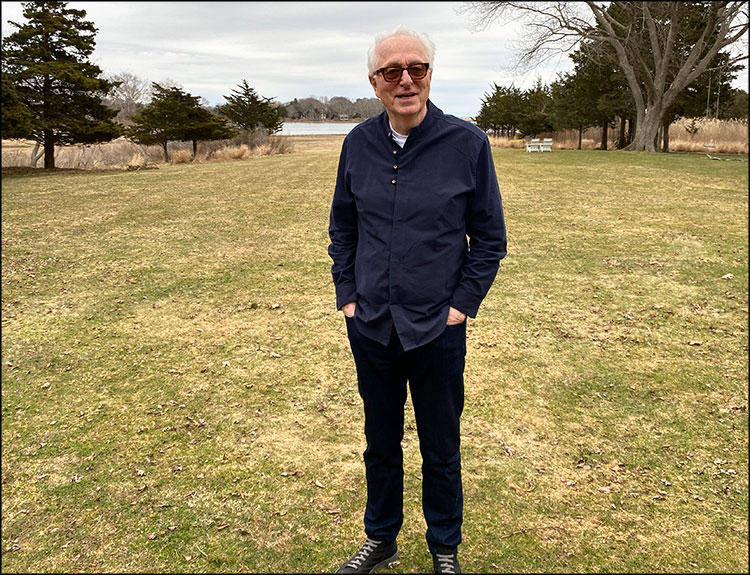
Mark Obenhaus, the co-director with Laura Poitras of “Cover-Up,” a documentary about the Pulitzer Prize-winning investigative journalist Seymour Hersh, explained during a conversation at his house in Springs why the film’s reception has exceeded the team’s original expectations.
“When we started it three years ago, all of us who worked on it had no idea it would meet the historical moment it has met. Sy Hersh has lived under the rubric of the First Amendment all these years and has benefited from people who were comfortable being sources or whistleblowers. Under the Trump administration, whistleblowers and sources are intimidated and there are all kinds of threats to journalists practicing under the First Amendment.”
“Cover-Up” premiered at the 2025 Venice Film Festival last August. “We had an overwhelming reaction there. We received a six-minute ovation, and it could have gone on longer except that Sy was so emotional, he kept asking the audience to stop.”
Since then the film was shortlisted for the best documentary feature Academy Award, was named best documentary feature by the National Board of Review, and received many other nominations in that category. It has been shown at the New York Film Festival, the Toronto International Film Festival, the Hamptons International Film Festival, the AFI Fest, as well as festivals in Stockholm, Chicago, Philadelphia, San Francisco, Denver, and many others.
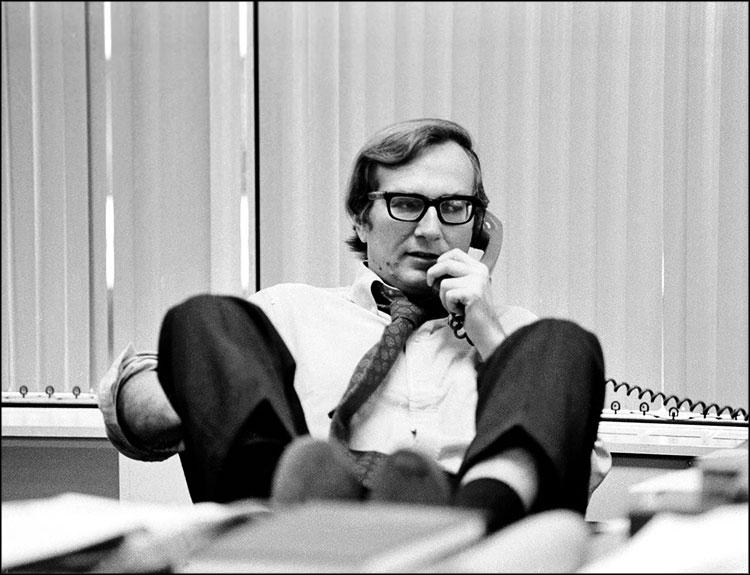
For now, at least, the success of “Cover-Up” is the icing on the cake of Mr. Obenhaus’s remarkably diverse five-decade career as a documentary filmmaker. His work has been recognized with five national Emmy Awards, the Alfred I. duPont–Columbia University Award, two Robert F. Kennedy Journalism Awards, the Writers Guild of America Award, and numerous other honors.
Growing up he spent half his time in Chicago, where his father was a professor at the University of Chicago, and half on a family farm west of that city. When he was 11, his father gave him a darkroom kit. “I was fascinated by still photography, and really considered myself as more of a still photographer all through my teenage years and even into college.”
After graduating from Oberlin College in 1968, he moved to New York City, where he had a scholarship to study film at Columbia University’s School of the Arts.
“Because of my still photography, I think I had developed a pretty good eye, and the movie camera was not an alien thing for me. About two years after I arrived in New York, I started out as a cinematographer and shot a lot of hand-held vérité films. I also worked with Bob Fosse on three or four Broadway show commercials.”
While shooting documentaries for other people, he also made two dramatic films in the early 1970s. “Merc,” which was inspired by a street person he had observed in Grand Central Station, was about his pursuit of that character, who was played by an actor friend. It was shown at the Whitney Museum in 1974, and another dramatic film, “Nomadic Lives,” played at the Film Forum three years later.
From then on he focused on documentaries, producing and directing films for the PBS series “Frontline,” among them “Abortion Clinic” (1983) and “Living Below the Line” (1984), both of which won Emmys. In fact, it was David Fanning, the founder of “Frontline,” who suggested Mr. Obenhaus make a film about journalism and who put him in touch with Mr. Hersh.
“I went down to Washington, knocked on the door of his office, which he had for 40 or 50 years. I walked in, and said ‘Hi.’ The rest is kind of history.” That history began with “Buying the Bomb,” which Mr. Obenhaus directed, produced, and shot for “Frontline.” The story Mr. Hersh was following was about Nazir Vaid, a Pakistani national who was trying to illegally obtain in this country timing devices the main function of which is to trigger nuclear bombs. When Mr. Hersh uncovered evidence that linked Vaid to Pakistan’s nuclear program, federal prosecutors agreed to a gag order and in the indictment excluded any mention of the nuclear connection.
Over the subsequent years, Mr. Obenhaus has produced and directed both political and more personal films, often with a cultural component. At the same time as he was working with Mr. Hersh he directed “Einstein on the Beach: The Changing Image of Opera” (1985) for PBS’s “Great Performances” series. Working with Robert Wilson, Philip Glass, and Lucinda Childs “was a fantastic opportunity,” Mr. Obenhaus said.
Other personal films included “Dreamland,” which focused on creative people “pushing the bounds of the possible” in Los Angeles; “Miles Ahead: The Music of Miles Davis” (1986), also for “Great Performances,” and “Steep” (2007), a mesmerizing film about high-mountain skiers, whose obsession is to ski where nobody has skied before.
“I was a passionate skier, so the opportunity to do a film on skiing was tremendously exciting for me.” The film begins with Bill Briggs, who was the first to ski the Grand Teton in 1971 and is said to be the father of extreme skiing in North America. It follows other skiers to the Chugach Mountains of southern Alaska, Chamonix and La Meije in the French Alps, Jackson Hole, even Iceland.
The breathtaking scenery, astounding feats of extreme skiing, and the mantra of living life to the limit are leavened by the death of several skiers featured in the film. Mr. Obenhaus was close to Doug Coombs and with him just before he died. Another subject of the film, Shane McConkey, died soon after in Italy’s Dolomites. As a result of those tragedies, Mr. Obenhaus gave up skiing shortly after finishing the film.
A political through line in his films follows John F. Kennedy. The first, “JFK: A Time Remembered” (1988), was produced, directed, written by, and shot by Mr. Obenhaus to commemorate the 25th anniversary of Kennedy’s assassination. “It was an homage; it was wonderful to do,” he said. The film combines heartbreaking archival imagery of the event and its aftermath with interviews with the journalists Dan Rather and Tom Wicker; Lawrence O’Brien, a special assistant to the president who was riding in the Dallas motorcade, and Angier Biddle Duke, the chief of protocol for the State Department under Kennedy, among many others. (Mr. Duke’s son Biddle lives just down the road from the filmmaker.)
Mr. Obenhaus produced and shot a second film, “Dangerous World: The Kennedy Years” (1997), an ABC/News special hosted by Peter Jennings and based in part on reporting by Mr. Hersh for his book “The Dark Side of Camelot.” The film takes a more jaundiced view of the Kennedy presidency, diving deeply into the connection between the Chicago mobster Sam Giancana, Frank Sinatra, and the Kennedys, the president’s affairs with Marilyn Monroe and other women, his secret war against Cuba, and other transgressions.
“The Kennedy Assassination: Beyond Conspiracy” (2003), also written and directed by Mr. Obenhaus and reported by Jennings, is “a very anti-conspiracy film. Oswald did it. It makes the case as best we could and I think it makes a good case.”
As for “Cover-Up,” Mr. Obenhaus and Mr. Hersh had been discussing making another film. “We were fumbling around getting that going, Covid hit, we raised money, then lost money, when Laura Poitras made her once-every-five-years request asking Sy if she could make a film about him. I said to Sy I thought it would be a good idea if Laura and I teamed up as we would have a better chance of raising the money. She’s a wonderful filmmaker and I was happy to work with her.”
Available to stream on Netflix, the film begins with Mr. Hersh’s investigation of the death of 6,000 sheep due to nerve gas, which the army denied. It continues with his investigative coverage of the My Lai massacre in Vietnam; the Watergate cover-up; Henry Kissinger’s involvement with the overthrow and killing of Salvador Allende in Chile; Operation Chaos, the C.I.A.’s domestic espionage project that targeted antiwar protesters, and the torture and prisoner abuse at Abu Ghraib prison in Iraq.
The film also dips into Mr. Hersh’s personal life, his family background, including his father’s death and taking over the family business. After enrolling at an inexpensive junior college, he wrote an essay that led to the teacher asking Mr. Hersh to meet him at the admissions office of the University of Chicago. Being accepted there changed his life, he said, adding he didn’t think he could change the world but felt he had some moxie.
As for his sources, Mr. Hersh said, “Time after time things I’m told turn out to be right.”
Mr. Obenhaus has been coming to the East End every summer since 1971. He bought his current house, which overlooks Accabonac Harbor, in 1987. He is married to Gay Cioffi, an early childhood education specialist and creator of “Flowers and Words,” a book of watercolors and quotations.