In Process, the Watermill Center’s ongoing series of studio visits and open rehearsals with its resident artists, returns tomorrow at 5:30 p.m. with Almond Zigmund, Edison Peñafiel, Matthew Diafos Sweeney and Sebastian Peters-Lazaro, Silas Jones, and Stephen Laub.
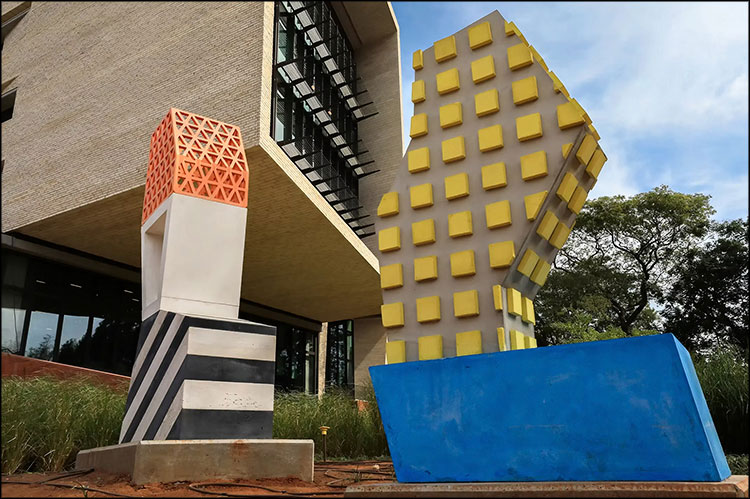
Ms. Zigmund is an East Hampton visual artist who makes site-responsive installations, discrete sculptures, works on paper, and paintings. Her sculptures and installations combine crisp geometry, vivid color, and intricate patterns to suggest walls, barricades, enclosures, and other aspects of the built environment. The architectonic works engage both the eye and body, inducing visceral reactions to the virtual and actual spaces.
Based in Miami, Mr. Peñafiel is an interdisciplinary artist whose work investigates migration, systems of power, and collective memory through environments that combine video, sound, and architectural form. In addition to large-scale installations, he creates autonomous works that translate spatial investigations into sculpture and textile-based compositions.
Mr. Sweeney, a director-composer, and Mr. Peters-Lazaro, a choreographer-designer, create immersive works in theaters, galleries, and unconventional sites. Hailed as “the future of contemporary performance” by The Los Angeles Times, their work draws on recurring mythologies, integrating postmodern dance, opera, experimental music, and installation art. Situated in downtown Los Angeles, they also collaborate with other artists, composers, and institutions to create aesthetic experiences.
Mr. Jones is a writer whose fiction has been published in The Cleveland Review of Books, The Paris Review, The Drive, Columbia Journal, Los Angeles Review, and American Literary Review. He won first place in Columbia Journal’s 2023 fiction contest, earned the American Literary Review’s Flash Flood Award, and won awards at Oberlin College for research in queer and gender studies and in American studies.
Mr. Laub, a multidisciplinary artist working in performance, video, and sculpture, has spent five decades investigating history through the juxtaposition of images and forms. Among the historical events that have found their way into his work is a document from the Wannsee Conference, the site of an infamous 1942 meeting of Nazi Party and government officials. Another work is based on the Bordereau, an 1894 document from the Dreyfus Affair trials that was used to falsely incriminate Dreyfus as a spy.
While the program is free, registration has been recommended.