The Sag Harbor Cinema will launch a five-week tribute to Luchino Visconti on Wednesday with screenings at 1:30 and 6:30 of “Ossessione (Obsession),” generally considered the first film of the Italian neorealist movement.
“I liked the idea of following a tribute to an esteemed distributor of classic films, like Rialto, with an homage to a major individual director, such as Luchino Visconti,” said Giulia D’Agnolo Vallan, the cinema’s artistic director. “I also think this is an interesting moment in time to revisit post-World War II cinema at its height. Even more through the work of an artist who was the offspring of Italian aristocracy, a member of the Communist Party, openly gay, and a devout Catholic, all at the same time. Together with, among others, Vittorio De Sica, Roberto Rossellini, and Michelangelo Antonioni, Visconti gave birth to what is still considered by many to be the peak of Italian cinema, out of the rubble of a global conflict, of the Fascist government, and of the national film industry.”
Visconti’s directorial debut, “Ossessione” (1943), is one of the first adaptations of James M. Cain’s noir novel “The Postman Always Rings Twice.” Marked by its stark portrayal of life in wartime Italy, the film stars Clara Calamai and Massimo Girotti as doomed lovers who will do just about anything to get away from her brutal husband and the rundown hotel where they live.
“La Terra Trema (The Earth Trembles)” (1948), set for March 18, filmed in Sicily, focuses on how a fisherman’s budding leadership of the local labor force threatens the price-fixing schemes of wholesalers. The film, one of the more formally daring of all neorealist works, features a cast of nonprofessional actors from the village where it was shot.
Next, on March 25, is “Rocco e i suoi fratelli (Rocco and His Brothers)” (1960), which chronicles the historical contradictions facing postwar Italy through a family’s relocation from the rural South to industrial Milan. Starring Alain Delon, Claudia Cardinale, Annie Girardot, and Renato Salvatori, it was described by Martin Scorsese as “one of the most sumptuous black-and-white pictures I’ve ever seen,” and “a simultaneous continuation and development of neorealism.”
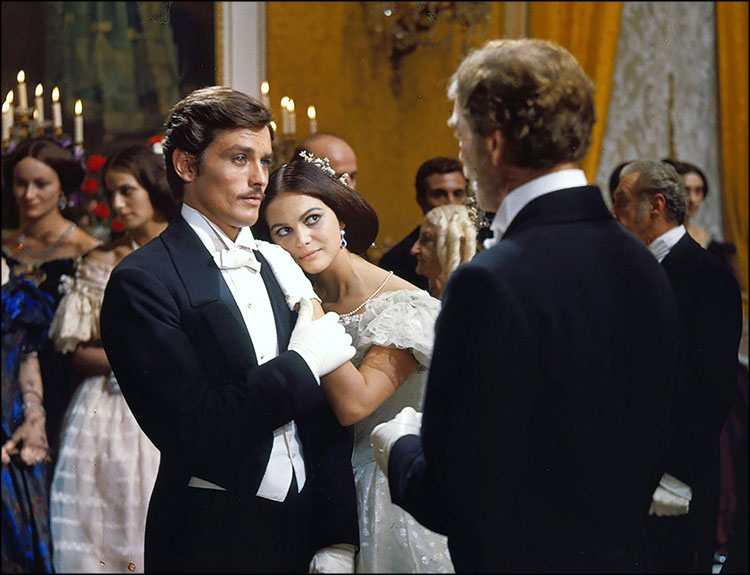
Mr. Scorsese has cited Visconti’s “Il Gattopardo (The Leopard)” (1963) as “one of the greatest visual experiences in cinema.” The film is adapted from Giuseppe di Lampedusa’s novel about a Sicilian prince at the end of the Risorgimento, the reunification of Italy, who, through political cunning, ensures the survival of the old aristocratic order in the face of revolutionary ferment and moral decay. Starring Burt Lancaster, Alain Delon, and Claudia Cardinale, and scheduled for April 1, Andrew Sarris of The Observer called the film “One of the greatest motion pictures of all time, as well as one of the most politically profound.”
The series will conclude on April 8 with “Gruppo di Famiglia in un Interno (Conversation Piece)” (1974). Lancaster plays a retired American professor who lives a solitary life in his mansion, surrounded by art and books. One day the wealthy but vulgar Countess Bianca Brumonti (Silvana Mangano) insists on his renting a floor to her, her much younger lover Konrad (Helmut Berger), her teenage daughter, and her daughter’s fiancé. The arrival of the countess’s eccentric family turns the reclusive professor’s life upside down.