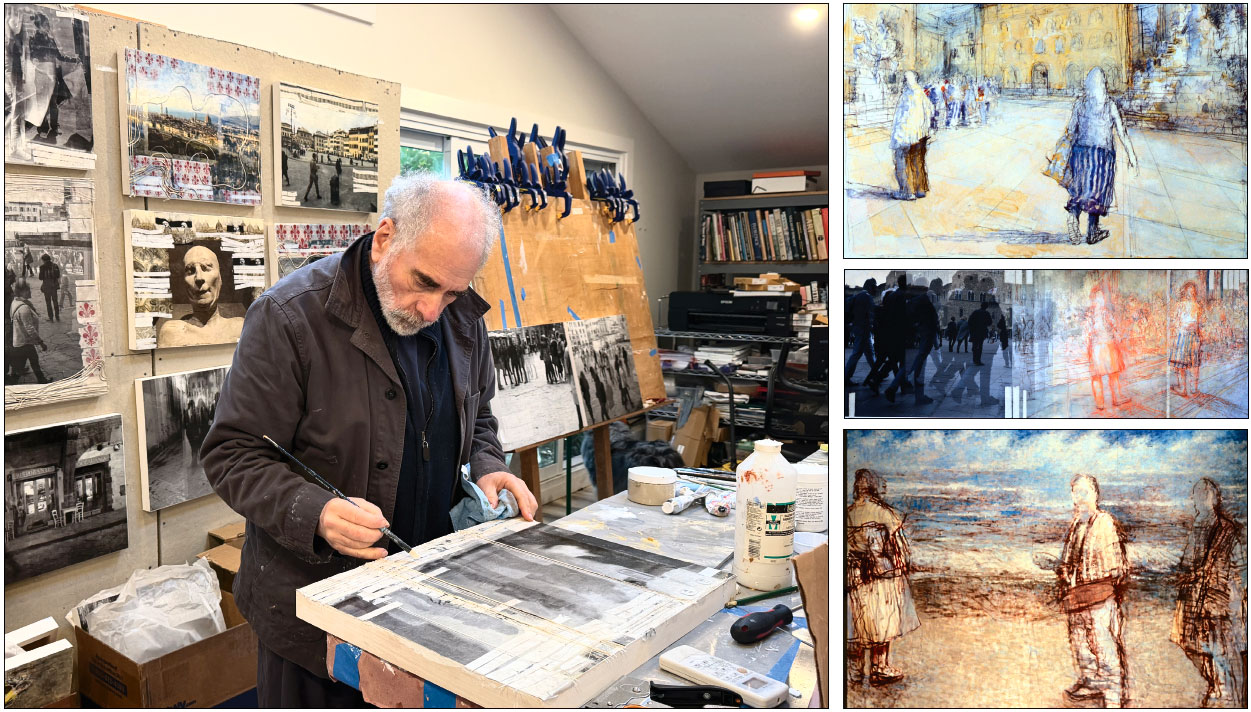
One of the many remarkable works in “Here and There: The First Churchennial” was Peter Solow’s “Piazza Signoria #2.” The exhibition in Sag Harbor featured the work of The Church’s previous artist residents, and Mr. Solow worked on that mixed-media composite while in residence there in 2024.
Over more than five decades, Mr. Solow, who lives in Sag Harbor, has produced a body of work that has stayed true to his profound thoughts about the making of art, while at the same time evolving from a focus solely on oil paintings and drawings to works that combine photography, painting, and drawing through the use of digital technology.
Mr. Solow has cited his visit to Florence, Italy, in 1984, as a seminal event in his artistic and personal life. Over the years since then he has returned there alone, with his family, and with groups of adults and students during his two decades of teaching at Pierson High School in Sag Harbor.
Florence’s piazzas have engaged his attention, as have city squares elsewhere in Italy and in New York, because for an artist so devoted to the figure, the movement or choreography of pedestrians in city spaces is a central motif.
The left portion of “Piazza Signoria #2” consists of multiple exposures of photographs of the square’s pedestrians and architecture. The orange hand-rendering on the right recalls the preparatory drawings, or cartoons, that Renaissance masters used in the creation of wall murals, according to The Church. The work is 5 by 14 feet.
As for the figures, whether in the photographs or drawings, they call to mind the words of John Russell, the late art critic for The New York Times, in a review of Mr. Solow’s work: “Sometimes they are so sharply characterized that we feel ourselves engaged in their doings and curious as to their outcomes. But sometimes they look like members of a large group who have forfeited their individuality in response to a collective urge to run, to walk, to look, and to wait.”
Russell’s observation applies as well to “Crossing Brooklyn Ferry,” an 8-by-14-foot painting from 1989 inspired by a poem of the same name by Walt Whitman, “who is addressing us, not his contemporary audience,” Mr. Solow said during a conversation at his studio. Written before the opening of the Brooklyn Bridge, the poem describes a ferry ride across the East River from Manhattan to Brooklyn.
Like so much of Mr. Solow’s work, the painting is populated by people in transit, most of them looking away from the viewer, with those in the background jammed together. One thinks of steerage, in a way, while at the same time feeling the energy of crowds with multiple destinations.
Mr. Solow grew up in upstate New York in a “tiny town that looked like the village in ‘The Last Picture Show.’ I used to draw all the time. My parents sent me to the Everson Museum in Syracuse for lessons,” but otherwise, aside from three framed posters of paintings by Van Gogh, art didn’t figure prominently in his family’s life.
While he preferred history to French, excelling in one and failing in the other, it was an art teacher in high school whose energy and excitement about making art rubbed off on Mr. Solow. Enough so that as a senior he entered a portfolio in the National Student Art Competition and won a full scholarship to study at Boston University.
He said the art program was very academic there. During the first year, required courses included color theory, two-dimensional design, and “a tremendous amount of figure drawing. But you weren’t allowed to paint.” Considering his facility with the human figure, and its prominence in his work, the experience had value, but he found Boston “very provincial and very segregated.”
The summer after his freshman year, he applied to Cooper Union in New York City as a transfer student and was accepted. His four years there were transformative. For one thing, its “crazy mixture of faculty” included the influential critic and curator Dore Ashton, and the artists Leland Bell, Robert De Niro Sr., Sue Ferguson Gussow, Jack Whitten, James Brooks, and Nick Marsicano, among others.
Just as important, “Because of coming in my second year as a transfer student, nobody seemed to be paying attention. I was able to spend an enormous amount of time in the painting department, either painting or drawing, and not doing other stuff. I had so much flexibility in my schedule that I was able to take Dore Ashton’s class for four years.” While his work evolved during those years, he was always working figuratively.
“The thing I felt and still feel is that there’s nothing that teaches you more about making art than making art.” A big part of making art for Mr. Solow was drawing. “Sometimes we would take a break from Wolf Kahn’s class and go to Adam and Eve’s, this big cafeteria on Waverly Place, and I would sit in back of the room and all I would do is draw what I saw in front of me. You have to draw fast, because people move.” Then he would return to his apartment and draw some more.
“I was drawing bottles, I was drawing my cat, I was drawing the view out the windows, I was drawing the fireplace, I was drawing all this stuff that was in there, just practicing. So I had these little pieces of paper I was working on and just doing piles and piles of drawings.”
After graduating from Cooper Union, he remained in New York. Because he had worked in several restaurants while growing up, he did the same in New York, cooking at Phebe’s on the Bowery and at Jake’s on East Fourth Street, where he was running the kitchen.
Restaurant work soon fell by the wayside, however, as he began showing his work in the late 1970s. Barbara and Norman Hirschl of Hirschl and Adler Galleries were very supportive, as was Richard Green in SoHo, the Gallery Moos, MB Modern, and Meredith Long, an influential dealer in Houston. Solo shows happened every year or so throughout the 1980s.
Toward the end of that decade, Mr. Solow and his wife, Elise Goodheart, were living in a loft on Lafayette and Houston Streets when they decided to move to Sag Harbor. “When we came out here I felt because I had a gallery in New York that it wouldn’t by any trouble trying to get representation out here. I had a very rude awakening about that.” But he did continue to show in New York and before long on the East End as well.
The shift to mixed-media composites began in 2012, when he was introduced to large-format printers at Stony Brook Southampton by his artist friend Scott Sandell. The components of a work like “Piazza Signoria #2” are printed on digital archival canvas and then sewn together.
On the subject of drawing, Mr. Solow said, “If you put a line or a mark down on the paper and it doesn’t feel right or it needs to be adjusted, that is part of the process, and looking at it is part of the process. If you think about it, so much of our lives we use the word ‘mistake.’ And what kills the sense of art in younger kids is that there is often a sense that there’s a right or wrong way to draw things, and things have to look like this or that. That’s antithetical to everything I believe in. I don’t know what things should look like. I’ve been trying to find that stuff that feels right from the beginning.”
Of his working process, he said that while we all have complex personal histories, “When I work, I try as much as possible to divorce myself from all that, because what I think makes art work are all these formal considerations. That’s been a very important aspect of what I do. The stuff is with me, but the idea is that I don’t dwell on that. What I work on is the structure of things.”
And working on the structure involves intuition and the willingness “to make dramatic changes and modifications to what you’re doing until you get that sense that it feels right. No matter how crappy something starts out, I always have the confidence because of my process that I can make it into something worthwhile. Screw all this stuff about talent and imagination. If there’s one word I’d like to eliminate from the English language, it would be ‘talent.’ "