The sixth iteration of Martin Scorsese Presents: The Sag Harbor Cinema Festival of Preservation, which is dedicated to the culture and preservation of film, will be held from Friday, Nov. 6, through Nov. 9. Chock-full of restorations and rediscoveries, it will include guest appearances by archivists, historians, collectors, filmmakers, and family members.
“From a female pioneer of Italian silent film to one of the fathers of African Cinema; from a visionary Hungarian puppeteer to America’s ‘King of the B’; from Pre-Code to the New Hollywood; from Powell and Pressburger to Abbott and Costello, the lineup this year reflects the vibrancy of cinema — past and present — through a wide variety of genres, styles, and ideas,” said Giulia D’Agnolo Vallan, the cinema’s founding artistic director. “I often find that juxtapositions open my mind. Which is very much in the spirit of this long, packed weekend.”
The “female pioneer” cited is Elvira Notari, whose emphasis on Neapolitan urban life and use of nonprofessional actors prefigured the Italian Neorealist movement of the 1940s and ’50s. Of her 60 feature films and over 100 shorts, only three remain in a complete state. One of them is “A Santanotte” (1922), a melodrama about a young woman forced to marry another man in order to save the one she loves. It will be shown on Nov. 7.
To prepare for that film, cinephiles might want to see “Elvira Notari: Beyond Silence,” a 2025 documentary by Valerio Ciriaci, which will screen on Friday, Nov. 6. Giuliana Bruno, the author of “Streetwalking on a Ruined Map,” the first study of Notari’s work, will be on hand to discuss both films and sign copies of her book.
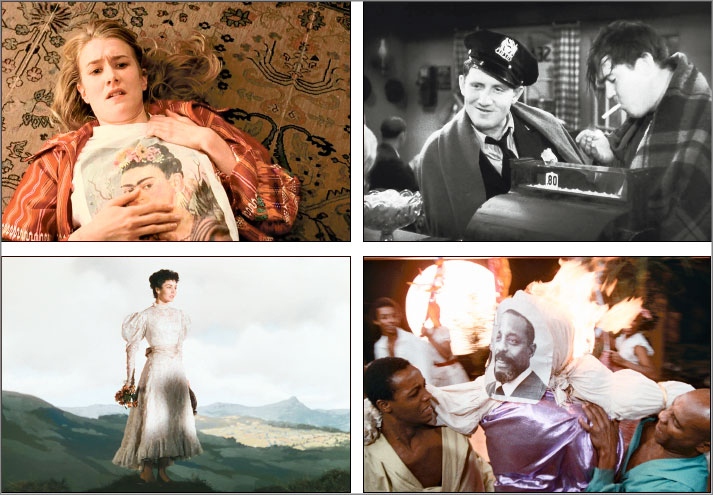
Another especially notable film is “Gone to Earth,” Michael Powell and Emeric Pressburger’s drama set in late 19th-century England and starring Jennifer Jones as an independent young woman torn between the lustful advances of an egotistical hunter and a more restrained and kindly minister. Drastically cut for its 1952 American release by its producer, David O. Selznick, the new restoration was supervised by Scorsese and Thelma Schoonmaker, Powell’s widow and a multiple Oscar-winning editor. Kevin Schaeffer of Walt Disney Studios will discuss the film and its history.
Med Hondo’s “West Indies: The Fugitive Slaves of Liberty” (1979) was at the time one of the most expensive African films ever produced; because of Hondo’s refusal to compromise his vision, it took seven years to finish. Filmed in an abandoned Parisian Citroen factory aboard a massive replica of a slave ship, the musical epic engaged with centuries of European colonial violence. Ashley Clark, the author of “The World of Black Film” (2026), will introduce the film and sign copies after the screening.
The film with perhaps the most complicated trajectory is Samuel Fuller’s “The Big Red One” (1980/2004), which starred Lee Marvin as the leader of an American rifle squad in North Africa during World War II. Based on Fuller’s experiences as a soldier during that war, it was conceived for Warner Bros. in the late 1950s, with John Wayne on board as the star. The project languished, however, until 1978, when Fuller revived it.
Its rough cut ran for over four hours, but United Artists, its distributor, slashed it to 113 minutes for its screening at the 1980 Cannes Film Festival. Over 20 years later, Richard Schickel, a film historian and longtime film critic for Time magazine, assembled a new cut, billed as “The Reconstruction,” working from Fuller’s script. Almost three hours long, the film premiered to acclaim at Cannes in 2004. Samantha Fuller, the filmmaker’s daughter, will introduce the screening.
Another daughter, Mary Corman, will be on hand for “The Masque of the Red Death,” a 1964 film adapted by Roger Corman from the writings of Edgar Allan Poe. It stars Vincent Price as a Satanist prince who torments members of the local peasantry and entertains other nobles in his castle while a plague runs rampant in the surrounding lands. Corman’s low budget B-movies helped launch the careers of Scorsese, Francis Ford Coppola, Peter Bogdanovich, Joe Dante, Jonathan Demme, and James Cameron, according to the cinema.
The festival also includes work from Brian De Palma and Alexander Payne, two directors known to engage with film history. It will present a new restoration of De Palma’s “Obsession” (1976), his tribute to “Vertigo” and other Hitchcock thrillers. The film stars Cliff Robertson as a prominent New Orleans businessman who becomes obsessed with a young woman who resembles his late wife (Genevieve Bujold in both roles). With a screenplay by Paul Schrader, it features a memorable performance by a 30-year-old John Lithgow.
The cinema cites Payne’s affinity to Leo McCarey’s blend of dark comedy and humanism, which can be seen in the newly restored version of his “Citizen Ruth” (1996). Laura Dern stars as an addict with four children whose unexpected pregnancy lands her inadvertently into a national abortion debate between two opposing activist groups. Payne will join the screening via Zoom.
Clarence Brown’s “Letty Lynton” (1932), which was inspired by a real-life murder case of a Scottish socialite accused of poisoning her lover, was unavailable for screening for almost 90 years because of a copyright dispute. Warner Bros. finally resolved the issue and restored the melodrama, which stars Joan Crawford in the title role and Robert Montgomery as her husband, who is threatened by the arrival of her spurned ex-lover (Nils Asther).
Other films include Charles Barton’s “Abbot and Costello Meet the Killer, Boris Karloff” (1949); Morton DaCosta’s “Auntie Mame” (1958); Raoul Walsh’s “Me and My Gal” (1932), Martin Ritt’s “Paris Blues” (1961), and two programs of “Puppetoons Shorts,” featuring animation from the 1940s by George Pal.
The Preservation Panel, set for Nov. 8 at 11 a.m., will include Grover Crisp of Sony Pictures Entertainment, on resurrecting lost films; Arnold Leibovit, a filmmaker and preservationist, on the work of Pal; Cassandra Moore of NBC Universal on the history of Universal’s classic monsters, including the Abbott and Costello horror-comedy; George Willeman of the Library of Congress on work done by the library on the Frisbee Collection of nitrate films, and Schaeffer, who will focus on “Gone to Earth.”
The panel is free and will be followed by brunch.