The production of “The Elephant Man” at LTV Studios begins just outside the Wainscott theater. As you present a ticket to the ticket taker, you are faced by a 10-by-10-foot drapery hand-painted with an enlargement of the original Victorian advertisement for the Elephant Man. If you don’t already know, you will soon that you are replicating the journey of those who paid to see the “freak of nature” in a sideshow in late-19th-century London.
Once inside the theater, as carnival music plays over the speakers, you are transported far from LTV’s Studio 3. A round stage is at the center of the room, dramatically lighted, surrounded on all four sides by seating that is separated from the stage by only eight feet. Black draperies circle the room.
Enter Josh Gladstone, LTV’s executive and creative director, in character as Ross, the abusive sideshow manager who exhibited the Elephant Man, a.k.a. John Merrick, played by Dayne Rasmussen, before Frederick Treves, a young surgeon portrayed by Robert R. Doyle, happened upon the sideshow and extricated Merrick.
Gladstone’s performance as Ross sets a high bar for the show, with his full-throttle Cockney accent, bombastic delivery, top hat and heavy beard, and just slightly shopworn appearance. Ross appears often during the show as both narrator and character, and Gladstone later emerges as a bishop who condescendingly sees Merrick as a reclamation project.
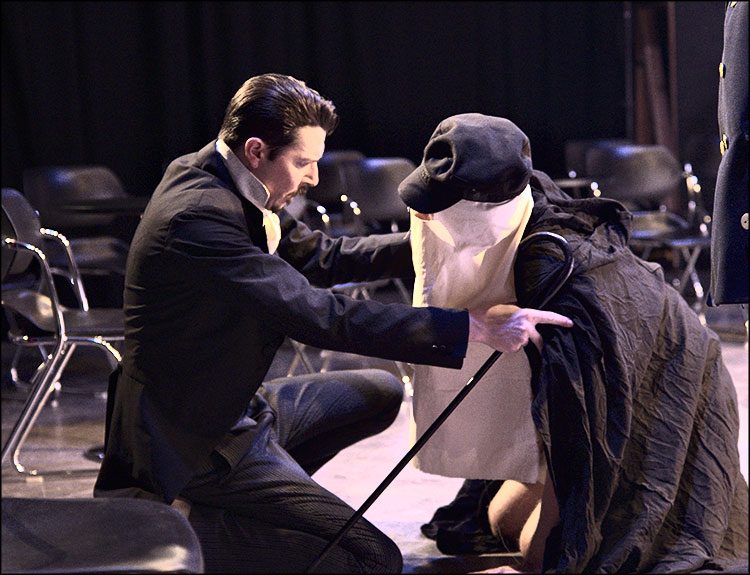
The scene shifts to a London hospital, where Treves and Merrick share the stage, Treves elegantly dressed from his morning coat to his spats, while Merrick is clad only in a pair of clunky pajama bottoms. As Treves elaborates on Merrick’s bizarre physical deformity in a delivery that is almost deadpan, Rasmussen slowly inhabits the role of the Elephant Man. As in other stage productions, Merrick isn’t disfigured; rather, he tilts his head at an angle, screws up his mouth, leans to one side, turns his right hand into a claw, and can barely speak.
The 1979 play, which won three Tony Awards, including best play for its author, Bernard Pomerance, proceeds to follow Merrick’s progression from near muteness to reading Shakespeare and from those pajamas to a tailored suit. With that development toward “normalcy” come complications, which are best left to be experienced by seeing the play.
As for Rasmussen and Robert R. Doyle (there are other Doyles in the show, none related to the other), they are the founders of the Mirror and Masque Theatre Company, which is co-producing the play with LTV’s Playwrights’ Theatre of East Hampton. They are also co-directors of the production.
Their performances as Merrick and Treves, two such different figures, are on the money. As Treves, Doyle gives the character of the doctor multidimensionality as he ranges from benevolent to imperious to angry to crestfallen, while Rasmussen adroitly suggests his deformities with body language, and seamlessly portrays Merrick’s transition from sideshow freak to a figure embraced by Mrs. Kendal, a well-known and socially connected actress, and other nobles.
As for the other actors, Gerard Doyle portrays Carr Gomm, the head of the hospital, and Carolann DiPirro is Mrs. Kendal, with other roles played by Rebecca Edana and Seamus Doyle, and Gerard Doyle even briefly doubles as a London policeman. The performances are impeccable.
Rasmussen and Robert R. Doyle deserve kudos for the staging of the play in the round. Almost as much action takes place in the narrow area between the stage and the audience as onstage, which is set as Merrick’s hospital room. Being able to experience the performances at such close range adds another layer of power to a powerful play. Those in the front row are advised to keep their feet under their seats.
That arrangement reflects a comment from the directors in the Playbill. “What makes this play, and we hope our production, so enduring is that it refuses to let us observe Merrick from a comfortable distance. Instead, it turns the mirror toward us so that we are compelled to consider the ways in which society defines normalcy.”
Kudos also to Betsy Doyle, Robert’s mother, the stage manager; Charles Dederick, assistant stage manager; Dan Lilley, lighting; Ollie Smythe, scenic design; Catherine Greenwood, costume design; Lynn Josephs, prop design, and Bethany Dellapolla, intimacy director.
“The Elephant Man” can be seen Thursday, Friday, and Saturday at 7:30 p.m. and Saturday and Sunday at 2. Tickets are $33.17 for general admission, $17.23 for students (who must have an adult present if under 18), and $69.18 for a cafe table seat with a drink ticket.