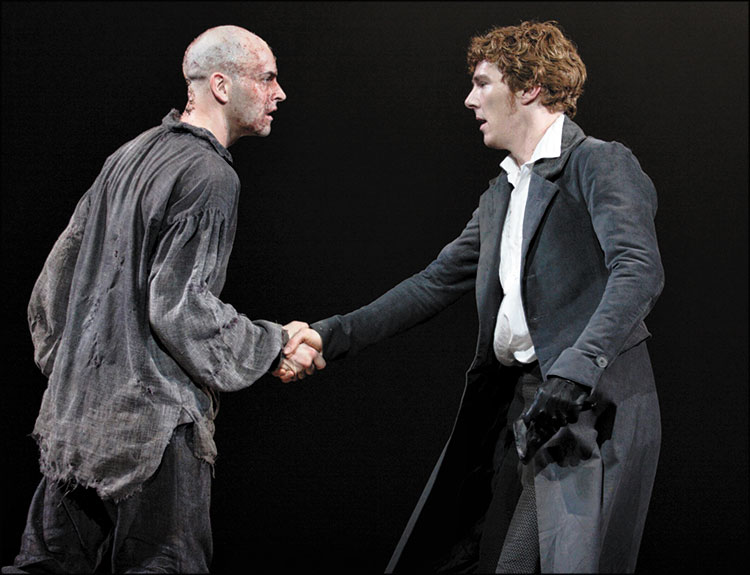
Just shy of Halloween, National Theatre Live will bring its 2011 production of “Frankenstein” to Guild Hall on Friday at 7 p.m. Directed by Danny Boyle (“Trainspotting,” “Slumdog Millionaire”) and filmed live at the Royal National Theatre in London, it stars Benedict Cumberbatch (“Hamlet,” BBC’s “Sherlock”) and Jonny Lee Miller (“Elementary,” “Trainspotting”).
Two versions of the production were filmed, one with Miller as the Creature and Cumberbatch as Victor Frankenstein, the other with the roles reversed. The version being screened at Guild Hall features Miller as the Creature.
In his New York Times review of the original stage production, Ben Brantley wrote, “It’s in the physical relationship between the two actors (especially if you get to see them in both roles) that you sense the real, unbreakable connection between these characters. There’s a lovely repeated gesture that has each reaching out to the other, a la Michelangelo’s God and Adam. Arresting visual imagery is never in short supply here.”
Since its sold-out stage run, the filmed versions have been seen by almost half a million people in theaters around the world. Tickets are $25.
“The Living Ancestors,” a new multimedia dance-theater work conceived and directed by a 2026 Guild Hall artist-in-residence known as j. bouey, will take audiences behind the scenes on Saturday at 7 p.m. Through excerpts and conversation, the in-process presentation invites attendees into the development of the “disco-funk space opera.”
With a libretto by Junauda Petrus, “The Living Ancestors” depicts a future global society on the verge of abolishing oppression. The Living Ancestors, a band of griots, reveal their origins as “formerly enslaved clones from the Underground and shift the future world’s perspective of a supposed utopia,” according to Under the Radar, a festival featuring innovative theater and performance, where “The Living Ancestors” will have it full premiere in January.
The Guild Hall production will feature funk, disco, and house music by Dane Deveraux and live-performance camera obscura projection design by George Del Barrio. It constructs its hypothetical world through a blend of movement, music, text, research, and live media.