News For Foodies: 06.25.15

News For Foodies: 06.25.15

Local Food News
By
Joanne Pilgrim

Momi Ramen, a noodle house in Miami, has opened an East Hampton location in the Pantigo Road space formerly occupied by Turtle Crossing. The restaurant makes fresh noodles in-house several times a day and adds them to concoctions using a rich pork-bone broth called tonkotsu. On the menu are hot and cold ramen dishes, including vegetarian and seafood options, as well as Japanese specialties such as shu mai and gyoza dumplings, oshinko (Japanese pickles), barbecued short ribs, and salads. The beverage choices include a number of sakes. The shop opens at 5:30 p.m. Wednesday through Friday, with hours till midnight on Friday and 11 the earlier days of the week, and on Saturday and Sunday starting at noon — till midnight on Saturday and 10 p.m. on Sunday.

Overlooking the Water

A new happy hour at the Inlet Cafe at the Gosman’s Dock complex in Montauk from 4 to 6 p.m. Mondays through Fridays just through the end of June features half-priced rum punch, domestic beers for $3, and $10 food specials. The cafe also features new hot menu items and sushi to order and eat on site or for takeout. Local restaurants are geared up for the season, with chefs and other staff members getting their bearings before the busiest days of the summer. Bostwick’s Chowder House on Pantigo Road in East Hampton is now open seven days a week, as is Duryea’s Lobster Deck in Montauk.
 

Seasons by the Sea: Don’t Knock Spinach

Seasons by the Sea: Don’t Knock Spinach

The nutritional value of spinach is off the charts
By
Laura Donnelly

Shame on you, Mark Bittman, for slamming spinach in your April 12, 2012, New York Times column. In it you refer to spinach as the “homework” of vegetables, you slam the ’70s fad of spinach salads, and say this is the “least convincing” or tasty way to prepare Spinacia oleracea, honorable member of the beet family. I admire you, sir, but here you are dead wrong.

Mr. Bittman does go on with some delicious sounding methods of beating the tender leaf into submission, from wilting, steaming, braising, and slow cooking with butter and a cup of cream.

I feel sorry for people whose only experience with spinach is in the form of the bagged stuff at the supermarket, chopped and frozen by the Green Giant, or hidden in some greasy artichoke dip at Applebee’s.

We are lucky out here to be able to grow our own, or buy freshly picked bundles at the farmers markets and local grocery stores. Yes, spinach is mild, but it is not tasteless. I rather like the French culinary description “cire vierge,” meaning “virgin beeswax,” in that the spinach is capable of receiving and absorbing any and all other flavors it is combined with. Most other vegetables assert their own flavors; spinach is the mellow, stoner-surfer dude, willing to be flash-fried, cream­ed, sauteed, a-a-a-and, served raw. Whatever, dude.

Spinach seems to have first turned up on the table in ancient Persia, then in India and China. By the 14th century it was popular in England and France, and when Catherine de Medici became Queen of France in 1533, she apparently liked it so much that she wanted it served at every meal. She was born in Florence, which is why many dishes served with spinach nowadays are referred to as “Florentine.”

The nutritional value of spinach is off the charts, but some people should be wary of some ingredients. It is full of iron and calcium but also contains oxalates, which make absorption of the aforementioned nutrients difficult. The oxalates are also what cause that fuzzy feeling on your tongue or gritty feeling on your teeth when eating cooked spinach. People with kidney or gallbladder issues should also restrict consumption of spinach as it can lead to the formation of pesky stones. Other than that, spinach is full of vitamins A, C, K, magnesium, manganese,  folate, and several B vitamins.

The “popularity” of spinach started by the cartoon “Popeye” in the 1930s actually came about due to scientific mistakes and misinformation that led consumers to believe spinach had many, many times its actual iron content. Quite sad when you think of all the poor children who were forced to eat spinach, most likely canned, and then boiled forever.

There are two basic types of spinach we are familiar with and that are most commonly found at the store. One is Bloomsdale, whose crinkly dark green leaves look like they are made of big green bubbles, similar to Savoy cabbage or black kale. The flat-leaf varieties (the kind you most often see bagged and called baby spinach) have a goosefoot shape and are smaller and flatter.

You want to buy spinach that is very fresh. It should be bright, not floppy or soggy or yellowing. To cook spinach, keep in mind that one pound will only yield three-quarters to one cup cooked. I admit that I am lazy and often buy the bagged “baby” and/or pre-washed spinach. This seems to shrink even more and be even waterier than good, fresh, still-on-the-root spinach. And, yes, washing it can be a bore, but it’s important because grit is no fun to bite into and some varieties have been sprayed and irradiated.

After washing spinach, I just add it gradually to a super hot frying pan, the water evaporates, and as the spinach shrinks down, I add more. To get rid of all the moisture, I just keep it on high heat until I have a little dark green blob of deliciousness.

Our cool climate and sandy soil are quite hospitable to spinach, so I encourage you to try some fresh, locally grown varieties soon, whether creamed or steamed, sauteed or raw in a salad. You too, Mr. Bittman.

Click for recipes

News For Foodies: 06.18.15

News For Foodies: 06.18.15

Local Food News
By
Joanne Pilgrim

The East End Community Organic Farm, known as EECO, which is on Long Lane in East Hampton, not only provides plots for community members to plant and tend, and acreage leased by local farmers, but is a place to go to purchase produce and related items. The EECO farmstand is now open from 10 a.m. to 6 p.m., Thursdays through Sundays.

At Nick and Toni’s

Julie Berger is the new manager at Nick and Toni’s restaurant in East Hampton, where she has worked her way up through coat-checker, table-busser, server, sommelier, and wine director for all of the Honest Man Restaurant Group’s properties, including Rowdy Hall in East Hampton and Townline BBQ in Sagaponack. Her experience includes a few years in California and a year at Jean Georges, the Michelin three-star restaurant in Manhattan.

Clam Bar Returns

The Clam Bar on Napeague is open again for the season, serving daily from 11:30 a.m. to 6 p.m. Old favorites include spicy crab and sweet corn chowder, fresh grilled tuna, lobster rolls, fried soft shell crab sandwiches, and fried oysters with — what else — fries.

Detox Classes

A new series of classes began this week at Fresh restaurant in Bridgehampton, focusing on healthy eating while including a few indulgences as well as a detoxification program. A series of three classes started Tuesday, but a single class will be offered on June 27 from 10:30 a.m. to 12:45 p.m. It costs $199 and includes lunch, a personalized detox program, and support.

Lobster Special

Every night presents a new opportunity to order a lobster dinner at the Harbor Grill in East Hampton, which serves dinner daily beginning at 5 p.m.

The special includes a 1.5-pound lobster with soup or salad, rice, corn on the cob, and butter, at market price.

On Father’s Day

Dads will get a free beer or Bloody Mary on Sunday, Father’s Day, at Navy Beach restaurant in Montauk. The drink will be served along with lunch orders beginning at noon.

At the Topping Rose House in Bridgehampton, Father’s Day will bring a pig roast. Four courses will be served beginning at 6 p.m., along with beers from the Greenport Harbor Brewing Company. For $95 per person, diners will get barbecued chicharrones and headcheese with homemade pickles as hors d’oeuvres followed by a salad of local microgreens with watermelon, mint, and homemade ricotta, a main course of the pork accompanied by homemade bratwurst and sides such as potato salad, grilled asparagus, turnip sauerkraut, and corn bread, and beer-flavored ice cream for dessert. The cost for children aged 5 to 12 will be $55.

Topping Rose will continue its pig roasts each Sunday through the end of September.

Takeout Organic

A new Tracy Anderson fitness studio on Park Place in East Hampton will sell healthy food items in a line called 3 Green Hearts. Ms. Anderson has partnered with the actress Gwyneth Paltrow and a third partner, Maria Baum, who serves as the company’s chief executive officer, to offer organic takeout meals, juices, and smoothies.

Items will include gluten-free pastas and cookies, quinoa salads, grilled salmon, fish tacos, and kale ravioli. The foods are selected to help those interested in fitness avoid additives and allergens, to reduce inflammation in the body, to maximize energy, and to help people lose weight. The company intends to extend the 3 Green Hearts line to Ms. Anderson’s other studios, and to add green cleaning products and beauty products to its offerings.

East End Eats: Scarpetta Beach

East End Eats: Scarpetta Beach

The food at Scarpetta Beach is as appetizing as the view.
Morgan McGivern
By
Laura Donnelly

Scarpetta Beach

290 Old Montauk Highway

Montauk

631-668-1771

Open for Dinner

Tuesday through Sunday

New York City, Las Vegas, Miami — and now, Montauk! The upscale, Italian, fine-dining establishment Scarpetta has arrived at Gurney’s Montauk Resort and Seawater Spa, courtesy of LDV Hospitality. That LDV stands for “la dolce vita,” and who doesn’t like that?

Scarpetta Beach, as this outpost is called, will only be here for the summer of 2015, but it is a welcome and delightful change from last year’s whatever-it-was-called restaurant. Last year’s renovation has been re-renovated and this, too, is a great improvement. Some of the walls have barn-board paneling, sleek sconces, and several beautiful woven rope sculptures, which are apparently a Scarpetta signature design element but seem particularly appropriate by the sea. The atmosphere is light, airy, and modern. The view, of course, needed no renovation.

Upon our arrival we were greeted by a lovely and cheerful hostess, which is always a good sign. To begin, we were served a basket of excellent bread and a few slices of stromboli, one filled with provolone and salumi, the other with broccoli rabe. Along with this was a little dish with three compartments, one containing a quenelle of mascarpone butter spread, another with citrusy olive oil, and the third with a savory caponata. All delicious, and fresh as a daisy.

For appetizers, or primi piatti, we tried the creamy polenta, market salad, and fluke crudo. The serving of various dishes is executed with much fanfare. The polenta arrived in two dishes with lids, upon a napkin-lined platter. A young server removed the lids and helpfully started to spoon the mushroom fricassee onto the polenta, spilling a good bit as he did. (They also have a rather elaborate method of angling a napkin around the water pitcher before they pour so the water doesn’t splash you, although it still manages to splash upon the table as they pour.) Get some pitchers designed to pour down, duh.

The polenta was quite refined, creamy and rich with butter and perhaps mascarpone. The mushrooms were in a meaty demi-glace with just a whisper of truffle oil. The market salad was exquisite, delicate, and colorful. Most of the vegetables had been sliced on a mandolin, so they were paper-thin ribbons of zucchini, asparagus, radishes, beets, yellow squash, a few sprouts of arugula, and some dollops of truffled ricotta cheese.

The fluke crudo, four small slices topped with a lemony sunchoke dressing and some arugula microgreens, was a bit puny portion-wise, but delicious nonetheless. Somebody in the kitchen got a little too enthusiastic with the black Hawaiian sea salt garnish, but this did not deter too much from the delicacy of the mild fish.

For entrees we ordered the halibut en croute, spaghetti with tomato and basil, short rib agnolotti, and a side order of crispy vegetables. We’re not sure why the halibut was described as “en croute,” which means it would have been wrapped and baked in a pastry, but it was slightly crisp on one side. It was served with braised leeks and endive and had a nice vinegary caper sauce. I had ordered the simple spaghetti dish because sometimes this is a good indication of how much attention is paid to the simple dishes. This version was quite nice, the spaghetti made in-house (as are all the pastas at Scarpetta), a bit chewy and lacking uniformity, almost rustic compared to the other dishes. The strands were twirled into a nice little bundle, and it was lightly sauced, the way it’s done in Italy.

The agnolotti were truly beautiful and delicious, tiny pasta pockets filled with rich short ribs and bone marrow, with a hint of sweetness. A crunchy layer of fried garlic chips gave them texture and a sharp contrast to the decadence of the filling. A grating of fresh horseradish and plenty of chopped parsley throughout enhanced the whole.

The crispy vegetables were excellent, fried in a salty batter, not greasy at all, and paper-thin. There were bits of zucchini and potato, fried lemon slices, flat-leaf parsley, sage leaves, and rosemary.

The service on the night of our visit was very good. Our waiter knew the menu well even though Scarpetta Beach has only been open a few weeks. He does get one strike, however, for responding to the question, “Are the desserts made in-house?” with “Uh-huh.” Sorry — for these prices, the quality of the food, and the fanfare of every dish coming out under a ceramic dome, “yes” would have been a more polite response.

All of the staff were friendly, and the manager that evening was making the rounds to all of the tables, making sure all was well.

Scarpetta is expensive. First courses are $16 to $19, pastas are $24 to $32, entrees $28 to $49, and desserts are $12. There is a whole page dedicated to vegetarian dishes (with the option of being prepared vegan), which we found impressive.

We were quite full, so we only sampled two desserts. They were truly outstanding. One was a limoncello semifreddo. Semifreddo is a bit like half-frozen ice cream, usually a mix of whipped cream, whipped egg whites, and flavorings. This version was super-rich and not as airy as some, but it was intensely lemony. There was a thin layer of a citrus gelée on top, along with a delicate pistachio tuile, some finely diced and macerated strawberries, and a few blackberries. A dark, dainty scoop of blackberry basil sorbet was superb with the lemon flavors. The only dissonant notes to the dish were two blobs of pistachio cake set on top and on the side. This brought to mind Coco Chanel’s admonition to “always take one thing off before you leave the house.”

The second dessert, which was also insanely good, was the espresso budino. Budino is like a pudding or custard. It was served layered in an old fashioned glass, with the espresso budino on the bottom, layers of crumbled chocolate biscotti, salted caramel sauce, and hazelnut gelato. Little Miss Bossypants here made her guests try each layer individually to get the true essence of the flavors. The genius part was that the espresso layer was highly caffeinated but barely sweetened. Combined with the sweeter sauce, cool nutty gelato, and crisp crumbs, it was just heavenly.

When we complimented our waiter and the manager on the biscotti, they brought us a few more; these were different, lightly spiced with a bit of cinnamon or allspice and faint heat from pepper.

Translated, “scarpetta” means “little shoe,” but is also a word to describe your last bit of bread used to scoop up the last bits of deliciousness on your plate. This place lives up to its name.

News For Foodies: 06.11.15

News For Foodies: 06.11.15

Local Food News
By
Joanne Pilgrim

Farming, cooking, and choosing well as a consumer will be the topics on the table Wednesday at a program at the Rogers Memorial Library in Southampton. Judiann Carmack-Fayyaz, a Bridgehampton School teacher who is the chairwoman of Slow Food East End and the president of Edible School Gardens, will discuss the recently published “Delicious Nutritious FoodBook,” along with several contributors to the book including Nadia Ernestus. Samples from recipes in the book will be served. The event will begin at noon; reservations are required and may be made by calling the library.

Wine Dinner

Fresh Hamptons restaurant and Lieb Cellars will pair up for a wine dinner at the Bridgehampton eatery tomorrow at 7 p.m. Lieb wines will be matched with hors d’oeuvres and four courses, plus dessert. The menu will include Peconic Bay oysters, Montauk sea scallops with wild lamb’s-quarter greens, local sea bass with lemon verbena vinaigrette, local asparagus and grilled bamboo shoots, duck confit with greens and local organic shiitake mushrooms, and Long Island duck breast with sugar snap peas and steamed Asian greens. The cost is $98 per person, plus tax and gratuity.

Save the Date

Tickets are on sale for the annual chef’s dinner at the Hayground School in Bridgehampton. To be held on July 26, the event features fare prepared by well-known chefs and raises money for Jeff’s Kitchen, a school culinary center commemorating the late Jeff Salaway, a founder of the school and proprietor of Nick and Toni’s restaurant in East Hampton.

Among the participating chefs will be Bobby Flay, Claudia Fleming, Christian Mir, Joseph Realmuto, and Jason Weiner. The event will honor Jonathan Waxman, also a chef, and feature live music and a live auction. Tickets, at $1,000 each, are limited, and may be purchased online at haygroundchefsdinner.org, or by sending an email to chefsdinner@ hayground.org.

At Solé East

Philippe Ruiz, a Michelin-starred chef, is the executive chef at the Backyard Restaurant at Montauk’s Solé East resort hotel, which is serving dinner beginning at 5:30 p.m. Wednesdays through Sundays. Lunch is also served on weekends, and brunch, accompanied by live bossa nova music, is offered on Sundays.

The fare at the restaurant is “Mediterranean-influenced” and centered on local and seasonal ingredients. Choices include seared coriander-crusted bigeye tuna with wonton chips, red cabbage slaw and orange-chili sauce, lobster pasta, scallops, grilled Montauk tilefish fillet, and skirt steak with chimichurri sauce.


Jackson Pollock’s Artful Eating

Jackson Pollock’s Artful Eating

By
Laura Donnelly

“Dinner With Jackson Pollock: Recipes, Art, and Nature”

By Robyn Lea

Assouline, $50

“Dinner With Jackson Pollock: Recipes, Art, and Nature” is not so much a cookbook as it is an assemblage, or collection of memories, imagined scenarios, and help from friends. The second half of the title is a more apt description of the book: “recipes, art, and nature,” for they are most certainly the primary focus and the “meat” as it were of this good-looking, well-researched tome.

The Pollock-Krasner House and Study Center is one of the best and most revealing artists’ residences one can tour. Ernest Hemingway’s house in Key West has the same atmosphere, that of the artist/writer having just stepped out for a dip (or a drink!), all the tools of their trade in place, jazz records scattered about by the stereo, and the kitchen visible nearby. Jackson Pollock and Lee Krasner’s property is exquisite in its simplicity, rich in landscape and water views, but fairly sparse as a structure. (For their first year in residence they lived with only a coal stove for heat and cooking.)

When Robyn Lea, the book’s photographer and author, began her research, only 16 recipes turned up. But as she and the center’s director, Helen Harrison, began digging deeper, they found recipes squirreled away inside books and magazines; family recipes, especially from Pollock’s mother, Stella, a prolific cook, and well-spattered pages in “The Art of Fish Cookery” and “The Pocket Cookbook.”

Pollock was well known for his baking skills; his recipes are written carefully and neatly on unlined paper. Krasner’s, on the other hand, are scribbles on envelopes, haphazard and careless, accurately indicating that she wasn’t too fond of cooking.

Entertaining was another thing entirely. During their 11 years together in the house in Springs, Krasner put together lots of dinner parties for fellow artists. After Pollock’s death in a car accident, she bought a bigger dining table and continued to court collectors and curators, keeping the Pollock and Krasner flame burning bright.

Jackson Pollock’s family had an 18-acre ranch in Chico, Calif., and another when they moved to Phoenix. His father grew everything, his mother cooked everything, and Jackson’s job when a mere tot was to collect the hens’ eggs every morning. So it’s not surprising that he was an avid gardener in Springs and loved clamming in Accabonac Harbor. He was especially proud of his eggplants and would present them like jewels to friends.

While the recipes on the whole are not particularly unusual or different, they are evocative of the time and provide a glimpse into the couple’s lives. Yes, a cherry upside down cake is made with canned cherries, but they always were in the ’40s and ’50s. And a poached pear recipe concedes that Krasner probably made it with canned pears. Actually, she was an imperious delegator of culinary duties for parties. She would give a recipe to a friend, tell him or her exactly how it should be presented on the platter, and then have the friend make it and deliver it to the party.

Pollock, like most bakers, was meticulous in his bread baking and pie making. His apple pie won first place at the Fisherman’s Fair one year, and people would clamor and bid for it well in advance in subsequent years. In perusing the recipe, it looks like a good one in that he cooks the apples before placing them in the pie shell, which is labor-intensive but does cut down on fruit shrinkage once baked in the pie. The crust is also all butter, not a combo of butter and shortening, which means it would have been difficult to work with but oh so delicious.

Reading about their friends and their parties felt familiar as well. Their friend Lucia Wilcox (or Lucia Anavi-Cristofanetti, Lucia Kabbaz, or just plain Lucia) was also a great friend of my grandparents. Berton Rouche and Jeffrey and Penny Potter were friends with my parents, as well. Lucia would make Syrian-style picnics for her husband, Roger, and Pollock to take to the beach. They would clam for hours, while enjoying her stuffed grape leaves, hummus, and baba ghanoush.

There are recipes from Rita Benson, Elaine de Kooning, Hans Namuth, and John and Josephine Little. Pollock helped John Little fix up his Duck Creek Farm where Mr. Little planted a kitchen garden and fruit orchard.

The photography in the book is beautiful. There are a few vintage images of the couple together, one of them doing dishes, he with a cigarette dangling from his mouth. Some pages have a snippet of a Pollock painting contrasting with an image of a recipe — green and white spatters across from a pea salad with Russian dressing or a recipe for cornbread across from a very yellow detail of his studio floor. “T.P.’s Boat in Menemsha Pond” looks as delicious and abstract as the creamy lobster stew on the next page. Krasner’s “Milkweed” is color-coordinated with a close-up of a can of Pittsburgh paint.

Of course it would be foolish to ignore the demons that possessed Mr. Pollock, even in a “cookbook,” because some of the “cures” offered by a pharmacist of that time play a part in the recipe collection. In an attempt to cure him of his alcoholism, it was suggested he subscribe to a diet of a soy-based emulsion, salt baths, mineral injections, Brussels sprouts, dandelion juice,  raw vegetables for lunch, and cooked vegetables for dinner. Perhaps a diet suitable for a Puritanical vegan of today, but sadly not something that would have cured his disease.

“Dinner With Jackson Pollock” is large, heavy, and padded like a coffee table art book. But open it up and you will find it is spiral-bound, with scraps of recipes, photos, and anecdotes, just like a homey collection of family and friends’ recipes would be. Jack the Dripper may have never found peace or a cure for his drinking, but as this book demonstrates, his time in Springs had moments of deep friendship, quiet clamming, and memorable meals shared around a little mosaic table, laden with homegrown vegetables, fruit, and bread from his own hands.

Click for recipes

News For Foodies: 06.04.15

News For Foodies: 06.04.15

Local Food News
By
Joanne Pilgrim

Babette’s restaurant in East Hampton has added some new dinner dishes to its seasonal menu. They include pan-roasted Montauk fluke served with sautéed broccoli rabe, organic wild rice, and lemon-caper sauce; penne pesto with asparagus, herbed roasted potatoes, sundried tomato, and roasted walnuts; a “rustic vegan” dish with blue corn-dusted tofu or smoked tempeh served with grilled asparagus, Japanese eggplant, organic red quinoa, and a dipping sauce, and a salad of roasted beets, haricot vert, baby arugula, and almonds, accompanied by crisp goat cheese dumplings and a lemon vinaigrette.

Babette’s is now serving from 9 a.m. to 10 p.m. on Friday, Saturday, and Sunday, and from 9 a.m. to 4 p.m. on Monday, Tuesday, and Thursday.

Wolffer Kitchen

The Wolffer Estate Vineyard is opening its own restaurant, Wolffer Kitchen, on Main Street in Sag Harbor this month. Co-owned by Marc and Joey Wolffer, who are siblings, the restaurant, according to a press release, will be a “casual neighborhood eatery” serving modern American, Mediterranean-influenced, and “wine-friendly” cuisine. The wine list, which Roman Roth, a Wolffer partner and winemaker, has helped develop, will include Wolffer Estate Vineyard hard ciders and wines along with other selections from vineyards on Long Island and around the world.

Deena Chafetz, a Long Island native who has cooked in restaurants in Manhattan and, most recently, northern California, will be the chef and will focus on seasonal and local fare. The new restaurant is to serve only dinner at first, with lunch and brunch to be added.

Easy Wine

Wainscott Main Wine and Spirits has launched a concierge service to deliver wine on Friday evenings this season, between 5 and 9 p.m. The shop will deliver orders to customers at locations from Southampton to Montauk, at Hampton Jitney stops or the train station, for those arriving for the weekend that way, or at other locations in between.

A minimum order of $75 is needed for the free delivery service. Orders may be made online at wainscottmain.com, from a “Somm-on-Call” menu of assortments, or a custom order can be created based on individual preferences and budget. 

Happy Hour Bites

At Townline BBQ in Sagaponack this month, Monday brings an all-day happy hour, and the other weekdays will extend “happy hours” from 3 to 8 p.m. During that time, there will be specials on drinks, from beer to cocktails of the day or on draft, and including $8 fresh lime margaritas, as well as snack specials at the bar such as $4 spicy chicken rolls, $4 orders of wings of various flavors, and $3 zucchini sticks. Popcorn, peanuts, and games of pool are free during the happy hours.

At La Fondita

As of Monday, La Fondita, the Mexican takeout shop in Amagansett, is open daily at 11:30 a.m. The daily specials lineup brings beef or chicken flautas and chicken enchiladas in green salsa on Monday, chilaquiles and torta Milanese — a breaded chicken cutlet on a roll with refried beans and fixings — on Tuesday, chicken tacos rancheros on Wednesday, and chiles rellenos on Thursday. The Friday specials are chipotle chicken tacos, soft or crispy, and quesadillas; on Saturday there is barbacoa de res, steamed chile-rubbed beef ribs, and on Sunday there is pork and white hominy soup and marinated steak tacos. The shop is open until 8 p.m. on Sunday through Thursday, and until 9 p.m. on the weekend.


Seasons by the Sea: Peas, Springtime Zen

Seasons by the Sea: Peas, Springtime Zen

Cailyn Brierley revealed the progress of Quail Hill’s pea plants this week.
Morgan McGivern
Peas will be available locally soon, so keep your eyes peeled when you go to the farmers markets
By
Laura Donnelly

Fresh peas are my favorite springtime vegetables. Asparagus, morels, and fiddlehead ferns are also fleeting and early spring treats, and I love them all, but there’s just something extra special about fresh green peas. Even shucking them is a Zen-like pastime on the porch. It’s slow, and you don’t have a great yield for your work, but it is so worth it.

In other words, don’t plan on shucking peas for a dinner party of eight. This will make the process feel more like a Sisyphean exercise than a little dinner-prep. You would need to start with about six pounds of peapods to get four cups of shelled peas. So save the work for smaller gatherings of two or four, or stretch the peas by incorporating them into a risotto or pasta primavera with asparagus, mushrooms, and fava beans.

Peas will be available locally soon, so keep your eyes peeled when you go to the farmers markets. I found some pea vine shoots at Quail Hill Farm this past weekend, and they are another delicacy, either tossed as a salad when super-young or quickly stir-fried as a side dish. Alice Waters, in her “Chez Panisse Vegetables” cookbook, suggests sauteing the vine shoots in duck fat for no more than a minute.

There are basically three types of peas you can eat raw or barely cooked. English peas, also called shelling or garden peas, should have large shiny pods. These peas are like corn; they begin to convert their sugar into starch within hours of harvest, so freshness is key. This is also a reason why frozen peas are not such a bad alternative in a pinch, or in winter. These peas must be shucked (the pod is not edible); one and a half pounds of peapods will yield about one cup of peas.  

Snow peas are flat pods that are picked before the seeds, or peas, begin to grow large. They are also called Chinese peas, because they are ubiquitous in so many Asian stir-fried dishes.

Sugar snap peas are tender, crunchy, and sweet, and don’t need to be topped and tailed like snow peas, or shucked like garden peas. They are called mange tout in France because you can, in fact, “eat all.” Pea greens or pea shoots should come from a particular cultivar of snow pea that is grown for its tender shoots.

There are hundreds of varieties of peas. Thomas Jefferson was obsessed with them and grew over 30 kinds. Here are a few more familiar types: Green Arrow has slim pods and small peas. Lincoln can tolerate warmer weather and bears a lot of pea pods. Champion of England is an heirloom variety with impressive yield, and Canoe packs as many as 12 peas per pod.

Look out for toughness and dryness when buying or harvesting peas. They should look moist and succulent. In the case of sugar snaps or snow peas, bruising or scars are okay, just not yellowing or dried tips. Chives, parsley, mint, dill, chervil, and lemon are perfect and delicate accompaniments to fresh peas. And, of course, your best butter!

In the 16th century, it was Italian gardeners who developed the more tender varieties of peas for eating raw or barely cooked. They became a huge fad, but were still a luxury item in France by the 17th century. They were grown in manure under glass globes and were presented to kings and queens, then shucked and cooked. It was referred to by Madame de Maintenon as “a fashion, a craze, a madness!” Apparently, the ladies of those times would eat peas before going to bed, thinking they would aid digestion after a rich feast.

Peas were one of the first vegetables to be offered frozen by Clarence Birdseye in the 1920s. Do not even think of eating canned peas, they are gray and mushy and gross. Stick with fresh, in season, or frozen.

Here are some recipes to inspire you for the upcoming pea season!

Click for recipes

News For Foodies: 05.28.15

News For Foodies: 05.28.15

Local Food News
By
Joanne Pilgrim

The Hampton Seafood Co. in East Hampton has not changed hands, as was mentioned here, but is under new management. Besides fresh seafood, the shop offers prepared dishes, groceries, and takeout, with a lunch and dinner menu daily at hamptonseafood.com. Specials are posted on its Facebook page, and on Thursdays from 4 to 7 p.m. during a happy hour, there are fish tacos for $3 and shrimp tacos for $4.

Futerman at the Reins

Bryan Futerman is now the chef de cuisine at Nick and Toni’s restaurant in East Hampton. Mr. Futerman has worked with numerous well-known chefs including Daniel Boulud, Andrew Carmelini, and Guy Reuge, along with Joe Realmuto of Nick and Toni’s. The former owner and chef at Foody’s, which was in Water Mill, Mr. Futerman is vice chairman of Slow Food East End and Edible School Gardens of the East End, and involved in culinary and gardening programs at the Springs, Hayground, and Bridgehampton Schools. As of yesterday, Nick and Toni’s is serving dinner seven days a week, beginning at 6 p.m.

Gurney’s New Restaurants

Gurney’s Resort and Seawater Spa has launched a new array of dining options. An opening party at Scarpetta Beach, the restaurant housed in the inn’s large oceanfront dining room, took place on May 19. The eatery is the East End outpost of Scarpetta, a restaurant with locations in Manhattan, Miami, Beverly Hills, and Las Vegas. The menu includes a selection of pasta dishes, seafood and meat entrees, and starters such as beet salad, creamy polenta with truffled mushrooms, braised short ribs, seared scallops, and burrata with tomato, garlic, and eggplant.

Also open at Gurney’s is a bistro called Tillie’s that serves breakfast, lunch, dinner, and brunch, and the Beach Club Bar and Grill, an oceanside spot for beverages, appetizers, salads, and sandwiches.

Eileen Roaman’s Legacy

Tickets are on sale for a June 28 fund-raiser for the Springs School’s Springs Seedlings gardening program and Project Most, an after-school program. To be held at Estia’s Little Kitchen restaurant in Sag Harbor, the event will feature food by a number of East End restaurants and vendors, including Debbie Geppert Events at Dreesen’s Catering, Balsam Farms, Cavaniola’s Cheese and Gourmet, Silver Spoon Specialties, the Sea Bean Natural Foods, Townline BBQ, and the Southampton Publick House, along with Estia’s.

Eileen’s Angels Art Auction and Garden Party, as it is called, will include live music and live and silent actions of art donated by more than 40 artists. It commemorates the late Eileen Roaman of Springs, for whom the Springs School greenhouse will be named.

Tickets for the 5 to 8 p.m. event cost $150 and can be purchased at projectmost.com. Artwork to be auctioned will be posted online beginning tomorrow at paddle8.com, where bids may be placed beginning June 12, and at Estia’s Little Kitchen as of June 3.

At the Yacht Club

Ron Duprat, who appeared on the Bravo TV show “Top Chef,” is the new executive chef at the Montauk Yacht Club. This summer, Daniel and Derek Koch of DMK Entertainment Group will host a series of Sunday-afternoon events at the yacht club, including brunch, along with some Saturday-night parties.


East End Eats: Winston’s Strong Right Out of the Gate

East End Eats: Winston’s Strong Right Out of the Gate

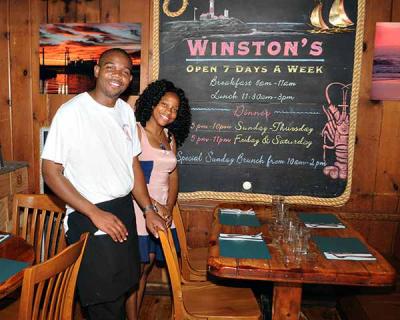
Winston’s friendly staff includes De-Andre Blackwood and Jhodia Ferguson, the manager.
Morgan McGivern
I love it when a restaurant is a pleasant surprise!
By
Laura Donnelly

Winston’s Bar and Grill

100 Montauk Highway

East Hampton

267-5400

Lunch and dinner seven days,

breakfast soon (from 8 a.m.)

Gosh, I love it when a restaurant is a pleasant surprise! I don’t know what I expected from the new Winston’s Bar and Grill where Nichol’s used to be on Montauk Highway in East Hampton, but I just didn’t expect such good food.

Nichol’s was extremely popular for many years, serving large goblets of reasonable wine and a pretty good burger and potpie. While many of my barfly friends liked it, it was never my cup of tea. As far as appearance goes, not much has changed. Many wine crate panels adorn the walls and ceiling of the small, two-room restaurant, and British memorabilia is plentiful. A Union Jack flag is stuck on the ceiling, and there are pix galore of Queen Elizabeth. One of the few hints of change are the little Jamaican flags out front.

The rooms are cozy and comfortable with brown banquettes and some tables in the front room, higher stools and bar tables in the second room, and a nook with two large tables for bigger dining groups. There are two small patios, one close to the parking lot and one very close to the highway, which on the night of our visit was unfurnished. Maybe when our population explodes this weekend more furniture will arrive.

We dined on a Sunday night, which is billed as Caribbean Night, and since the chef, Winston Lyons, is Jamaican, I thought this would mean some interesting and unusual dishes would be offered. However, other than an oxtail special the menu is pretty much straightforward seafood and meats. We began with crispy fried oysters, a Thai kale salad (Whah? How did you sneak onto the menu?), and a grilled artichoke. All three appetizers were absolutely delicious.

Apparently, Mr. Lyons worked at East Hampton Grill (along with a few other good local restaurants) for some time, and he has definitely picked up some tasty tricks from these establishments.

The fried oysters were served on thin slices of toasted baguette with a lemon aioli drizzled on top. The crisp batter was slightly spicy and the oysters were juicy within. Kale salad is everywhere, and it can be delicious when treated properly or a frickin’ nightmare to chew and chew and chew if the leaves are too big and haven’t been massaged properly and marinated into submission. This version was kale cut into chiffonade, thin ribbons, lightly dressed and tossed with crushed peanuts. The Thai flavors, a bit salty and citrusy, came through, but it wasn’t spicy or overwhelming with fish sauce. It was so good I took the leftovers home. The grilled artichoke, definitely reminiscent of East Hampton Grill’s version, was three large globe halves, marinated and charred and served with a beautifully balanced remoulade sauce.

It’s worth mentioning here that we ordered a few specialty cocktails as well. They are worth mentioning because they were so good and only $9 each. One was a watermelon Cosmo, made with freshly pressed watermelon juice, and the other was called the Eastbound Jitney, a mixture of fresh grapefruit juice and vodka. We enjoyed riffing on what the Westbound Jitney would be if it existed, no doubt three times more powerful to make the ghastly ride back to N.Y.C. more bearable. Neither of the drinks were overly sweet, which is a deal breaker for yours truly.

For entrees we tried the jerk chicken, the Fisherman’s Pot, and crispy fried lobster. Again, all three were great successes. The jerk chicken was moist and tasted brined, it was seasoned all the way to the bones. You could detect all the traditional spices like cinnamon, nutmeg, allspice, and a wee bit of cayenne, well balanced. The half chicken was served on top of fried plantains, a tasty combo of soft and sweet beneath the warmly spiced chicken.

The Fisherman’s Pot was a variety of calamari, shrimp, mussels, and clams in a light tomato sauce with spaghetti. The tomato sauce was briny and spicy, and the seafood was cooked just enough.

The crispy fried lobster (we got the smallest size offered) seemed bigger than a one-and-a-half-pounder, which was fine with us. The menu said it was served with a ginger scallion sauce, which was either forgotten or perhaps had been drizzled on the lobster and just couldn’t be detected. The crispy bits clinging to the shell may have been the same batter used for the oysters, and they were fun to chomp on with the sweet lobster meat. My guests said they would have liked some lemon butter for dipping. It was served with a little dish of shoestring plantain fries, not as crisp as potatoes because the plantains have more moisture, but a nice addition.

The service on the night of our visit could have been better, but that is only because our waiter was woefully under-trained. He was as friendly as can be but continually reached all the way across the table to deliver dishes and clear the empties. Replacement utensils had to be requested and empty glasses cluttered the table, but in the casual atmosphere it wasn’t too bothersome. The busboy was super attentive, refilling our water glasses constantly, but we were pretty sure it was because he was crushing on our lovely Kerrie. Prices are moderate. Raw bar items, appetizers, and salads are $8 to $22, entrees are $22 to $43, sides and desserts are $7.

One of the things I liked best about Winston’s, besides the food, was the mixture of clientele. Admit it, there aren’t very many places out here where you see a lot of Hispanics and African-Americans mixed in with us tighty whities, but such was the case here. Quite refreshing.

The desserts are made in-house. There were only two available this particular evening, cheesecake and bread pudding, so we tried both. They were just okay. The cheesecake was New York style, simple and fluffy with no crust and was topped with a bright red cherry compote. The bread pudding was served with a warm apple compote and was a bit dense. Both had a slight taste of refrigeration fatigue. These were the only flaws of our meal.

There are rumors that the rickety old Quiet Clam/Nichol’s/Winston’s building may be torn down at some point. If this is the case I hope it is rebuilt or that Winston Lyons can find another place in our community to serve his delicious food. Or as my friend Orlando Satchell taught me in a few words of Jamaican slang, “all fruits ripe, everything cook and curry, mash it up, Winston! Irie!”