Save trees but poison the water? That’s been the equation for the last four years since beech leaf disease was first identified on the East End.
That could be changing. A little.
Since emerging in Ohio in 2012, the disease, known as B.L.D., has quickly spread across the Northeast and has now reached as far south as North Carolina.
In East Hampton Town, the biggest stands of American beech trees are in the Stony Hill area, according to Scott Wilson, the town’s director of land acquisition and management.
“It’s anecdotal at best, but I haven’t witnessed any beech trees that were not affected by B.L.D.,” he wrote in an email. “I couldn’t say what the mortality rate is. It’s simply too early to tell. I have limbs at my own house dropping on a regular basis. The prognosis isn’t good.”
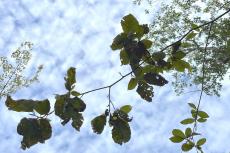
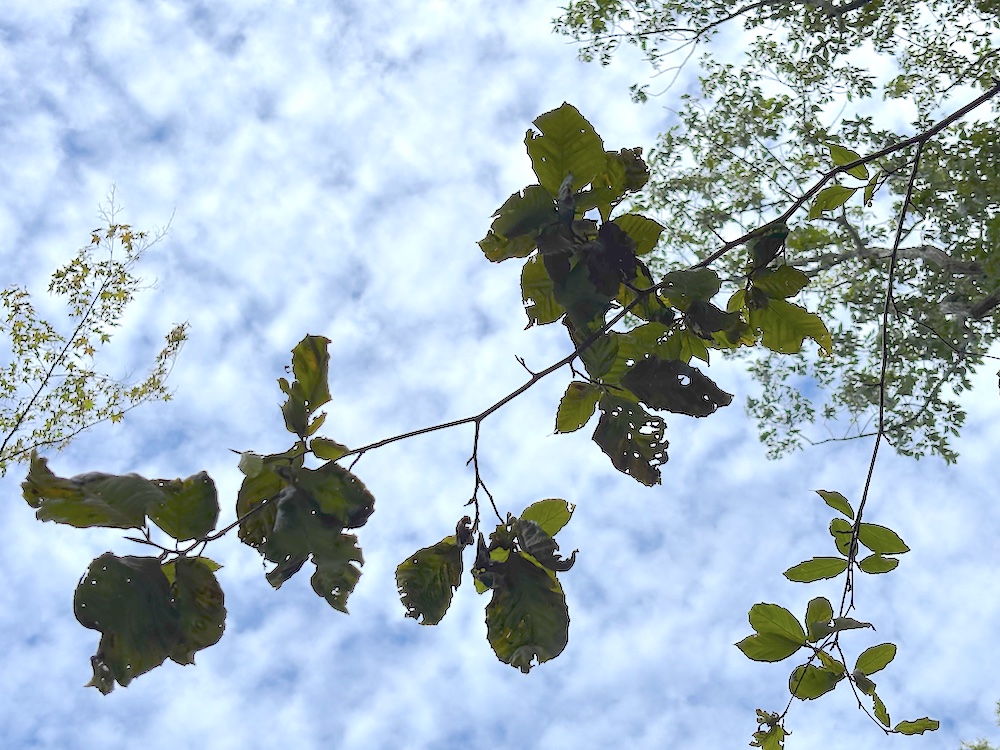
This is how the disease works: Foliar nematodes, basically tiny worms that hide inside the buds of the tree, eat essential components, slowing photosynthesis and starving the tree of carbohydrates. Affected leaves have either a striped and or leathery appearance. Diseased trees may push out a second flush of leaves in one season, but these leaves are often lighter colored and don’t provide as many nutrients to the tree.
The disease spreads rapidly, either by wind, birds, or both. It’s not yet clear.
As terrible as beech trees look locally, it’s an even worse forestry story. Beech trees are one of the dominant trees in the Northeast.
According to a 2025 study by Brianna Shepherd, David Burke, and Katharine Stuble, 29 percent of beech trees have died at a site close to where the disease first emerged. Most of the mortality is recent, coming in the last few years, with young trees dying before older trees. Areas of beech tree dominance fare the worst and surviving trees are also growing moe slowly than they did before the disease outbreak.
An Aug. 26 article in Forest Pathology, written by David Burke, Mary Mason, and Jennifer Koch, shows that beech leaf disease symptoms vary across genotypes of American beech trees, and that “Further examination is warranted to determine if this natural variation in B.L.D. symptom development can be improved through breeding, potentially producing trees with increased resistance to B.L.D.”
That could provide some hope, but meanwhile time passes and more trees succumb.
While there is no cure, locally there has been a pyrrhic sort of temporary treatment in the form of an antifungal pesticide, Broadform, that was previously banned by the New York State Department of Environmental Conservation because of its impact on groundwater.
Broadform is a mixture of fluopyram and trifloxystrobin, two chemicals with the specific propensity to last long enough to leach into our single source aquifer. So, in time, because of its use over the last few years, Broadform will show up in our drinking water if it’s not filtered out with reverse osmosis or activated carbon filters.
Broadform also readily runs off, unfiltered, in rainstorms. This compromises bays and ponds; it is toxic to aquatic organisms.
According to an August webinar titled “Beech Leaf Disease: The Latest Research and Management Strategies With Dr. Andrew Loyd,” posted by Rainbow Ecoscience (a seller of the products mentioned by Dr. Loyd), there is some limited good news in this fight.
First, Broadform has now been found to be effective in a far lower dose.
“We went big. It’s like, go big or go home, so we used pretty high rates of it, the highest maximum label rate,” said Dr. Loyd. When B.L.D. was first detected in New York, the D.E.C. gave “special local need” emergency approval for Broadform’s use in Nassau and Suffolk Counties. The label allowed pesticide applicators to mix eight ounces per 100 gallons of water. Studies now show that even one ounce of Broadform per 100 gallons of water can be effective. That should make applications less expensive and also less environmentally damaging. Edwina von Gal, founder of the Perfect Earth Project, is against the use of Broadform regardless.
“It’s a systemic poison,” she said in a recent phone call. “It works through infiltrating the system of a tree, so every part of the tree becomes poisonous, every beech nut, the pollen, every leaf is poisonous. The ground around it is poison too. Any insect or wildlife that tries to find sustenance through that tree is poisoned.”
So, if Broadform is still problematic, residents might appreciate another bit of positive news. There’s a better alternative that won’t poison the aquifer.
Bill Struss, an arborist and head of plant health care at Bill Miller & Associates in Water Mill, said he has largely switched to a product called Arbortech.
Like Broadform, it’s a fungicide, but instead of being sprayed, it’s injected. It has been used for decades to fight Dutch elm disease. “Without a shadow of a doubt it has a smaller impact on the environment than Broadform,” he said in a recent phone call.
Remember, the nematode that’s plaguing the beech tree is a microscopic worm. Gross as it sounds, Arbortech was originally formulated to attack the gut parasites in livestock. Later, it was even adapted for human use to treat roundworm infections.
It’s still not great. Mr. Struss said even though it’s not sprayed, as Broadform is, Arbortech is systemic and will bioaccumulate in the insects and birds that eat from the treated trees.
“On some level I’m sure it’s affecting them,” he said; however, he speculated it’s not affecting their life cycles. “It certainly is present in birds and caterpillars, bioaccumulating.”
He also said that depending on the tree, Arborech has the potential to be used only once every three years, which also brings down costs. Broadform is often sprayed multiple times a year.
Based on studies done at Planting Fields Arborteum in Nassau County, Dr. Loyd said Arbortech proved just as deadly to the nematode as Broadform. “Arbortech is a viable tool for an I.P.M. [Integrated Pest Management] program in beech leaf disease for landscape trees,” he concluded.
Unfortunately, Dr. Lloyd said non-pesticide treatments he studied, including a polymer film coating sprayed on the leaves, didn’t seem to be effective. He added that treating a tree in the winter when it has no buds is useless.
“There’s another alternative,” said Ms. von Gal. “Watching them adjust. They’re not necessarily going to die. We’re being fed that by the companies that stand to gain by adding product. I don’t consider Bartlett’s impartial. This is not a death sentence; nobody knows why some succumb and some don’t.”
Mr. Struss said if a tree is 60 percent foliated or less, he won’t treat it. European beech trees, also known as copper beech trees, are often used more ornamentally, and so aren’t surrounded by other beech trees. They may be faring better because there are fewer nematodes in their immediate vicinity. (According to the 2025 study, when American and European beech trees were met with the same number of nematodes, they both fared poorly. Japanese beech trees showed better tolerance.)
If disease is apparent in the springtime, a tree can be treated to provide control the following year. It’s important to have an arborist monitor the trees. They may not need constant treatment.
Ms. von Gal said now is not the time to replace dying beech trees with more beech trees.
Red maple, swamp maple, or any of the native oak trees are good options, she said, and the fall is a perfect time to plant. Another favorite of hers is the pepperidge tree. “The name pepperidge is local to eastern Long Island,” she said. The tree is more commonly known as black gum or black tupelo.
“If we don’t change our behavior we’re going to lose more and more of our native ecosystems,” said Mr. Struss. “The first problem and main leading reason in the decline of the native ecosystem is humans and the nursery trade and transporting ornamentals.”
Over and over the environment seems to be giving us the same message: Plant native species.