
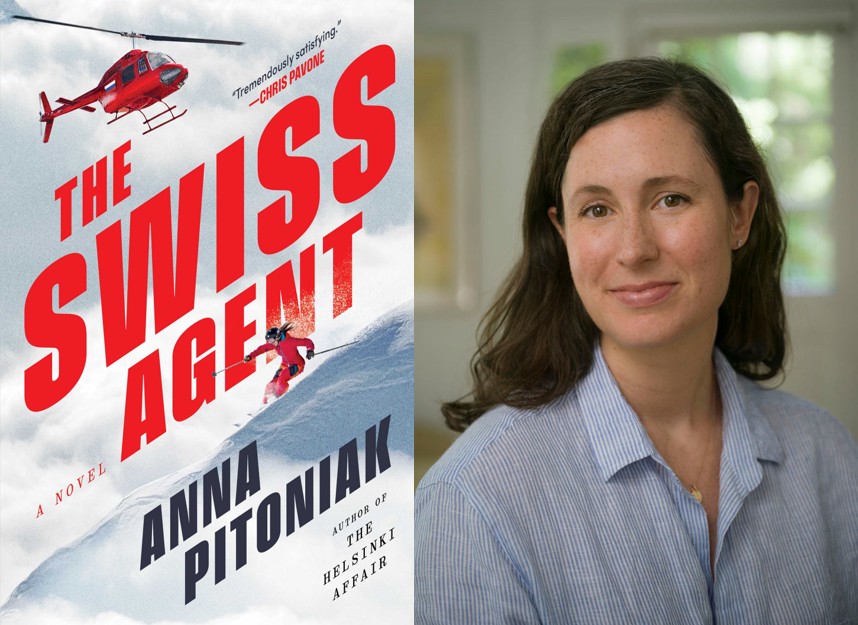
“The Swiss Agent”
Anna Pitoniak
Simon & Schuster, $29
For a "Dear Reader" introduction to her 2023 debut in espionage fiction, "The Helsinki Affair," the veteran novelist Anna Pitoniak made clear her underlying intent: to enlarge the role of women, both as major characters in the genre — neither seductive distraction nor villainous vamp — and also as authors, uniquely capable of exploring female psychology and approach in the special world of spy fiction, "the taut pacing . . . shadowy intrigue . . . moral murkiness" she so enjoys in the works of John le Carré, Graham Greene, Sag Harbor's own Alan Furst, and others.
A worthy cause in which Pitoniak takes another read-worthy step with "The Swiss Agent," returning to the gut-following, often exasperating ways of a young C.I.A. Rome station chief, Amanda Cole. But she also amplifies the role of Cole's longtime Company cohort, Kath Frost, arguably the more complex and interesting character in this new, wide-ranging international, political, diplomatic post-Soviet murder mystery.
Even if the murder and its motive are no mystery to the reader after page 8. Of course true heroines of espionage are not virgin territory in the spy genre. Le Carré's Connie Sachs, with her near-photographic recall (and to her drunken dying days), was the master (or mistress) of Cold War intel on Kremlin agents and tradecraft. Sachs is widely understood to be modeled on Britain's real MI5 mole-catcher, Milicent Bagot.
For the team of Cole and Frost, intuitions, emotions, connections, persistence, and unlikely luck are very obviously fundamental. Had it not been for the prompting of her mom, Amanda would never have gone to Sunday Mass at the venerable Rome church where a friend from French intelligence mentions his suspicions about the apparent drowning of a renowned chef on the Italian isle of Capri.
Another contact, at the American ambassador's residence, remembers that the dead chef had been working for a Russian oligarch, Yefim Volkov, known to be close to the Putin-style President Nikolai Gruzdev.
Suspiciously, if only to Amanda, Volkov has never reported his favorite employee missing. Which leads her to request a copy of his autopsy, which found in the corpse's stomach traces of foie gras — not a common dish on Capri.
So, a V.I.P. dinner party. With only one specialty food supplier on the island, Amanda quickly confirms delivery of the fatty duck liver to Volkov. And from the colleague of yet another friend, a bartender at Capri's best hotel, she learns who ordered car and driver for a dinner at Volkov's hillside address that night his chef died -- Martin Beaufoy, a NATO deputy secretary general.
Scrambling timelines as she so often does in this tale (maybe too often), we've already seen the ruthless Volkov poison his friend the chef right before Beaufoy's eyes, presumably adding life-or-death consequences to a bribe he offers the NATO man to get top Turkish diplomats behind an even bigger bribe to their nation's leader. The goal: to block a bid by tiny, war-torn Bosnia to join the European defense community. Gruzdev despises more Western encroachment on his regional pre-eminence.
Not surprisingly, C.I.A. Director John Grasko doesn't see much importance in the chef's death or the dinner, angrily demanding that Amanda steer clear. They've had their differences before. "And don't think you have nine lives in this business. Just one," he shouts. "And the deal in this one precious fucking life is that you have to do what I say."
But no. Winsome Amanda manages a far-fetched face-to-face in the Oval Office that wins plaudits from President Elian Ramos, which she takes as a green light.
Of course Amanda wants Kath, a brilliant counter-intel expert, to help analyze and foil the Russian plot, though the two have been estranged since an earlier collaboration in Switzerland that left suspicions about Kath's loyalty. At first Kath furiously opposes joining a mission to Geneva to focus on Volkov's trusted Swiss banker, Julian Schmidt, who just happens to be the former love of her life. "He was very important to me. It was a long time ago — but you understand," she explains to Amanda. "A person can get under your skin. And no matter how much time goes by, they manage to stay there."
Yet Kath is instantly back on board the mission upon learning its connection to Bosnia, major loser in an international arms arrangement she once dodged the chance to expose. "Do you know how much this could mean to Bosnia, getting into NATO?" she cries. "Do you realize how poorly they've been treated? Or have you forgotten everything they went through in the last war? I changed my mind . . . I'm going to Switzerland. This is our operation. We're doing it our way."
Kath's reunion with Schmidt — eventually involved and inevitably compromised in their Get Volkov Op — is predictably romantic, but complicated. "Being in love, the language struck Kath as correct," we read. "She was in love. She was in it, immersed in it . . . such that her surroundings, at every moment of every day, were extensions of that all-encompassing love." Delicious but clearly dangerous on a secret C.I.A. mission.
Unlike other forms of undercover action, love rarely helps defang covert Kremlin threats. And there are many memorable, if fanciful, twists and turns intruding on Kath's dreamy interlude. Her very life is endangered by one covert recording, her honor and loyalty reaffirmed by another.
The American president who so valued Amanda's tip about the Bosnia connection briefly contemplates killing her father, Charlie Cook, also a C.I.A. veteran, after he reveals that plot in the course of yet another, unconnected covert operation.
That operation involves Kremlin sympathizers in Washington sliming the Company, and America more broadly, by getting Charlie to concoct a tell-all memoir of C.I.A. mistakes and misdeeds, including as a late addition, and of course from Amanda, White House failure to act on knowledge of a top NATO official in the Kremlin's pocket.
"The ghostwriter just takes him at his word. It's not like they give a shit about fact-checking or anything like that. He can say whatever he wants," remarks another agency insider.
Not with a 10-foot pole, you say? Gullible media buy in big time: morning news, "60 Minutes," with Charlie a sudden celebrity and President Ramos deemed a dunce, outraged.
"The entire world is laughing at us," he complains. "You know what we do? We pick up a gun and we shoot that motherfucker."
In the real world, such exposure might well blow a bribery plot right out of the water. How could Turkey then publicly side with Russia? But Ramos decides to make a bold counter bid — buying Turkey's vote for Bosnia with more U.S. war planes, greater economic investment, and a state visit by Ramos himself.
By the novel's end, Amanda has come to think of her job as "a perpetual game of whack-a-mole . . . that to finish one chapter is merely to begin another." Kath is out in the cold again but turns up in Rome one day to catch Amanda on her usual morning jog. Many questions remain, but few words are exchanged.
Kath has the last. "I'll see you, Amanda. Try to stay out of trouble." But what fun would that be should Pitoniak fancy yet another sequel?
Anna Pitoniak is the author of "The Helsinki Affair," "Our American Friend," "Necessary People," and "The Futures." A former editor at Random House, she has a house in East Hampton. "The Swiss Agent" comes out on Dec. 1.
David M. Alpern was a reporter, writer, senior editor, and radio host for Newsweek magazine, including many interviews with former C.I.A. directors and top agency veterans. He lives in Sag Harbor and hosts programs for local libraries. His tribute to le Carré is at youtube.com/@tuberdma.