First established in 1855 by the United States Life-Saving Service, the lifesaving station at Napeague was rebuilt between 1888 and 1889 and used in rescue operations at that location until 1947.
After World War II, the Coast Guard, which had replaced the Life-Saving Service, began consolidating stations across the South Fork, shutting down the Ditch Plain station and establishing a main one at Star Island, on Lake Montauk. However, the Coast Guard wanted to keep the Napeague structure, which had 15 rooms and weighed about 200 tons.
In part, the decision to keep it intact came down to cost. To build a completely new station would have cost upward of $140,000, or $1.7 million today. The cost to transport the building was around $35,000, or $434,000 today.
In 1954, the process of moving the Napeague station to Star Island began. It took six months in total. Before the station could be moved by water, it had to be transported over land, negotiating railroad tracks and communications wires. Power lines had to be shut off. After the structure made it to the Napeague Harbor shore, the Coast Guard had to wait until high tide and a full moon to continue the journey.
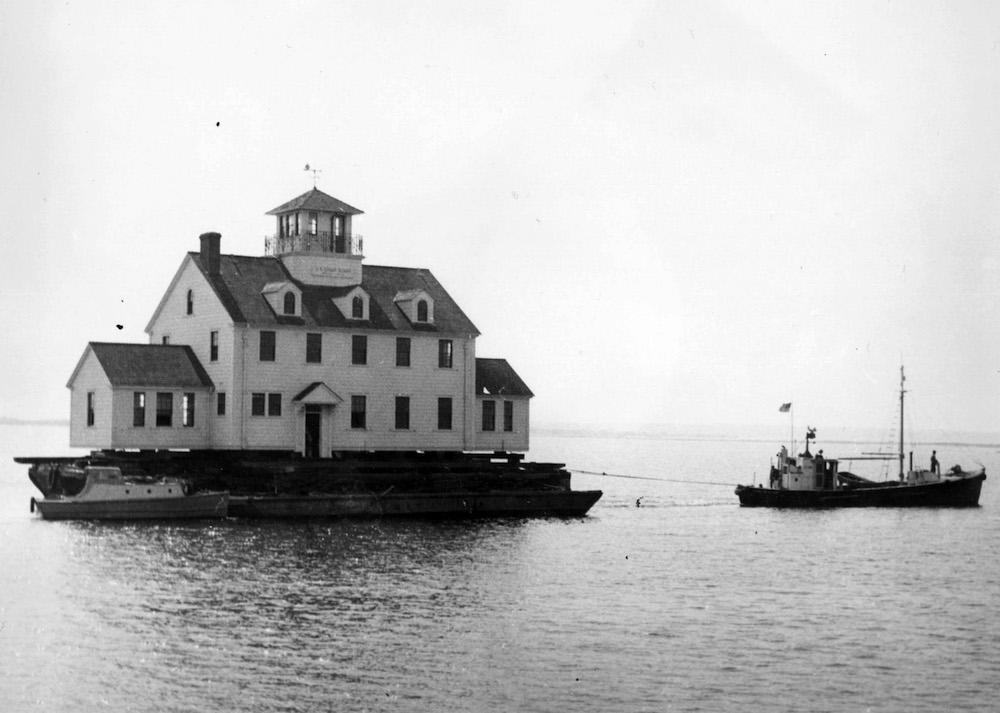
Once in the water, it had to cross about 10 nautical miles over Napeague Bay to Star Island, pulled by tugboats, as seen in this photo taken in 1954 by Eunice Telfer Juckett Meeker (1914-2000), a prolific local photographer. During this phase of the move, the building got blown into a sandbar during a storm. It took two months to free it. The station made it to Star Island on March 22, 1955, and still operates there for the Coast Guard today.
—
Kristen Ahearn is a former librarian and archivist for the Long Island Collection.