Never has a group of people been happier to talk about human composting than at Edwina von Gal’s Perfect Earth panel discussion on green burial held at the LongHouse Reserve on Sunday.
It all began when Ms. von Gal was at a recent dinner. “It turned out that out of 14 people, 12 of them had somebody’s ashes in their home,” she said. “We do not get our bodies back to the earth.”
She decided to explore how to do that.
“Raise your hand if you’re a death doula,” Gabrielle Gatto, the manager of public programs at Green-Wood Cemetery in Brooklyn, asked, sort of like a D.J. at a wedding asking everyone to put their hands in the air and say “Yeah!”
Three women, in an audience of roughly 60, raised their hands, certainly a higher percentage than exists in the general population.
Ms. Gatto is also a death doula. She explained how once she eased a woman toward death using the Patrick Swayze film, “Dirty Dancing,” of which her client was a fan. “There was a TV in the room. I logged into my Amazon account and put it on. I didn’t want her to leave without hearing Patrick Swayze’s voice one more time.”
“When I got into this business in the early 2000s, 7 out of 10 people were buried,” said Darren Crouch, the president and co-founder of Passages International, a green funeral provider, which promotes environmentally-friendly options for end-of-life rituals. “Today, 7 out of 10 people are cremated. That number is projected to go up.”
Turns out though, cremation, what with the ovens and the exhaust, isn’t the greenest way to dispose of a human body. Ashes also contain high levels of salt and phosphorus that make them essentially toxic to plant life.
Joseph Charap, vice president of landscape at the Green-Wood Cemetery, said his team mixes ashes with a product appropriately named Let Your Love Grow, which neutralizes the toxic elements. “We dig a hole, place the remains mixed with this substrate at the bottom of the hole and sell them as tree lots,” he said.
So that’s one way.
Then there’s terramation, in which bodies are gently tossed hither and thither, becoming a light mulch in only 40 days.
Shortly after the law allowing terramation in New York was passed, in December 2022, Mr. Charap said his cemetery began looking to bring the process to its grounds. Along the way they consulted with an expert in large-cadaver composting (“their claim to fame was that they had composted a whale”) and now Green-Wood is building the first terramation facility in the state, a 14-pod site.
“The process of terramation goes like this,” he said matter-of-factly, to the suddenly silent audience. “A body is placed on a substrate of organic material: hay, straw, alfalfa, wood chips, leaves. It’s in a large tub. Think of it like a recycled bathtub with a lid. The lid is closed. The body is then rocked gently for 15 to 20 minutes in 145-degree arc. Oxygen is pumped into the chamber, and at the end of 40 days, the body is no more. The body is turned into organic matter.”
Then the compost is cured for another month.
If instead, you picture yourself as part of the sea rather than as a tree, there are options. Amy Cunningham, a death educator and funeral director, explained Eternal Reefs after a question from the audience.
“They take cremated remains, mix it with concrete, sculpt it into a ball, a porous ball that is lowered into the bottom of the ocean at particular sites in Florida,” she said. “They give you the opportunity to have a little plaque. You could scuba dive down there and visit your loved one.”
Then again, maybe dying isn’t your thing at all.
“You don’t have to die,” said Faith Popcorn, a futurist. “Here’s how it goes,” and she launched into an explanation of what she called “uploading.”
“Consciousness is currently being uploaded,” she said. “You, your brain, your history is being uploaded. This uploading can also read the newspaper and other things, so it’s up to date. It has your voice. It has your personality. It knows everything you’ve ever said and done, and it keeps learning.”
Sure, there were details to be worked out, and uploading could create issues for inheritance lawyers and religion, but that was not Ms. Popcorn’s concern.
“Ashes to ashes, yeah, that’s the body,” she said. “But the mind and the consciousness will go on. I want to live long enough to hear my dogs talk. Just when you thought things were nice and you could just disintegrate on some flowers, you see that it’s more complicated than that.”
You could also do the opposite and simply step back in time.
“Green burial is just back to the frontier of America,” said Ms. Cunningham. “The way we used to do, with no chemical embalming, no concrete box in the grave, just having a grave in the earth and a bathed and wrapped deceased person. In some cemeteries, you don’t even need a casket.”
“It’s just returning the body to the land, the land from which we sprang, ashes to ashes dust to dust,” she continued. “It’s as simple and as elegant a disposition as any can be, and our teachers are the Jewish people and Muslims, because both of those religions honor the dead by returning them to the soil. We want the body to decompose. We’re done with that old-fashioned notion of, ‘Oh, you have to preserve them. You have to put them in a 20-gauge steel casket.’ “
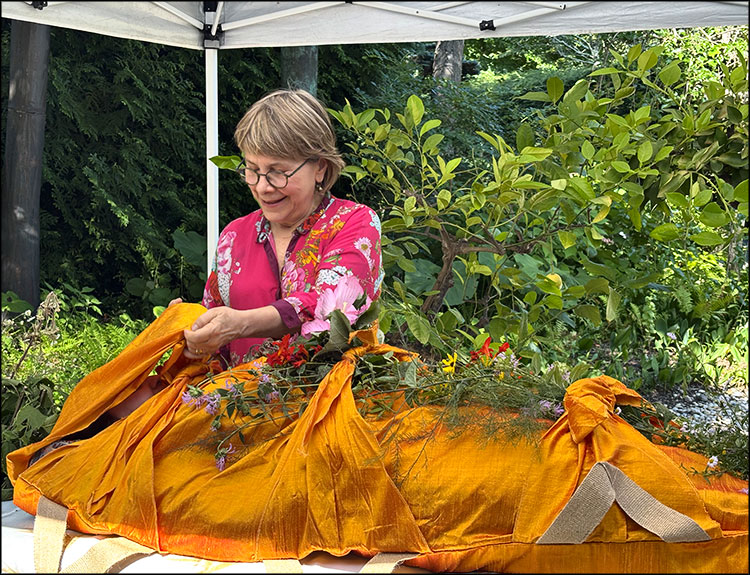
Green burials are often more informal too, she said. Families can lower their loved one into the ground themselves. They can shroud the deceased in beautiful fabrics.
An elderly man nodded when she explained how beautiful it can be to “deliver a deceased person to a beautiful natural setting” and how “grieving people need to be out of doors.”
“Folks leave these ceremonies feeling so uplifted,” she said.
After the group shared how they’d like to be disposed of, the audience of about 60 mulled and spoke with vendors. There were examples of biodegradable caskets, urns, and shrouds.
Meanwhile, Ms. Cunningham was doing a shrouding demonstration, wrapping a brave volunteer in orange silk that was complete with handles.
“People come out of the experience feeling like they did something so courageous, beyond their understanding. And it’s such a simple thing,” she said.
“And if you didn’t have the handles?” asked a woman.
“Funeral home people are very gifted,” said Ms. Cunningham reassuringly. “Often that’s how they use a bottom sheet. They use it as a hammock.”
Over at a table, Hye Kyung Lee, director and chairwoman of Aeon Woods, a not-for-profit conservation cemetery, told one onlooker about the model.
“Many folks that run conservation cemeteries have the ethos that you’re not necessarily using this one spot for this one person forever,” she said. “We’re burying you under conditions that will fully biodegrade you, including bones. If that’s the case, there’s the ability to use that land more responsibly.”
Her cemetery waits 75 years to reuse a burial plot.
“We feel that time is reflective of the time span of the surviving family of the person that was buried. We want up to their grandkids to come and visit,” she said.
Of course, that’s assuming you choose not to get uploaded.