“There is a natural way,” began the advertisement in the July 9 issue of The Star. “Did you know that East Coast redwoods could be one possible safe and affordable long-term solution to climate cooling?”
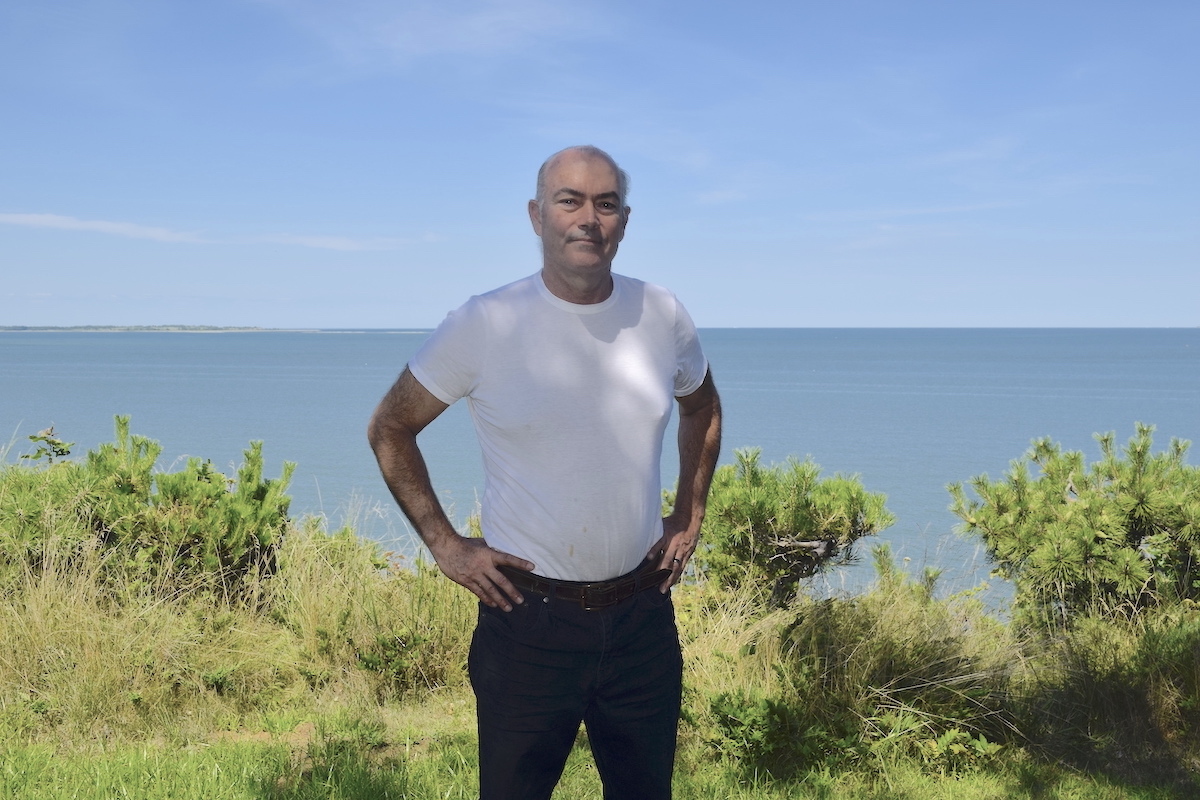
Rivers Burke was on the road in Pennsylvania, on his way to East Hampton Town from his 15-acre farm in Ohio with around 10 saplings when The Star contacted him on Sunday. A nurse, he typically spends three weeks caring for Mary Stone, a Springs resident, then one week at home, and then repeats the cycle. “I try to plant a few trees each time, along all the rest stops,” he said.
In Mr. Burke’s advertisement, he offers to plant redwood saplings, at no cost, “for you and perhaps each member of your entire family soon too.” Each of 100 giant sequoias he has planted between Ohio and the South Fork, his advertisement states, “are the largest living trees by volume and will capture and sequester my life’s entire carbon footprint and yours in its trunk and store it for over 3,000 years,” unlike shorter-lived trees that will release carbon at the end of their life span.
The coast redwood, found in the climate of the Northern California coast, is the tallest tree on earth, reaching up to 370 feet. Its close cousin the giant sequoia, found in the dry terrain of the Sierra Nevada mountain range, is the largest tree on earth by volume. Though species like eucalyptus sequester carbon faster in their youth, the giant sequoia locks away carbon for centuries or millenniums. The General Sherman Tree, which is still growing in California’s Sequoia National Park, stores around 392 metric tonnes of elemental carbon.
According to the Save the Redwoods League and Cal Poly Humboldt in California, research “confirms the exceptionally large role that redwood forests can play in California’s strategy to address climate change. The research demonstrates that old-growth redwood forests store more carbon per acre than any other forest type.”
On the South Fork, where an impact of climate change is seen wherever vast tracts of woodland have been decimated by the invasive southern pine beetle, Mr. Burke hopes to plant as many redwood and sequoia trees, both of which are highly fire resistant, as he possibly can, in the process inspiring others to take up the cause. “I am determined to find a way to plant a million more trees,” he wrote in the advertisement, asking, “Why can’t I, with some help from people like you” who are “concerned about their carbon footprints and would like to actually do something about it!”
“Growing up, I guess I was always a tree-hugger,” he told The Star. He is inspired, in part, by Benmore Botanic Garden in Scotland, where in 1863 James Piers Patrick, a wealthy American, planted Redwood Avenue, 50 giant sequoia saplings grown from seeds imported from California, 49 of which remain, each more than 160 feet tall. Mr. Burke has mimicked Redwood Avenue at his Ohio farm, he said.
Further inspiration comes from the Archangel Ancient Tree Archive, the missions of which are to propagate the world’s most important old growth trees, archive the genetics of ancient trees in living libraries, and reforest the earth with the offspring of those trees. The organization partnered with Arboretum Detroit to plant a giant sequoia forest in Detroit’s Poletown East neighborhood, using saplings cloned from California trees to transform vacant residential lots into urban green spaces. Local youth planted the trees, in the process learning about tree care and environmental stewardship.
“What they’re doing in Detroit,” Mr. Burke said, “taking abandoned homes, bulldozing them, making redwood forests to improve air quality, curb pollution, taking a dilapidated part of downtown Detroit and turning it into a future redwood forest — that’s my ultimate dream. Once I realized that, I said I can do my part. It dawned on me that this is accessible to everyone.”
While planting as many trees as he can, Mr. Burke is refining his strategy. “I am attempting to plant trees as far east — because I travel this way — as I can on this continent to see how close they can survive next to the water,” he said. He has planted in sand, on hilltops, and in valleys, “trying to find out what soil types, elevations, and conditions they require.” He mused about a north-to-south planting sojourn, “but they’re growing in Wisconsin and down in Southern states already.”
“From my point of view, the more plants we put in the ground, the better,” said Tony Piazza of Whitmores Tree Farm in East Hampton. “Just get trees in the ground, that’s what I tell my clients.”
While the late architect Norman Jaffe planted sequoias at Sam’s Creek in Bridgehampton, Mr. Piazza said, redwoods and sequoias “just don’t get as tall” in the Northeast. A native tree such as an oak, he said, “will sequester a lot of carbon and live for hundreds of years.”
In an age of digital devices, social media, video games, and seemingly endless screen time among young people, “we need to get kids excited about trees,” Mr. Burke said. “When you plant one, now you’ve become attached to it, in a way. You come back to that spot to see how it’s doing, you have some connection with the tree. If you can get a kid excited about that, throughout his or her life they teach others to do the same thing. I’m just trying to spread the idea that this is what we need to do. If you have a parcel of land, a backyard, plant a tree, something that’s going to have a long legacy.”
Through the project in Detroit, he realized that “it doesn’t have to be 100 acres,” he said. “It can be a half-acre. Put trees there, something that will be permanent. We have to plant with this intention.”
While replanting forests can help cool the planet, cutting greenhouse gas emissions remains essential to minimize the impacts of climate change. But “I believe we need to start planting trees with the intent of growing long-term carbon sinks right now and everywhere we can,” Mr. Burke wrote in his advertisement, while “giving science a chance to find other solutions.”