Cole Brauer, the first American woman to sail solo nonstop around the world, finished second in the 2023–24 Global Solo Challenge, in which she was the youngest, smallest, and only female participant. A 2012 graduate of East Hampton High School and a member of its athletic hall of fame, she has just released her first book, “First Light: Sailing Solo but Not Alone.” Brauer spoke with The Star about her life at sea, her love of sailing and her blue-collar roots — a Bonacker through and through.
“The first spark of my love for sailing happened on a boat that had no sails, no winches, and no ropes. It happened on a 104-foot fishing trawler that smelled of bleach and rubber boots. The boat’s name was the Viking Starship, but I was really there because of Little Al. I was seventeen, and he was a twenty-one-year-old tall, super-skinny skater boy, covered in tattoos. His pants were always falling down, and he had a mess of dirty-blond hair popping out from beneath the flat-brimmed cap he always wore. I thought he was the cutest thing on the face of the planet, and he looked at me the way nobody else ever had then or has since,” she wrote in the prologue to the book.
It’s hard to imagine a less likely origin story for a championship sailor — first falling in love with the ocean aboard the Viking Starship, swept off her feet by Little Al. But somehow, the narrative fits Cole Brauer perfectly.
Growing up in Springs, the daughter of a construction worker and a dance-store owner, Brauer believed the best jobs for kids like her were in restaurants, landscaping, construction, and fishing. She worked at a surf shop in Wainscott before getting fired from 668 the Gig Shack in Montauk for refusing to clean the toilets. Hers was not a fancy life.
“I had met Al, we got together and he was like, ‘Oh, you should just come out fishing, you know, you can make quick tips.’ And I went out fishing, and I realized that it was more than just fishing. This was actually becoming something that I could see myself doing for the rest of my life. And it wasn’t the actual fishing part, but it was getting my hands dirty, being out in nature, being so far away from land that you can’t even see land anymore. And it was an absolute no-brainer to me that that’s where I wanted to go and to be.”
It would be years before Brauer started sailing. In high school, she said, her friends were waiting tables at the Devon Yacht Club, not boating there. Brauer ran track for East Hampton — a 3,000-meter specialist — and calls herself a “dirty Springer,” who spent more time getting in trouble as a teenager than getting out on the high seas. She credits Adam Fine, then her principal and now the district’s superintendent, and her teachers with letting her be herself while pushing her to be her best.
“I’ve always said that East Hampton High School was a great high school for me. It taught me how to be strong. I had fabulous teachers and they pushed me super hard. I wasn’t a great student at all and that didn’t matter. They weren’t going to ruin my life just because I was a bad student. They were like, ‘No, she’s going through a phase,’ “ she said.
Brauer is especially fond of Fine, who, she said, still has a picture she took for her Advanced Placement photography class hanging above his desk.
“There was this photo that I had taken when I was abroad in Prague and it’s actually of the Virgin Mary, but the way that I had framed the photo, she’s quite dark and it’s quite menacing, and I wanted it to be something that caused a reaction. I wanted people to have feelings, you know? And I was told that it was too controversial to be put in the gallery. I had brought it up with him, and he saw it, and he was like, ‘This is amazing. Will you sign it for me? And I’ll hang it.’ And he did. To this day, he has it above his desk. And so when I went back after 12 years, there it was above his desk, still there with my signature and everything. I started crying because I was like, ‘Oh my God, you kept it.’ “
Brauer’s parents, Kim and David Brauer, pushed her to go to college after high school, hoping it would help her find an easier life. They didn’t want their daughter working well into her 90s, as her grandfather had.
“The majority of my friends didn’t go to college and they didn’t leave the East End. I can still go to the bar, and they’re still sitting on the same stool in Montauk to this day,” she said. “My parents were like, ‘We want to get you out. We want you to have a good life and not work hard labor,’ which is hilarious because I still work super hard labor. I just do it on really nice boats now.”
Brauer got serious about sailing at the University of Hawaii, where she eventually became captain of the sailing team.
After college, she drove up and down the East Coast, sleeping on a $49 foam mattress from Walmart in a van she said she had stolen from her father, towing boats on trailers and looking for steady work. It was hardly the better future her parents had envisioned.
That began to change in Charleston, S.C., in 2019. While working at the MegaDock aboard her own small boat, she laid eyes on First Light, the Class40 sailboat for which her book is named.
Their first trip out to sea was the beginning of a love affair.
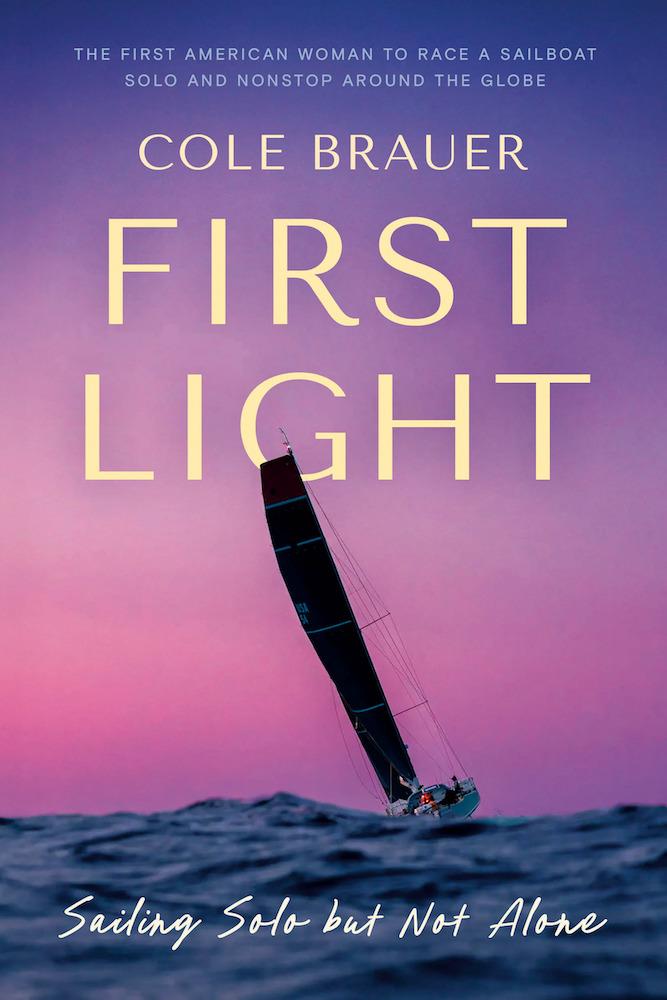
“She speaks to me. We fall in love that day. I love everything about this beautiful boat: her creaking, the flapping of the A2 in the air between waves, even the settling sound of the ropes on the winches. There isn’t a moment during those days that I don’t feel her personality. Even the practical things — the fact that she is big enough for me to stand up inside, or the ease of sail changes — speak of her kindness and generosity. She makes me feel comfortable, even though this is my first time doing solo watches offshore on a high-performance vessel. It is easy to let myself relax in her company,” Brauer writes in the book.
It was the first of many journeys she would take with First Light, building a bond she wouldn’t find anywhere else.
“It was quite emotional to find out that it didn’t happen with every boat. I kind of assumed maybe it’s me? Maybe I can be the person that tailors this and it’s not. Sometimes, it’s how the boat interacts. It’s how much time you spent with the boat,” she said. “The boat is your first life raft. It’s actually your protector. It’s the thing and the person who is there to hold you and give you confidence.”
Her connection with First Light — and her desire to change a sailing culture that did not embrace women — inspired Brauer to race around the world on her own. At 5-foot-2 and 100 pounds, she believed she would remain stuck in her career, earning less than her male counterparts, unless she found a way to prove herself.
“I had somebody the year before in a tryout tell me, ‘How could you ever believe that you could ever be on a team like this? You’re way too short for the Southern Ocean.’ And that was just the right amount of crushing that I needed to put myself into gear and say, ‘I’m going to do it solo. F these people.’ “
She also believed Mother Nature was calling her. The pull was so strong that she took on the round-the-world challenge with just four months of preparation — a wildly inadequate amount of time for a race of that magnitude.
“I had been working in the industry for about 10 years, so I knew electrical pretty well. I knew mechanical. I had made so many mistakes over the years. I can’t even tell you. There were thousands. I just made every mistake in the absolute book and then had to fix it quickly, so I didn’t look like an idiot or die or sink. And so for me, I think I was already mentally prepared long before. I think I was ready for the race myself.”
In her book, Brauer describes her 130-day trip in detail, from an early bout with an unexpected illness to the profound loneliness of being at sea solo.
“You have a lot of time to actually, like, sit with your own thoughts. And sometimes it can feel like you’re a prisoner of your own mind, like you’re in a jail cell. It’s not really until you start to appreciate the world around you, and read the clouds, and understand the weather, and let the boat speak to you. And the boat will speak to you, but you’ve got to be listening. You have to be quiet. You can’t have other things in your mind, and you can’t be battling with other things in your mind, or you can’t hear her.”
Brauer believes that ability to listen to her boat helps her sail successfully against bigger and more experienced competitors. Just seven of the 16 sailors who set out on the round-the-world journey in late 2023 completed it. Brauer beat all but one.
Toward the end of her more than 27,000-mile journey, she found herself wishing it wouldn’t end, overwhelmed by the thought of leaving the ocean.
“You have this security, the safety that you feel offshore that gets lost when you’re back on land. Once you experience that type of peacefulness when you’re offshore, even when there’s absolute chaos, that peacefulness stays with you. My heart rate really is so much lower when I’m away from land. And then when you come back, you know, you’re thrust back into it, and there’s this little bit of a depression.”
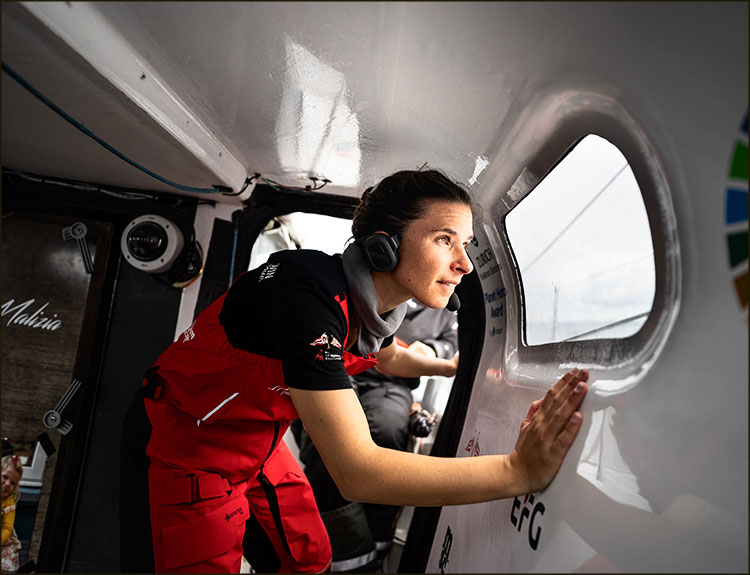
To combat that depression, Brauer spends as much time as possible at sea. She is a co-skipper with Team Malizia, an international offshore racing team that sails an IMOCA 60 and trains in Lorient, France. Next year, she plans to race around the world with Malizia. In 2028, she’ll attempt a new solo sailing record, never afraid to be alone with the sea.
“First Light” (Convergent, $28) is available now.