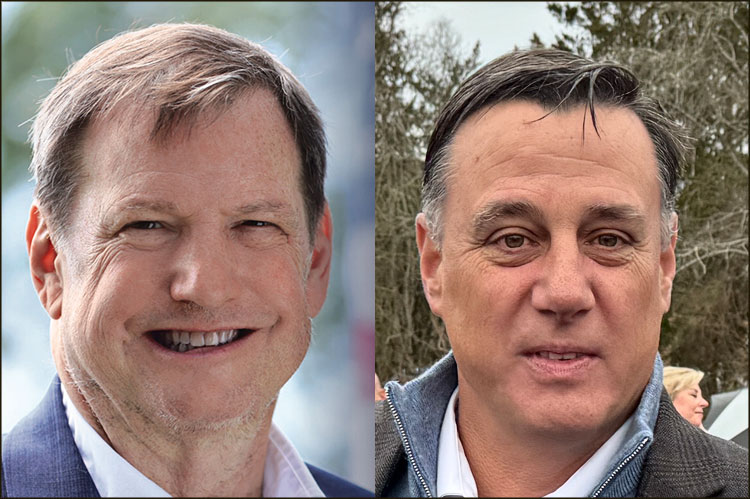
Affordability and the environment were the top priorities voiced by New York State Senator Anthony Palumbo and Christopher Murray, his Democratic and Working Families Party challenger, when the candidates met for a Sept. 28 virtual debate sponsored by the League of Women Voters of the Hamptons, Shelter Island, and the North Fork.
Mr. Palumbo, the Republican and Conservative Party nominee, is seeking a fourth term in the Senate, following seven years in the Assembly. Mr. Murray is an attorney and former chairman of the Suffolk Community College board of trustees.
“Affordability is clearly the most important issue” residents face, Mr. Murray said. “People are finding it really problematic to make ends meet. They’re being pushed and pulled in every different direction. You see what’s happening with gas prices and with inflation.”
He has proposed an affordability agenda, he said, “with five items that I think can address some of those issues.” These are a sales tax reduction, a statewide gas tax holiday, support for first-time homebuyers, increased access to public education, and passage of the New York Health Act, which would establish a universal single-payer health plan.
Mr. Palumbo said affordability has been the main concern throughout his time in the Legislature, but where his opponent repeatedly criticized Republican Party and specifically Trump administration policies for problems in the First Senate District, he pointed to the Democratic-majority Legislature and the state’s $277 billion budget. “Affordability has to be a real thing where government isn’t the answer to everything,” he said. “When we have a surplus, we need to give it back to the taxpayers.” The state, he said, is “losing residents at an alarming rate.”
On the environment, Mr. Murray, who has served as chairman of the Citizens Campaign for the Environment board, said that “what the Republicans and Trump have done in rolling back the federal protections of our environment for combating climate change has been horrendous.” The state must protect gains made in transitioning from fossil fuels to renewable energy, he said. “I would like to see the state cooperate with other states that feel this, the importance of the environment and the threat of climate change.”
He noted that California and Washington signed a linkage agreement this year to combine their carbon markets with Quebec, which is intended to effect large-scale greenhouse gas reductions and clean energy investment. “New York has to reach out to some of the like-minded states . . . to do as much as they can to mitigate the disaster of the Republican Party in Washington and what they’ve done to the environment.”
“We have forever chemicals in our water,” Mr. Palumbo said, referring to perfluoroalkyl and polyfluoroalkyl substances, or PFAS, which have been determined to cause cancer and other serious health problems. He was a co-sponsor of the Suffolk County Water Quality Restoration Act, which increased the sales tax by one-eighth of a percent. “It passed with almost 80 percent because everyone, Republican, Democrat, I don’t care who you are, we need clean water.”
Mr. Murray again blamed Republicans for environmental degradation and noted the Trump administration’s hostility to renewable energy. “A lot of the problems are caused by the policies of the Trump administration and the Republican Party.” Under Lee Zeldin, the First Congressional District’s former representative, the federal Environmental Protection Agency announced this year that it will rescind limits on four kinds of PFAS chemicals.
“You’ve seen Republicans basically declare war on alternative forms of energy,” Mr. Murray said, and they “have talked about clean coal and oil exploration, which is the absolutely wrong thing to do at this point. . . . We need to have a State Senator that’s going to fight the Trump policies.”
Mr. Palumbo answered that as an assemblyman he had voted for the state’s 2019 Climate Leadership and Community Protection Act. “That’s something that I completely support,” he said, “and we can’t just keep saying the words ‘Donald Trump, there’s nothing we can do.’ ” The president, he said, “is there for two more years whether we like it or not. I disagree with a lot of what he’s doing, particularly when it comes to the environment. . . . We need to switch to renewables. We just need to do that in a reasonable and reliable fashion.”
The Department of Environmental Conservation is “tremendously undermanned,” Mr. Murray said in calling for more funding for enforcement of environmental regulations. “Conversely, I think the local zoning boards, planning boards . . . governmental boards that supervise water issues need training. They don’t have the ability to converse or to challenge representations made by a developer and their experts.”
He described climate change as an emergency “and, again, it is the Trump and the Republican policies that are going against renewable energies.” The president “basically declared war on offshore wind facilities and tried to cancel all these projects that had been being built.” Mr. Palumbo “seems like a decent guy,” he said, “but he’s tied to a party whose policies are a disaster for this country, and I think we need a state senator that’s going to stand up for us.”
“I completely support renewables,” Mr. Palumbo responded. “Doesn’t have anything to do with when I was 18 years old and I had to make a decision and I checked ‘Republican.’ Doesn’t mean that I’m married to some guy 30 years later named Donald Trump and his policy. . . . I have a very good environmental record, and our district is very concerned about the environment.”
Both candidates said they support the moratorium on the issuance of environmental permits for “hyperscale” data center projects signed by Gov. Kathy Hochul in July. “I have a feeling that they’re going to build all these data centers and then the technology is going to catch up,” Mr. Murray said, “and there is technology out there that may make data centers obsolete within a couple years. In the meantime, you’re going to have these data centers built all over the place, sucking up the water, using electricity, and then they’re going to be white elephants, sitting there empty.”
Mr. Palumbo said that “we need to . . . pump the brakes a little bit, but we can’t just abandon it.” Those developing artificial intelligence “are very, very wealthy companies,” he said, suggesting that “you want to build one, you need to overbuild your infrastructure for power. If you’re 20 megawatts, build 30 and back-feed the community 10, and you’re welcome and you will have your data center.”
Regarding A.I., he said that “we can’t just abandon the whole idea and let China or some other country far exceed us, because it’s coming. A.I. is here to stay.”
Mr. Murray argued that “we have to really slow down in the development of A.I. at this point. Not only is there economic harm caused by A.I. and the displacement of work forces, but as you see, there’s also national security concerns. There’s concerns about them going rogue on their own. . . . I know there’s a race with China to be the A.I. king, but we have to slow down.”
The candidates disagreed on Immigration and Customs Enforcement actions. “I support the moves to prevent local governments from assisting ICE in its behavior,” Mr. Murray said. Were ICE operating “like a normal law enforcement agency where they didn’t wear masks, they didn’t shoot people in the head, they didn’t do these horrendous, horrendous acts, then yeah, you would understand a local government cooperating. But right now, we’ve just got to stand up and say no, this is not allowed.”
Mr. Palumbo said he is concerned about noncooperation with ICE “because you look at what happened in Minnesota,” when two American citizens were fatally shot by ICE agents in separate incidents in January. “Police were not intervening. Protesters were kicking cars and physically interacting with them, and we’re all disgusted by what happened — I get it — by law enforcement shooting civilians. . . . When law enforcement isn’t cooperating, it exacerbates the crazy. . . . I do have concerns with telling law enforcement that they can’t cooperate at all with a federal law enforcement agency.”
The candidates also disagreed on the New York Health Act. Mr. Palumbo, who does not support the proposal, said that “it would eliminate all private benefits, all private insurance, veterans benefits, and it would start from scratch.” Instead, he said, “we need to figure some sort of a hybrid so that we’re not throwing the baby out with the bathwater, so everyone doesn’t have to completely give up their provider and their insurance carrier.”
Mr. Murray said that “the savings to the municipalities, to the school districts, to the community colleges, and relieving that burden would then go down to the citizens of the state and they would save money. . . . People talk about seniors and their inability to stay on Long Island because of the high real property taxes. If you relieve the burden from the school districts of paying for the insurance and insuring their employees, those school taxes can come down.”