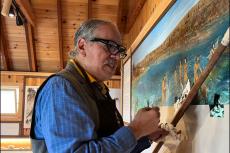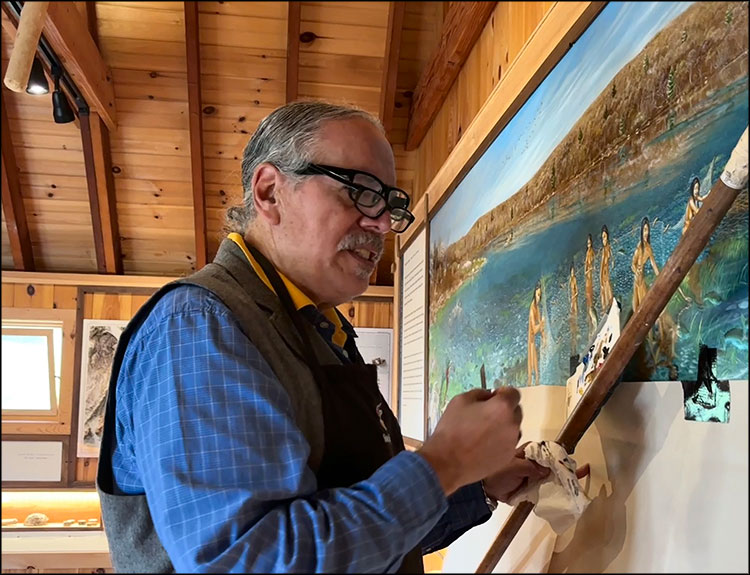
The Montauk Historical Society has appointed David Bunn Martine as director of its Montaukett Indian Museum, which is on the grounds of Second House Museum.
Mr. Martine has experience with Native American archives and collections, including at the Shinnecock Nation Cultural Center and Museum in Southampton, where he was responsible for overseeing collections and acquisitions for more than 20 years and curated and installed temporary and permanent exhibitions. He has also worked for the Smithsonian Institution, where he was involved in the transfer of some 10,000 objects from New York City to the Cultural Resources Center of the National Museum of the American Indian in Suitland, Md.
Mr. Martine, who is of Shinnecock, Apache, Montaukett, and Hungarian descent, graduated from the University of Oklahoma with a bachelor’s degree and also holds a master’s degree in education. A working artist, he has won awards for his art and was the first Native American to receive the Joan Mitchell award in painting.
As a recipient of an Andy Warhol Foundation Curatorial Research Fellowship, he wrote a book, “No Reservation: New York Contemporary Native American Art Movement” and curated the exhibition “The Old Becomes the New: New York Contemporary Native American Art Movement and the New School.”
Mr. Martine worked part time for the historical society last summer, prior to accepting the directorship of the museum, which allowed him to become familiar with the collection and evaluate the strengths and potential of the museum.
“Along with his achievements in the arts, David is extremely knowledgeable about Native history and cultures, and his degree in teaching allows him to impart information in a very accessible way,” Mia Certic, the society’s executive director, said in a statement. “Also, he has a super-friendly demeanor, which immediately sets visitors at ease.”
“This is a small space, but it’s very attractive and has been planned well,” Mr. Martine said in the same statement. “I have enjoyed augmenting what’s here by bringing in personal artifacts and illustrations, which add a human dimension to the museum and help to tell the story of the Montauketts. I think it’s important for people to understand that we are still here.”