“Three unusual hooked rugs, showing familiar Long Island scenes, will be featured at the August Hooked Rug Exhibition that will open at the Southampton Historical Museum on Wednesday,” The New York Times reported on Aug. 16, 1954.
One of those hooked rugs, created amid a midcentury resurgence of American folk art, was a stair runner by Edith Parsons, who lived on Newtown Lane in East Hampton Village. Her husband, Harry Parsons, was descended from one of East Hampton’s first settlers.
“For her stair carpet Mrs. Harry Parsons of East Hampton has used historic scenes around the Montauk peninsula,” The Times reported, “including Home, Sweet Home; Clinton Academy, the First Church and the Parsons homestead.”
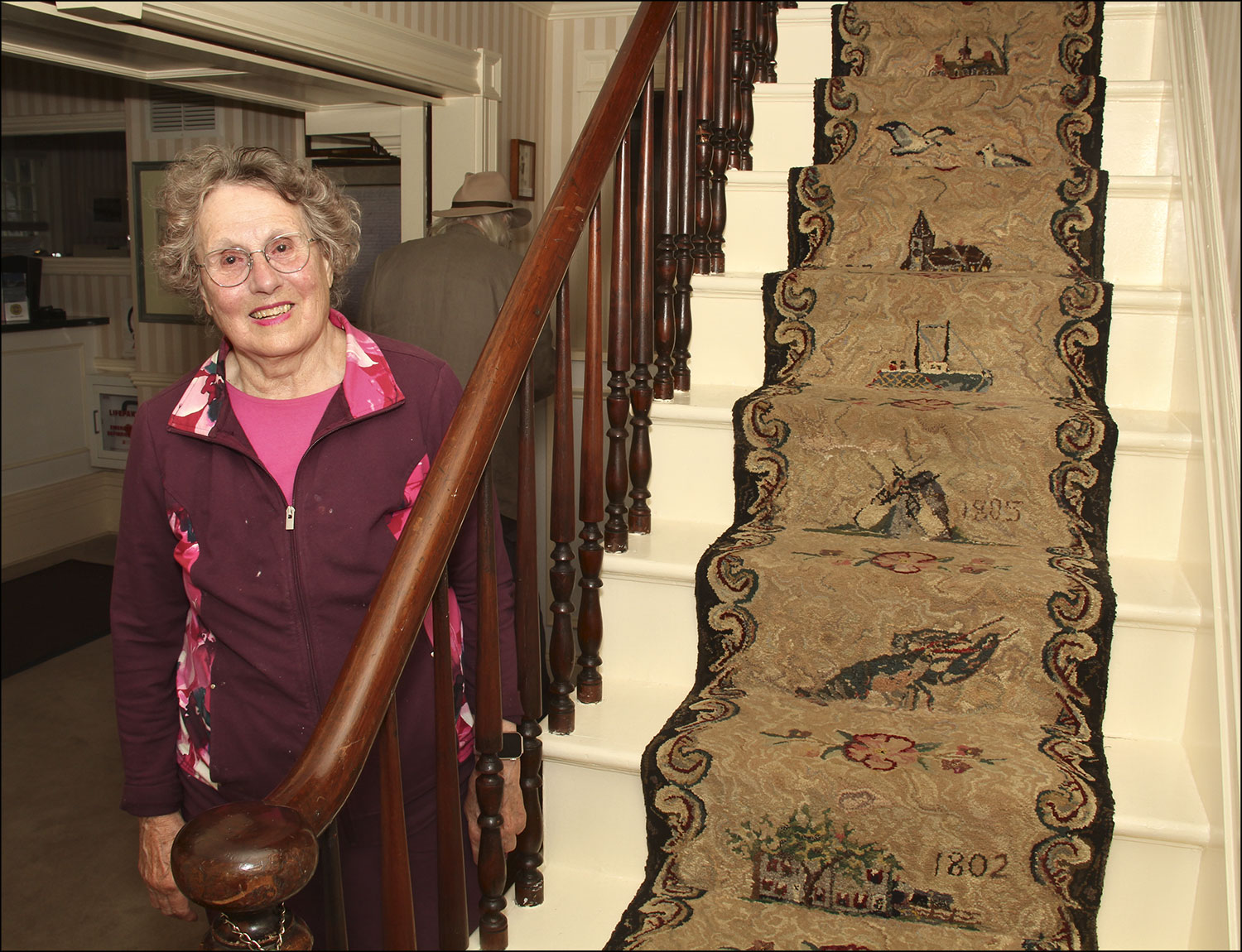
In fact, it is the Second Church, built in 1717, that is depicted on the stair runner, which was recently donated to the village by Mrs. Parsons’s daughter, Mary Ella Moeller. Also depicted on the stair runner’s 8-by-24-inch riser panels are the Montauk Lighthouse, a whale, seagulls, a fishing boat, a lobster, ducks, a windmill, and the Home, Sweet Home Museum. When viewing the stair runner from above, each step depicts a flower.
In December, the village board accepted by resolution Ms. Moeller’s donation of the stair runner and another piece, a hall runner, which she described at the time as more than 13 feet long and 2 feet wide and depicting a map of Long Island. “It’s magnificent,” she told the village board. Her mother, she added, arrived in East Hampton at age 18. She became a schoolteacher, and “then married a local man, my father, Harry Parsons.”
A second resolution, passed in June, allocated money for labor and the installation of the stair runner at Village Hall, where it now greets visitors on the staircase directly inside the front door. The hall runner is now at home at Home, Sweet Home.
The stair runner was created between 1951 and 1953, and the hall runner from 1955 to 1957.
“Some women save their pin money to buy stair carpets,” wrote The New York Sunday News on March 9, 1952. “Mrs. Harry Parsons of East Hampton, L.I., however, has approached the problem from a different angle. She’s been saving old clothing — bundles and bundles of them, which when cut into tiny strips are used for the hooked runner she has designed for the fourteen risers and thirteen treads of the stairs in her Newtown Lane home. A large section for the landing is also ‘on the agenda.’ Started at Christmas time last year, the runner is now more than a third complete, and if all goes well, Mrs. Parsons may finish it in time for Christmas.”