
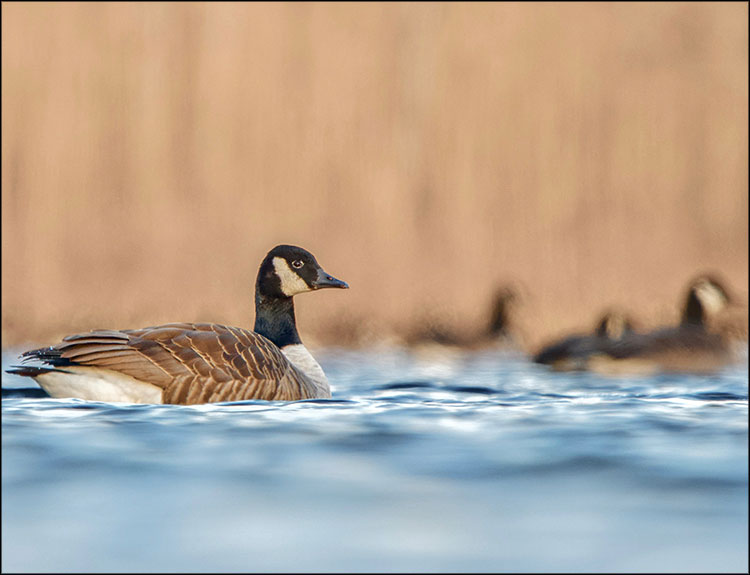
Scores of dead Canada geese half buried by blown sand in various stages of decomposition and strewn across the beaches of the East End somehow made sense in early 2026, what with the dead or dying trees, a brand-new war in Iran, and the strangely beautiful arc of the doomsday missile test-launched over the Pacific in early March.
A test and a warning, that missile, they said.
It’s enough to make one retreat to thoughts of childhood, if even in an airbrushed, portrait-lens sort of way. In the backyard it was always golden hour and there were two mourning doves in the dogwood, a cardinal in the birdbath, and healthy geese flying overhead.
Mom sat in the screened-in porch with her coffee and paper and called them Canadian Honkers. So did I. Like most things, I took them for granted. Just another part of the sky, like the clouds.
I grew up less than half a mile (as the goose flies) from the Bethpage State Golf Course, where they collected in large conglomerations, as they’re known to do, and ate grass and shat grass and honked.
Their daily migrations were the invisible thread tying me to the course and I remember them fondly.
Now, they’re an invisible thread to my childhood. They bring me to the old backyard. Mom is planting impatiens. I’m hitting rocks with my baseball bat into my neighbor’s house. She either doesn’t realize my motive, or care. It’s the ‘80s.
However, in 2026, people have found reasons to hate geese. They excrete in our parks. They get sucked into jet engines. In Water Mill, dogs are specifically trained to chase them from polo fields. Imagine that.
Then there was the first article about bird flu posted three weeks ago to The Star’s Instagram account, which elicited the following comment from @mariesworld: “Happiness is no geese in the world,” she wrote, adding the applause emoji.
At first, I’ll admit, her angry comment made me angry, because the ease with which stupidity flows through the internet makes me angry.
Oh, but then I did that annoying thing my wife always encourages me to do, where I tried for a second to understand where @mariesworld was coming from. I forced myself to wonder what sort of trauma this poor woman had suffered from geese and my feelings toward her softened
Still, as the food columnist she is, according to her bio, she should like geese. Apparently, they are tasty.
Maybe she was talking about Geese, the band?
But okay, I’ll admit at times I’ve hated geese.
Staring into fields of thousands, trying to separate the one strange goose (the East End has been visited by the rare barnacle goose, pink-footed goose, and earlier this year, a Ross’s goose) as they feed in a field, often along some busy roadway with distracted drivers blowing by at 40 or 50 miles per hour, who then sometimes yell some epithet out the window, that is, if they are paying attention to their surroundings, is my least favorite type of birding.
As a birder, I’ve long ignored these birds. Of course, that was a mistake. The trick has always been to just appreciate the thing in front of you, even if it’s a Canada goose, on its own terms, and not wish for it to be something other than what it is.
It’s like that with everything: relationships, your body, Iran, maybe your writing. I guess it’s just part of the human condition, the “compare and despair” sad part of the human condition.
Anyway, so what are these geese doing all day?
Around here, they spend the day feeding in fields and then often move to ponds, in the evening, to sleep. They are loyal to their ponds and fields.
Andrew Farnsworth, a migration ecologist at the Cornell Lab of Ornithology, says there are dynamics at work within what can appear to be steady populations, often invisible to us humans.
Some of the birds we see in the massive flocks aren’t resident geese. They’re from migratory populations just dropping in to temporarily hang.
“There are surely plenty of resident geese on the East End,” Mr. Farnsworth said in a phone call. “If you tagged and tracked them from March to May you would find pairs in the same area, starting to nest, producing young in late April. But there are migrant populations that breed much farther north.”
However, like the summer people, even those migrants are loyal to this place, returning winter after winter.
Mr. Farnsworth said that birds observed in huge high skeins are often birds traveling longer distances, perhaps to escape adverse conditions elsewhere. Large groups circling and frequently changing altitude more likely represent local movement.
While the bird flu will dent our local population (thousands have been removed from various shorelines in the past weeks), Mr. Farnsworth said in general, Canada geese are doing well.
They’re one of the only birds that have bucked the otherwise terrible trend of bird loss in the last 50 years.
“Just because Canada geese are common now doesn’t mean it’s always going to be that way,” cautioned Mr. Farnsworth. “No population is safe.”
So next time you hear a goose flying overhead, honking, appreciate it. There are a lot of them and that might be a good thing, especially if this new war goes sideways.