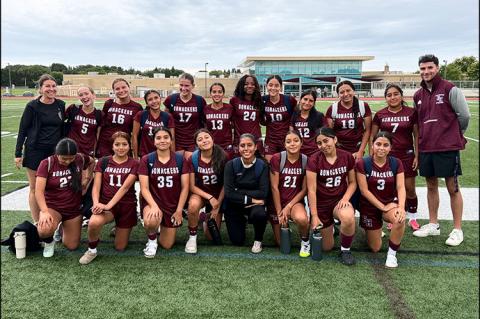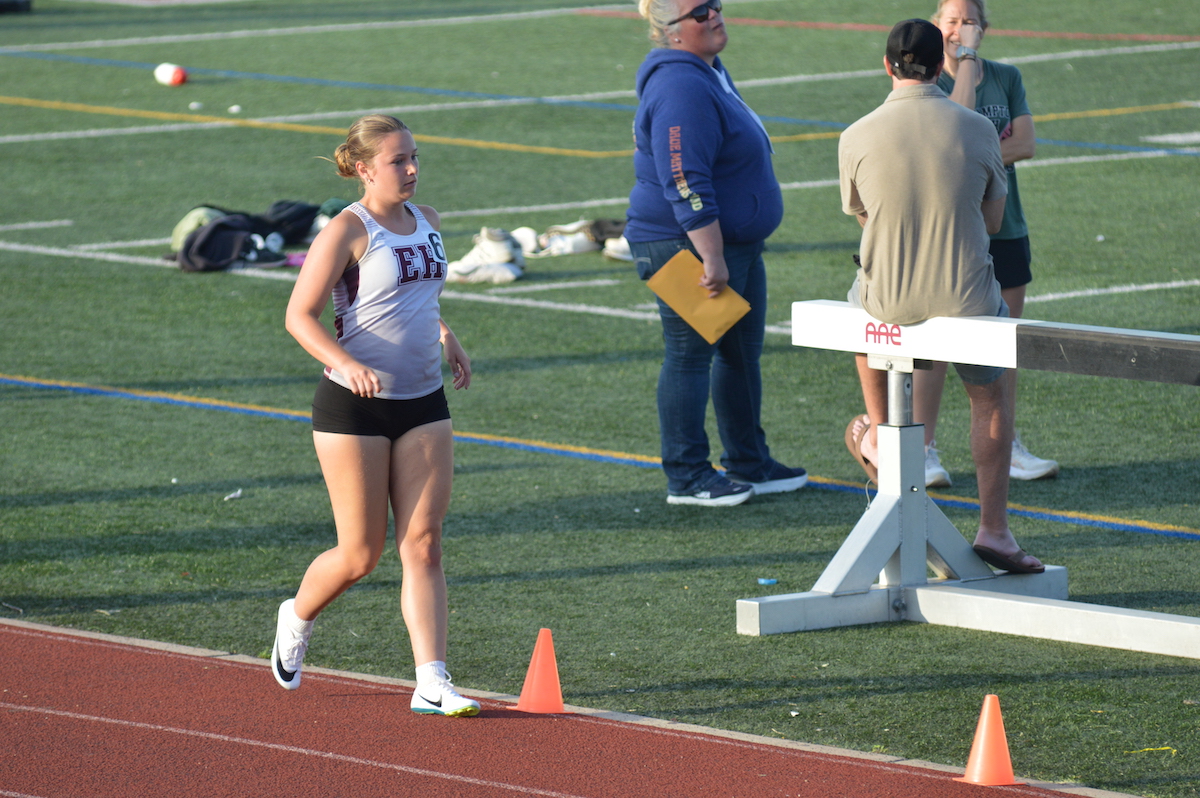
A fascinating thing has been happening on the East Hampton High School track this spring. A trio of athletes has spent most of their time walking, not running. Bennett Greene, a senior at Pierson High School, Olivia Chapman, a junior at East Hampton High School, and Olivia Stiglitz, a freshman at Pierson, are all racewalkers on the Bonac girls track and field team, tackling an event that might sound easier than sprinting but is incredibly tough to master.
“Racewalking is certainly not for the weak,” said Nick DeLuca, the assistant coach, who has developed the team’s racewalking program. “It’s a grueling and challenging event that requires endurance, commitment, and motivation. It requires one foot to always be in contact with the ground and a ‘straight leg/no bent knee’ until the leg passes under the hip.”
Greene, the leader of the group, said that often means late nights nursing sore knees with ice.
“At first it was a lot of pressure on my knees, hips, and shins, too,” she said. “After each race my knees and shins are burning, but as soon as I walk it off it kind of goes away. Sometimes I’ll stand still and have my legs together and bend my knees and bounce up and down and that helps. And I stand on one leg and shake the other leg out. Sometimes my knees can really ache — the muscle right above my knee. I had a couple of problems with that and my lower quad. So foam rolling does help.”
East Hampton didn’t have any racewalkers when DeLuca first started coaching, and the event wasn’t highly regarded. “The culture surrounding the racewalk was, ‘It’s lame, it looks silly, it’s just speed walking.’ My goal was to change that. In 2022 and 2023 we had some athletes try the racewalk; however, those athletes were sprinters. We quickly realized that sprinters couldn’t quite adapt from sprinting 100 meters or 200 meters to suddenly racewalking for 1,500 meters.”
That trial and error helped DeLuca discover that this was an event for the cross-country distance runners. He enlisted Dylan Cashin, class of 2024, a three-time state qualifier for cross-country, and she was a natural, setting a new school racewalking record of 6:57.65. “She wound up being an all-league, all-county, and all-American racewalker,” DeLuca said. “This was when racewalking became something other athletes wanted to try.”
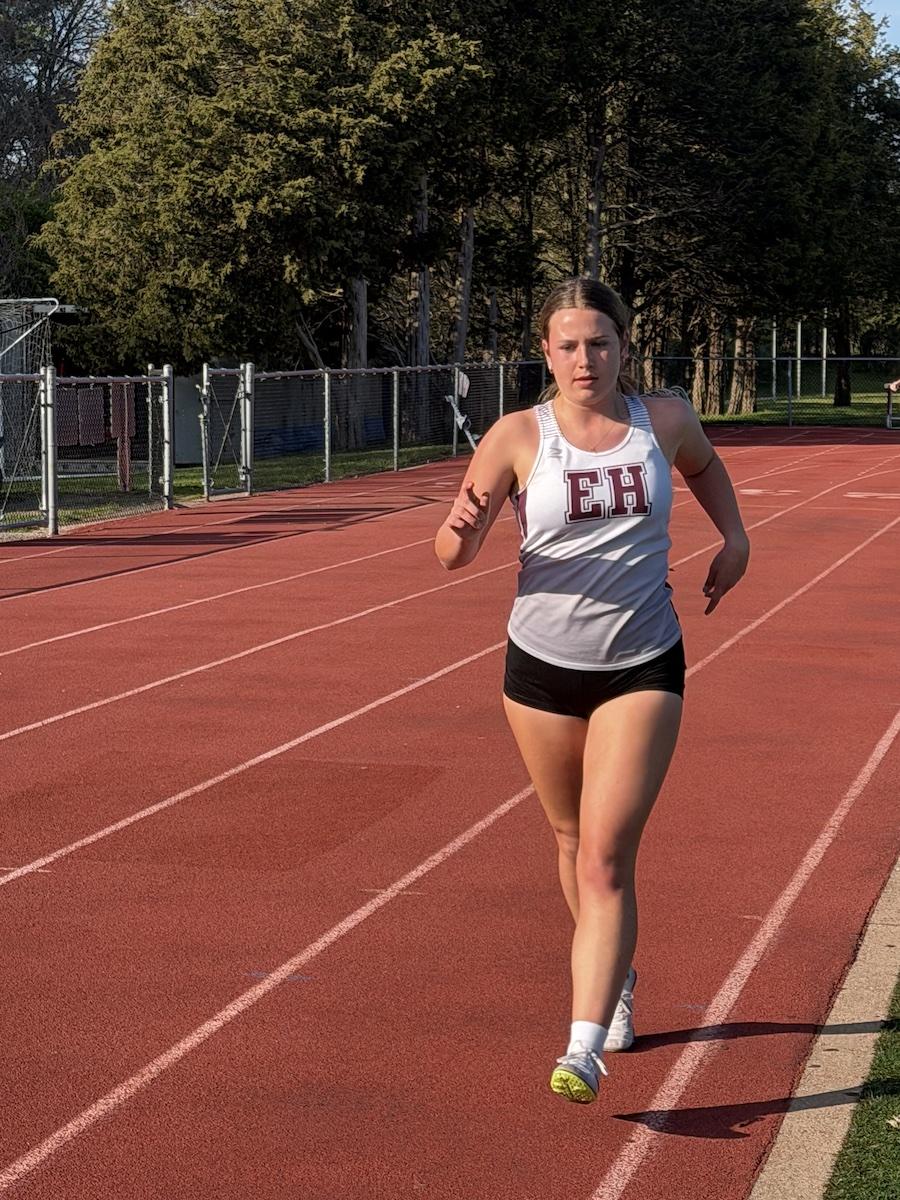
Greene started walking in the spring of her sophomore year and has had tremendous success.
“I jokingly did it at practice one time and Coach DeLuca said, ‘Oh you have good form,’ ” she said. “After he saw that, he slowly started trying to get me into it. Every race that I wasn’t doing it, he’d throw me in. Towards the end of the season, I started to like it and started getting good, so I stuck with it.”
“I really enjoy seeing Bennett improve in an event that is all her own,” said Yani Cuesta, the girls head coach. “This differentiates her from her older sister, Penelope Greene, who also ran distance for me throughout her high school career. Penelope is one of Pierson’s standout athletes of all time and so for Bennett to have this that is all her own, then there is no reason to compare. That’s the problem all students and athletes have when they have older siblings, right?”
So how does a racewalker prepare for competition? Greene’s workouts might look different, but she trains much like any other distance runner, with long runs and shakeout runs. The only difference? She’s walking.
“Most of the time Coach DeLuca will have all the distance people do the same thing,” she said. “If the runners are doing an 800-meter repeat workout, we’ll racewalk the same repeats.”
DeLuca trained himself to become better at teaching racewalking, reaching out to coaches with strong programs like Connetquot and Hauppauge to learn new drills and tips. He taught Greene, who has since trained Chapman and Stiglitz.
“I showed them the ropes and gave different critiques and advice on how to keep form,” Greene said. “I gave them motivation so they’d stick with it. I tried to make it fun. Both of them turned out to be really good.”
Greene’s goal this year was to break the 8-minute mark, something only three East Hampton athletes have done before. She came close, setting a personal best of 8:19.40 at home against Harborfields on May 4.
Stiglitz neared the 8-minute mark at the East End Classic on May 16, finishing in 8:08.70, a personal record.
Chapman also set a personal record at the East End Classic, finishing in 9:02.92.
“I know Olivia Chapman was trying to break 9 and was so close. And Olivia Stiglitz was trying to break 8. I was never able to get down to 8:00, but Stiglitz can because she’s still a freshman. She’ll be able to do it,” said Greene.
While she graduates this month, the pair of Olivias will remain part of Bonac track. Greene hopes they’ll keep racewalking alive and well for years to come.
“I want them to stick with it and try to continue to recruit people. It’s a very underrated event and not a lot of people understand how difficult it really is,” Greene said, thankful for the wonderful experience she’s had with East Hampton track. “I wouldn’t change it for the world. I made so many friendships and got so close to so many people. They were the best four years of my life because of all the connections I made through this one sport.”