
The elder of my daughters, far more up on things than I’ve ever been, walked out of Buffalo Street Books on a sunny spring day in Ithaca with Uketsu’s “Strange Pictures,” the “Japanese mystery-horror sensation,” Anbara Salam’s “The Salvage,” a “rich, gothic mystery,” according to Flynn Berry, a name that might be familiar to Amagansetters and close readers of this paper’s past books coverage, and P. Djeli Clark’s “Ring Shout,” set in 1915, when “The Birth of a Nation” casts its spell, “swelling the Klan’s ranks and drinking deep from the darkest thoughts of white folk,” the jacket copy says. Quite the haul.
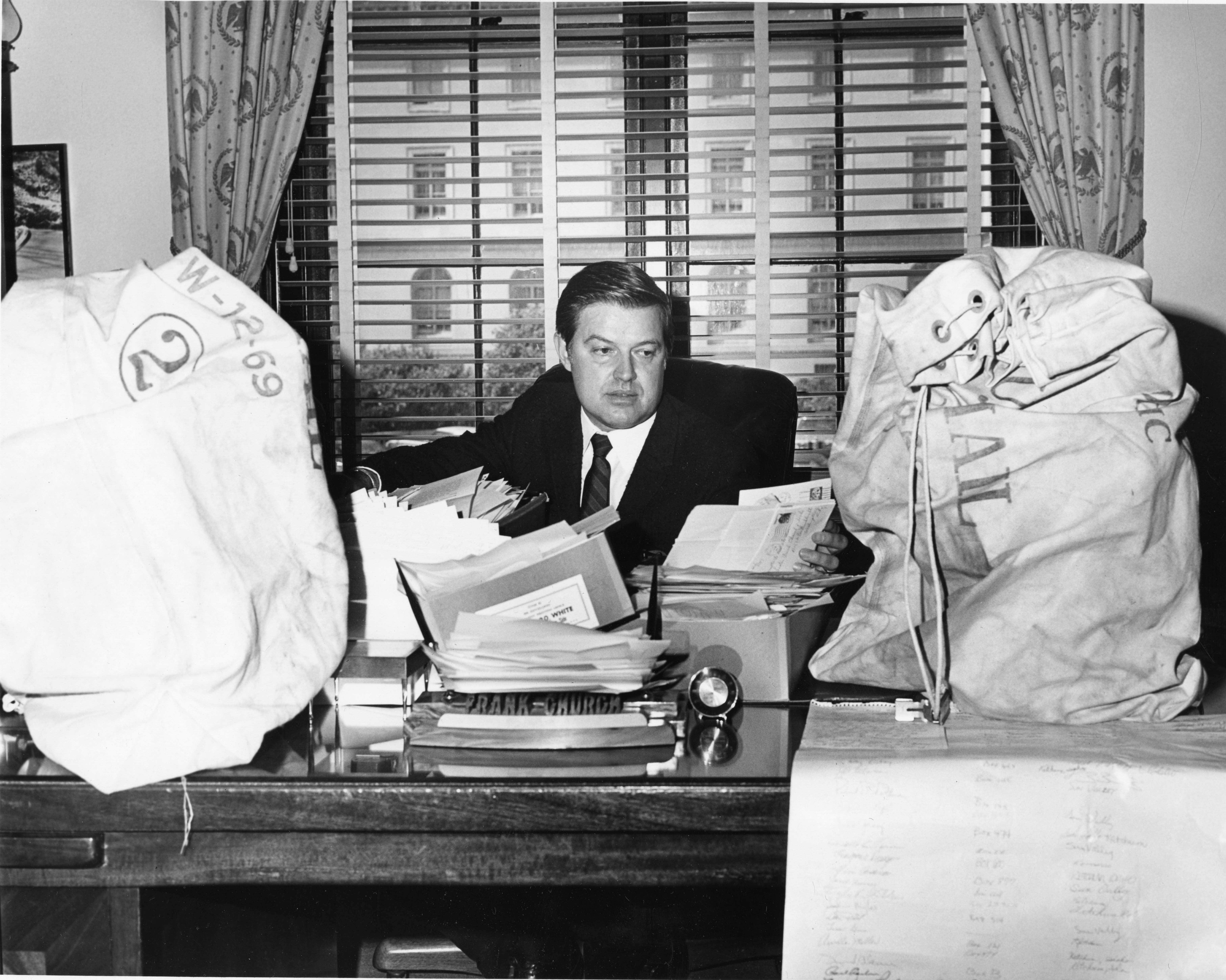
What caught my eye on those lefty shelves was the good hair and earnest visage of onetime Idaho Senator Frank Church as he held up a C.I.A. assassin’s dart gun complete with scope during a long-ago congressional hearing. This was on the cover of “The Church Committee Report,” newly condensed and readable thanks to Matthew Guariglia of the Electronic Frontier Foundation and Brian Hochman of Georgetown University and containing “Revelations From the Bombshell 1970s Investigation Into the National Security State,” in the words of its subtitle.
This is precisely the kind of vigorous self-examination the country needs today but will not be getting. The best we can do now is to take pleasure in the Foreign Intelligence Surveillance Act’s continuing failure to be renewed in Congress. In contrast, “No government document has done more to expose the mechanisms behind America’s aspirations of political supremacy in the twentieth century,” the authors write of the Church Report.
You want depravity? “Three witnesses who cooperated with the Church Committee,” Guariglia and Hochman add, “were murdered in the months surrounding the publication of the final report.”
On the domestic front, of course, there was F.B.I. Director J. Edgar Hoover. He died in 1972, “three years before the committee began its work,” the historian Beverly Gage writes in the foreword. “But as the committee’s staffers soon learned, his confidence that no outsider would ever see his files meant that those files were remarkably candid about the Bureau’s secret methods, illegal practices, and political intentions.”
Targeting dissidents isn’t a barrel of laughs. “The F.B.I.’s Effort to Discredit Dr. Martin Luther King: 1964,” as a chapter subsection puts it, is particularly depressing. But with the healing distance of time, the sheer persistence and number of attempts to discredit the civil rights leader, thoughtfully laid out and broken down by category, border on the comical: “with the White House,” “with the Congress,” “with Universities,” “with Churches,” “with the Pope,” “during his receipt of the Nobel Peace Prize,” not to mention the “attempts to block Dr. King’s publications” and the “unsuccessful F.B.I. attempts to locate financial improprieties.”
The efforts to blackmail him and encourage his suicide? Not so amusing.
I’ve only just stuck my toe into the volume’s depths. We can all simply be glad it exists.