Beech leaf disease. Southern pine beetles. Laurel wilt. Development.
The challenges to trees on the East End are many and protections few. The East Hampton Town Sustainability Committee seeks to change that.
Nearly a full year after it made a presentation to the town board about the need for a tree protection ordinance, and after a recent high-profile removal of a century-old, healthy tree at the north end of Newtown Lane in East Hampton Village, on Aug. 11 the committee asked the board to begin drafting legislation.
“Tree protection ordinances are municipal bylaws enacted by local governments to protect trees and other important vegetation by establishing legitimate oversight and/or requiring permitting for certain tree-related activities and setting required replanting standards commensurate to the tree loss,” Jaine Mehring, speaking for the sustainability committee, told the board.
How to judge what is commensurate with an ancient tree is just part of the challenge of drafting code. Some would say a tree like that is irreplaceable.
The board agreed to lend staff to the difficult task.
The stories of lost trees go beyond Newtown Lane, which is not in the town’s jurisdiction.
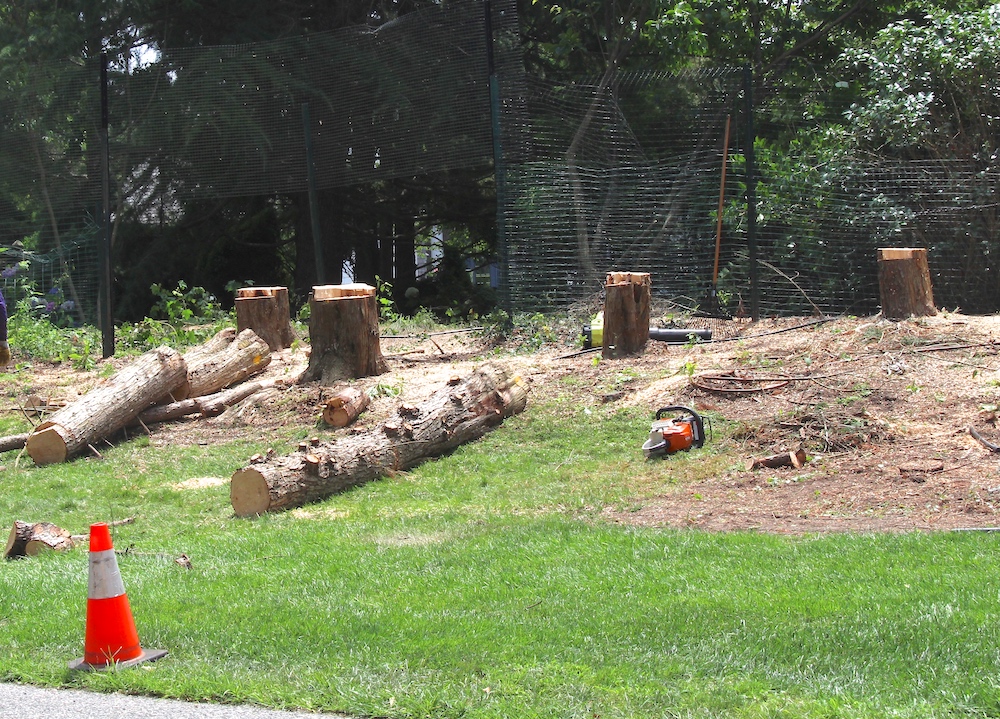
“One of the things we hear so much from people here is, ‘Oh, so and so clearcut that property.’ They didn’t even have a building permit, and they don’t have to cure it,” said Ms. Mehring.
Councilwoman Cate Rogers, the town board liaison to the sustainability committee, read a letter to the board from Gloria Frazee, also a member of the sustainability committee, relaying an all-too-common experience for town residents.
“Over the past few years,” she wrote, “it’s felt like every few weeks you turn a corner and there’s a big empty hole where a tree grew tall.”
Carol Steinberg, a resident of Springs, called to relay her experience with a neighbor.
“The owner over-cleared the property, cut down an entire acre of trees, and those trees are gone forever. They’re mourned by the entire community. They were replaced by five or six little spindly trees, and that’s just not enough,” she said.
There’s a need, community outcry, and the educated group willing to push the board is the sustainability committee that spent the last year poring over 30 various tree protection ordinances in other New York jurisdictions to compare them and assess their efficacy.
Still, despite that, perhaps because of their experience changing the gross floor area law, during which it had 14 work sessions on the topic but still faced industry criticism, the town board was cautious.
Call it tree-pidation.
Board members seemed eager to make obvious their support for industry professionals, builders and surveyors, and called for them to be engaged in the process. Hiring town staff to support the potential new code was floated.
“I want to make sure that the regulations are respectful of practicality and how people are able to accomplish things,” said Councilman Ian Calder-Piedmonte. “I hear a lot from people about how sometimes it can be difficult to work with East Hampton because of our regulations.” He also worried over the costs to the “average homeowner.”
Councilman David Lys identified some issues: How the tree protection ordinance might affect solar installations and how the town would define a “pre-existing nonconforming” lot in a place that was once almost entirely farmed and cleared.
“I fully recommend bringing in the business committee but also maybe other arborists that we see in the community that can give them their advice,” he said.
“I’m cautiously optimistic with this because I think that there’s not one person in this room who, when they drive down Newtown Lane and they see that tree missing, doesn’t think
something went wrong,” said Councilman Tom Flight. “Something’s wrong with the system if a tree like that can be taken down. That said, I do think we have to be cautious with property owner rights here.”
“As you draft this code I would like to have someone from the building industry on that committee,” Mr. Flight continued. “I want to protect the trees, but I don’t want to add six to eight months onto a project because we cannot operate efficiently. I’m just very cautious of introducing this without a means of making it work.”
Ms. Rogers suggested drafting the code in stages, garnering community support along the way. “The process is the most important part,” she said. Receiving advice from a surveyor is important, she added, because they’re the ones responsible for mapping what counts as cleared on a parcel.
Ms. Mehring ran through 10 essential elements of successful tree codes and provided links to a dozen codes her committee found most pertinent. The analysis was exhaustive. She took the board through a 62-page presentation (in 2025 it was a 68-page presentation) including definitions of what a tree is, what constitutes a removal, and what rises to the level of violation.
Generally, she said, there were two types of violations: removing a regulated tree without a permit and not replanting or not complying with the terms of a permit.
“Drafting, implementing, and enforcing T.P.O.s can be challenging and sometimes a little controversial, but I guess our question to the board, and to each other, is: ‘If so many other places can do it, why can’t we?’ “ she asked.