Zach Studenroth says he can tell the age of a gravestone from a half-mile away.
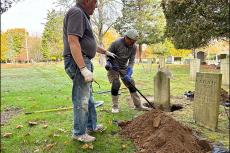
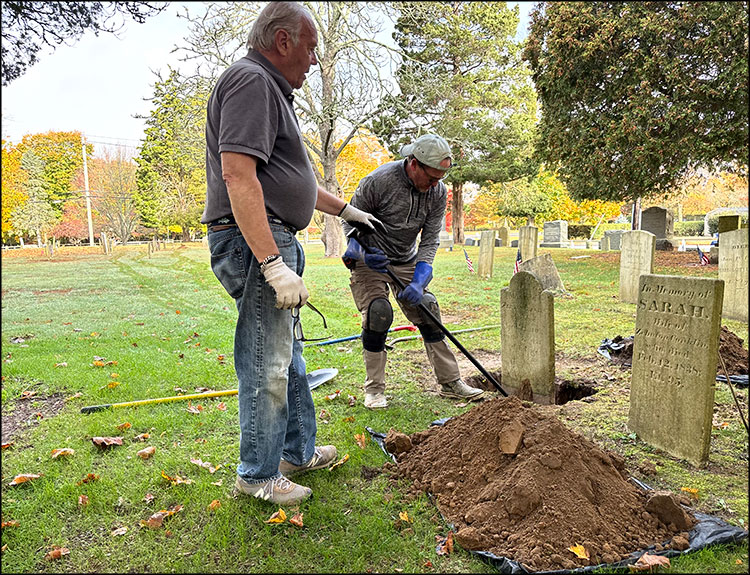
As he helped Joel Snodgrass — his partner in something called the Burying Ground Preservation Group — realign and reattach the cracked headstone of Samuel Conklin in the East End Cemetery on Atlantic Avenue in Amagansett, Mr. Studenroth explained that Mr. Conklin’s gravestone was made of brownstone, common in the 18th century. (Mr. Conklin died in 1802.)
By the early 1800s, marble began replacing brownstone.
“Brownstone is very vulnerable,” said Mr. Studenroth.
“Marble was discovered in Dorset, Vermont, in 1790,” he continued. “A large mountain of it that was very accessible. Pure white. So perfect. Brown suddenly looked old, and the white marble caught everyone’s imagination.”
If you drive by a cemetery and see a lot of marble headstones, you can be reasonably sure they are from the 19th century.
Last Dec. 16, the East Hampton Town Board resolved to spend up to $6,800 as part of the town’s celebration of the nation’s semiquincentennial. (A mouthful, yes, but also an optimistic name, as it assumes the country will make it to 500.) The money was to be spent specifically on “patriot gravestones.”
“We’ve got about a dozen patriots buried here in this one,” said Mr. Studenroth. “ ‘Patriots’ meaning these guys are war heroes from the Revolutionary War.”
The Daughters of the American Revolution maintains a database, first published for the Bicentennial in 1976, of where the patriot headstones are located.
The men, who have worked as a team for decades, explained the difference between conservation, which is what they were doing, and restoration, a more vigorous process.
“It’s important to point out we’re not restoring the stones,” said Mr. Studenroth. “This is conservation treatment. Joel is a conservator.”
Mr. Snodgrass was working with a long pole to lever a stone back to a straight standing position. “He is treating what exists. If we can find more, through probing to re-attach pieces, now you’re getting closer to restoring the original stone. There’s a common misconception about what restoring means. Restoring is an effort to put it back exactly as it was. So, you’re trying to find the rest of the stone, and put it in its original location. Whereas conservation is the process of care of these materials, and to take them out of harm’s way. To buy more time. It can lead to restoration, but if you’re left with something where you don’t have the same piece, you can’t say it’s been fully restored.”
Mr. Snodgrass, wearing kneepads over beige pants, along with blue rubber gloves, a backwards cap, rubber boots, and a gray quarter-zip, carried a neon tape measure and wooden sheath in his belt, which he removed now and then to scrape soil from the base of a stone.
“You never put metal to the stone,” he said. He was now standing astride the partially excavated stone of Benjamin Eyres, who died in 1797, tamping the dirt around it as if he had just planted a flower bulb. Nearby, a tarp was covered in dark soil, waiting to be replaced.
The Eyres headstone, which they referred to as “he,” had somehow migrated many feet away from where it belonged. The two men were piecing together puzzles, right here in the graveyard. They had some hints: A footstone bearing the patriot’s initials, B E, had been found.
The headstone should go approximately six feet from it, in an east–west orientation. Why? So that during the second coming of Christ, who would rise in the east, the dead bodies could sit up in their graves to witness the spectacle.
Mr. Snodgrass said it had taken him about an hour to probe the ground six feet from the footstone, to finally locate the buried base of the headstone, found under a massive cedar tree.
“There are gradations of intervention,” said Mr. Snodgrass. “We’re not here to make things squeaky clean. You don’t necessarily take an action because it makes something look better.”
His interest in conservation, he said, began with the National Historic Preservation Act of 1966, which was passed after Manhattan’s Pennsylvania Station, an architectural treasure, was unceremoniously torn down. (The city passed its Landmarks Law not long after.)
In the Amagansett cemetery that morning, flanked by a titmouse in a cedar tree and a river of traffic on Montauk Highway, it was easy to think of all that had been lost.
However, while Mr. Studenroth quietly inspected a thin crack along the top of a headstone, and Mr. Snodgrass softly blew dirt particles from another, it was also nice, for just a minute, to focus on at least a few things that were being conserved.