The short-term rental industry in East Hampton Town pulled in nearly $100 million since October 2025, and that may just be the turret on the house, so to speak.
For perspective, that is just 10 percent less than the entire town’s entire 2026 budget.
“These are the ones that are licensed,” said Councilwoman Cate Rogers. “What is not included is any kind of shadow agreements that don’t happen through platforms, that may be just between two people. They’ve taken it off the platform, so they don’t have to share any of the profits with the platforms.”
There were 2,442 licensed short-term rentals in the town as of September. Only 1,117 advertise online. Of those that advertise online, a whopping 885 have at least one violation in their ads, according to Ms. Rogers.
In Springs there are 623 listings; in Northwest Woods, 323; elsewhere in East Hampton, 899; 631 in Montauk, and 736 “down by the water,” Ms. Rogers said.
Her data came from Rentalscape, which the town board contracted with in May, paying $43,120 for its technology. The Rentalscape software uses A.I. to scrub over 10,000 rental websites to gather information.
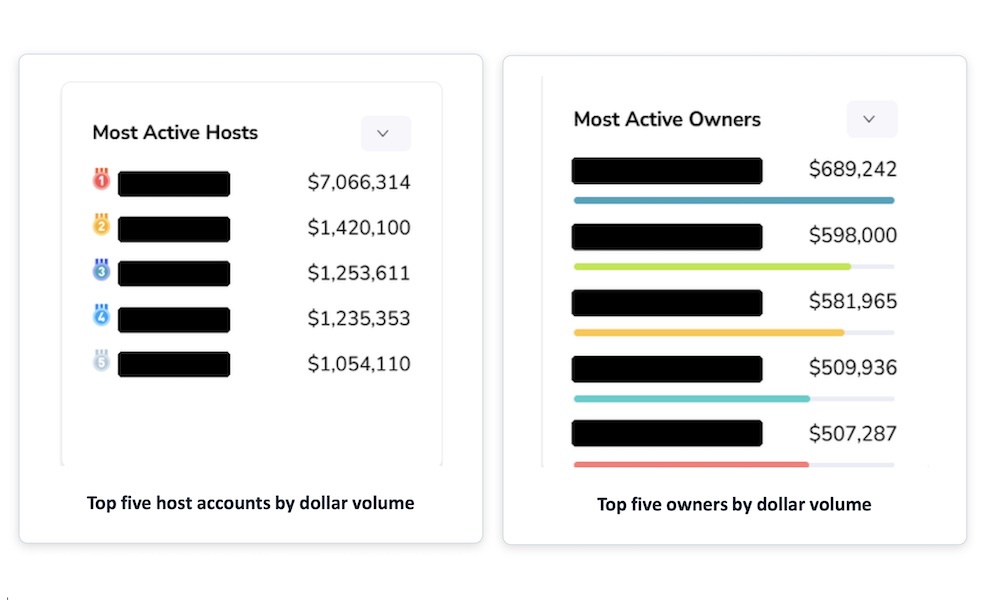
The most active host across platforms made more than $7 million, according to Rentalscape, far surpassing the second most active, who raked in $1.42 million.
“That particular host is a company that is one of the largest hosting companies in the country,” said Councilwoman Rogers. “It’s based in New York City, and they manage approximately 250-plus listings for these units in our community. That’s where you see this accumulation of wealth. So, what we’re really looking at, the host is not the ‘mom and pop’ version, the local resident renting out their house to be able to supplement their income. These are for-profit companies and most of them are not located in our town.”
In town code, a short-term rental is defined as a property that is listed for rent for 13 nights or less. Homeowners are not allowed to conduct a short-term rental more than twice in any six-month period. Rentals must be registered, and the rental-registry number must be noted on the platform used to book the rental. Landlords must submit notarized registration and self-inspection forms and confirm a certificate of occupancy is on file.
However, Ms. Rogers said, the code is being grossly abused.
According to her presentation at Tuesday’s town board meeting, most violations occur when the listing fails to provide the license number for the rental. Others provide an invalid number or allow more guests than they are licensed for.
“Short-term rental platforms do not have to follow our code about registry numbers,” she said. “They don’t check for registry numbers. We have nothing in our code right now that holds them accountable. That’s one of the proposals in the future.”
“They don’t have to follow our code?” asked Supervisor Kathee Burke-Gonzalez. “I thought if you were renting you had to have . . . “
“That’s the homeowner,” said Ms. Rogers. “That’s not the platform.”
Tuesday’s presentation on the short-term rental market was the first of two; the second will be held in early December and focus on strategies for addressing the problem.
“My goal to look at the data,” Ms. Rogers said, “to show what this industry has become in our community and then present actions we may want to take.”
She repeatedly made the distinction between a local family renting their house once or twice a season to supplement their income versus the massive for-profit host companies profiting off of rentals in residential neighborhoods. She also tied the short-term rental market to affordability.
Councilman Ian Calder-Piedmonte did not seem to accept the point. “I think that we have to be balanced here and that there have always been landlords,” he said. “There’s always been people who own homes and rented them.”
“This is a huge industry and it’s in our town,” Ms. Rogers persisted. “What are our residents paying for these people to be able to make this profit? There’s homes in our neighborhoods that are being used as catering facilities and host weddings every weekend. You want to live next to a wedding-catering place in your residential neighborhood? This is a quality of life issue that I hear about constantly when people talk about the challenges of living in East Hampton in 2026. It doesn’t make it less expensive for the rest of us. If anything, it drives up prices across the board.”
Further, Rentalscape’s data showed that 61 percent of short-term rentals were offered by those with out-of-state addresses.
“Courts have long recognized the right of municipalities to entirely segregate business uses from such districts and to otherwise prevent unwarranted commercialization from encroaching therein, including that commercialization caused by the misuse of single-family residences,” read a note from her presentation, which she co-presented with Kandi Malor, head of client success at Deckard Technologies, which owns the Rentalscape software.
The presentation also showed how owners are using something called “bonus depreciation” to offset their tax bills, adding insult to injury, as they are not just violating town code but dodging tax. Trump’s Big Beautiful Bill kept bonus depreciation at 100 percent, meaning a huge chunk of renovation costs could simply be written off.
Town board members seemed taken aback by the huge dollar amounts and were interested in the data, but it was unclear what actions could be taken.
“We now see what the problem is,” said Mr. Calder-Piedmonte. “I think we need to figure out if there’s a way for us to enforce our rules or change them so that they are enforceable. But I’m going to be a little bit skeptical of stacking additional regulations unless we’re sure there’s a way to enforce them.”
“Some communities have said town residents only,” said Ms. Rogers, perhaps foreshadowing December’s presentation. “If you’re a primary resident in the town, you can avail yourself of short-term rentals.”
Councilman Tom Flight offered a simple enforcement solution. “I think it would be very helpful to see how many of these properties are owned by L.L.C.’s,” he said. “In my mind, that automatically disqualifies them from doing short-term rentals. If you’re a corporation, you’re not a resident.”
Since 2020, house sizes in East Hampton have increased dramatically. One cause may be because they’re serving the short-term rental market, not housing needs.
“Why do people need seven bedrooms all the time now?” asked Ms. Rogers.