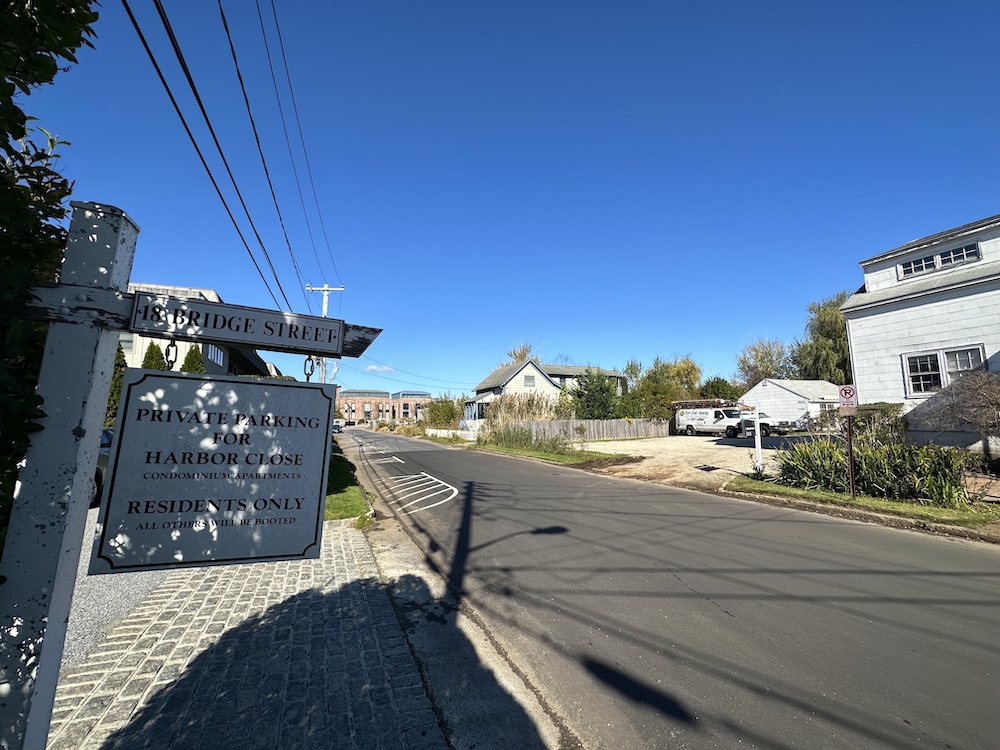
In Sag Harbor, all eyes are on Adam Potter and his three Bridge Street properties, where he plans a mixed-use building with 48 apartments and ground-floor commercial units. Following the dramatic closing of his so-called “gas ball” parking lot at 5 Bridge Street last month, this week attention turned to an upcoming planning board review, a zoning board inquiry, and an impending public hearing marking a state review of his cleanup plans there.
In a move that came as a surprise to everyone in attendance at a village zoning board meeting on Tuesday, Mr. Potter had made some adjustments to his application, dropping half of the requested variances from the properties at 7 and 11 Bridge Street.
Mr. Potter, who owns 5, 7, and 11 Bridge Street, is planning to tear down the existing buildings at 7 and 11 Bridge Street and build a three-story, 81,000-square-foot building with around 50,000 square feet devoted to housing. He is planning 28 units he could sell at market price and 20 affordable units. On the first floor, 8,500 square feet would be set aside for service-use commercial space. Forty-four parking spaces have been proposed at 7 and 11 Bridge Street.
In all, a dozen variances originally requested for 7 and 11 Bridge Street were trimmed down to six this week.
On Tuesday morning, Save Sag Harbor, a civic group, sent out a mass email asking residents to show up at the Sag Harbor Village Zoning Board of Appeals hearing that night to speak out against plans.
While a handful of people showed up, the group, which promised to hire legal counsel, sent Jeff Bragman, an East Hampton attorney, to represent them. He said Save Sag Harbor would be “reserving our comments” until he has the opportunity to review the latest, unexpected changes.
The proposal requires several approvals from the planning board, including a special exception approval to allow apartments in the office district and to build a structure larger than 3,500 square feet in the waterfront overlay district.
The planning board has lead agency status, which means it is in charge of the State Environmental Quality Review process that is currently underway. That review and the final environmental impact statement will be discussed at its meeting on Tuesday night.
The Z.B.A. is barred from making a determination on any part of the applications until the planning board wraps up its SEQRA review.
Of particular note and still remaining are a variance to permit a three-story building where only two stories are allowed, another to reduce the size of some of the apartments to 600 square feet where a minimum of 800 square feet is required, and one to permit 48 units where only five may be built.
Additionally, Mr. Potter plans parking with no structure for the lot on 5 Bridge Street, known as the “gas ball” lot, which is now being leased to the village for municipal parking. That lease, agreed upon in 2024, is set to expire in 2027.
The Z.B.A. is being asked to approve nine variances for the parking lot and to repeal the building inspector’s determination from last year stating that the lot could not be used for parking without a primary structure on it.
However, on Tuesday night, Mr. Potter requested to adjourn the board’s review of that application until September.
Last week, members of the Sag Harbor Village Board said they would be meeting with Mr. Potter to discuss the future of the lot and the village’s lease. In May, Mr. Potter said he would not be extending the lease.
The village pays some $52,000 a year to keep the lot open to the public but charges users up to $22 to park there for up to five hours.
Mr. Potter has a 99-year lease on the property with National Grid but is allowing the village to sublet the lot, after which it will revert back to Mr. Potter’s private use. The lot has been used for parking only since the gas ball was removed in 2007 and would require a variance to remain a parking lot — even if Mr. Potter’s plan doesn’t happen, Tiffany Scarlato, his attorney, said in March.
On Tuesday night, Mr. Potter noted that with the parking provided by 5 Bridge Street and on his other lots, his redevelopment plan would have adequate parking as defined by the village code.
He took the board on a virtual walk through the village by way of an aerial map. Along his route, he placed Post-it notes over each building he said had received variances of the magnitude he is seeking. The Sag Harbor Cinema, the Watchcase condominiums at Bulova, Harbor’s Edge Condominiums on West Water Street, and the condos at 2 West Water Street had all secured some relief from the Z.B.A., he said.
“That’s your neighborhood,” Mr. Potter said, stepping back from the marked-up map, implying that the proposed three-story building would be in keeping with a neighborhood with a multitude of two, three and four-story buildings. He added that while the plan calls for three stories, the building would still meet the height cap of 35 feet.
Edmund Hollander, who lives in the village and is a landscape architect, said Mr. Potter’s assertion is essentially, “you have granted so many variances previously you should grant mine.”
“It’s like saying Covid wasn’t as bad as the Spanish flu . . . it’s a fallacious argument,” Mr. Hollander said.
But perhaps more important than maintaining the character of the neighborhood, Mr. Potter said, are the proposed affordable housing units. He called the eight 600-square-foot apartments “intentionally modest,” saying that while variances would be required to build them, they are similar in size to other Main Street apartments and comply with the village’s accessory apartment regulations.
John Geoffroy, who lives on Meadow Street, said Mr. Potter’s affordable housing plan was just a drop in the bucket. He said of the 50,000 to 60,000 people filtering onto the South Fork by his estimation, those eight units would not do much to curb the problem.
And as far as Nancy Achenbach, the director of the Sag Harbor Historical Society, is concerned, the housing would not be worth it. She said Sag Harbor is already “bursting at the seams.”
“I would definitely recommend that we don’t allow this,” she told the board.
Historically, the property at 11 Bridge Street was used as a lumber and coal yard in the 19th century and then a vehicle garage; 7 Bridge Street has been residential as far back as 1899, according to state records.
Residents and village officials alike were displeased late last month when Mr. Potter abruptly closed the 93-spot gas ball parking lot, claiming that the village had failed to perform maintenance there.
“It has also come to our attention that dangerous conditions are existing on the premises, including irregular and dangerous concrete forms and lack of adequate lighting,” Alex Kriegsman, an attorney for Mr. Potter, wrote to village officials at the time.
Liz Vail, the village attorney, denied this. “The village rejects your claim that maintenance is required at this time,” she wrote to Mr. Kriegsman.
The gas ball lot has since reopened.
The New York State Department of Environmental Conservation and the Suffolk County Department of Health are reviewing Mr. Potter’s proposed cleanup plan for 7 and 11 Bridge Street (but not the gas ball lot).
It has come to light that there is extensive coal-tar pollution on the properties. Mr. Potter said that pollution is known to exist on the gas ball lot (it is a recognized Superfund site) but that it has spread to the other two lots.
However, the D.E.C. notes that National Grid’s own cleanup of the gas ball lot as well as 11 Bridge Street included an environmental easement and other safeguards to protect from contamination. TK
The state says that tearing down the existing buildings would trigger the need for new controls to be put in place.
But, according to a D.E.C.-issued document, “the site does not pose a significant threat to public health or the environment.”
However, “There are no assurances on the remediation,” Julie Moses, who lives in a condo on Bridge Street, said on Tuesday, adding that complete remediation of the gas ball property has never been achieved.
Next Thursday, a public hearing will be held at the Municipal Building on Main Street at 6 p.m. to discuss the cleanup plan, which can be viewed on the village’s website.
The plan consists of nine steps: demolishing the two buildings on site; investigation to establish excavation limits; removal of contaminated soil 15 feet below ground; collection and treatment of contaminated ground water; conducting a soil vapor intrusion evaluation; bringing in clean soil; implementing plans for health and safety during the remediation and for managing the site in the future, and entering into an environmental easement agreement with the state and county to ensure proper use of the land in the future.
Public comments will be accepted until Sept. 5, at which point the agency will consider the comments, revise the proposal as it deems necessary, and issue a decision.
In the meantime, the planning board will meet to discuss the final environmental impact statement at 5 p.m. on Tuesday. The Z.B.A. scheduled Mr. Potter’s next hearing date for all three properties for Sept. 15.