Fewer than 11 acres of Accabonac marshland were treated with mosquito larvicide by the Suffolk County Department of Public Works’s Division of Vector Control in 2026, a dramatic reduction from the 2,600 acres cumulatively treated a decade earlier.
At their Nov. 9 meeting, the East Hampton Town Trustees reviewed statistics prepared by Nick Cormier, a biologist with Vector Control, that showed the impact of the program started in 2017 to sample the marsh for mosquito larvae. This program, using helicopters flying at low altitude, allowed targeted treatment of “hotspots,” rather than blanket application of the larvicide methoprene, which may harm nontarget marine species such as lobsters and crabs in addition to mosquitoes.
“Methoprene is not good for aquatic organisms,” said John Aldred, a deputy clerk of the trustees. Connecticut banned its use in coastal areas in 2013, New York City restricts its use near Jamaica Bay and other sensitive tidal wetlands, and Rhode Island relies on alternative larvicides and municipal practices that avoid its use in coastal and open-water areas. Each of those jurisdictions relies on Bti, a biological agent that is believed to be harmless to nontarget species.
The trustees take weekly samples in the marsh during the warmer months and forward their findings — the number of larvae, if any, their larval stage, and marsh conditions such as flooded, pooled holes, or dry — to Vector Control using a survey app, and the division uses the data to determine whether to conduct a targeted larvicide application.
Mr. Aldred told his colleagues that larval counts spiked only during a few weeks in late May and June, and again in late July and August. A graph depicted these spikes, which roughly correspond with those from 2021 through 2025 but at lower, sometimes dramatically lower, levels. “There’s probably more rainfall in the spring and the fall,” Mr. Aldred said. “We did have a very dry June this year, and then it peaked later in the season, in August, and a little peak in September.”
An eagle that briefly took up residence in an osprey nest near the Merrill Lake Sanctuary in Springs was also responsible for reduced larvicide application, Mr. Aldred said after the meeting: The State Department of Environmental Conservation instructed the county not to spray within a specified distance of the nest. “The eagle left fairly soon,” Mr. Aldred said, “but the restriction was never lifted.”
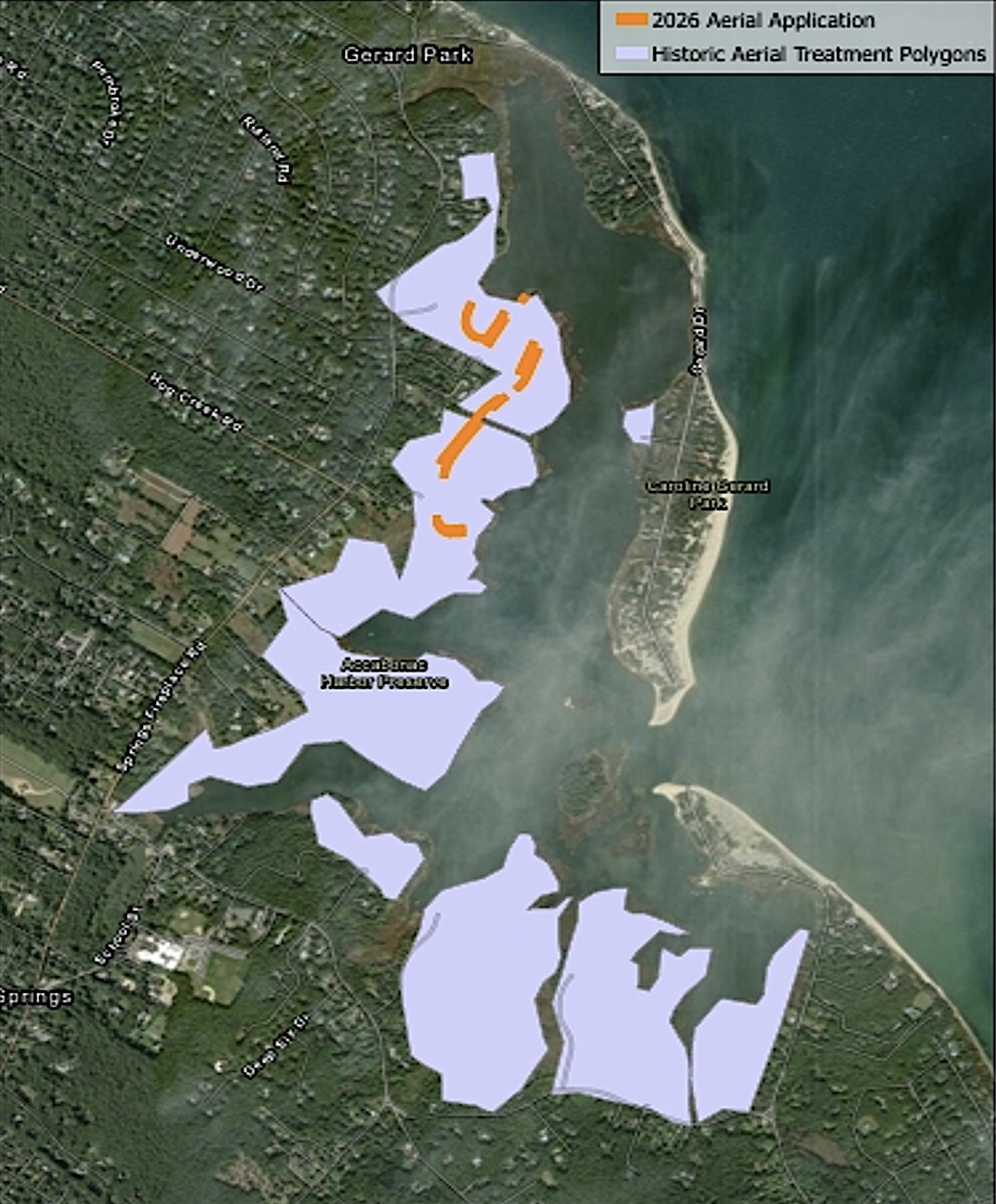
An aerial photo depicted a vastly shrunken area of aerial application this year as compared to the historic treatment area. “You can see the spraying is a lot more targeted, now that they know where the breeding actually takes place, and if it has to be treated at all,” Mr. Aldred said.
Another graph laid bare the degree of reduction in larvicide application. After the 2,600-acre figure in 2016, acres treated fell to 2,000 the following year, when the trustees, the town’s Natural Resources Department, and the Nature Conservancy began sampling as a pilot program. In 2018, just 500 acres were treated. That number fell to 100 in 2019 before rising to 150 the following year. But just 50 acres were treated in 2021, 2022, and 2024, 73 in 2023, and 58.33 in 2025.
This year’s total was just 10.59 acres.