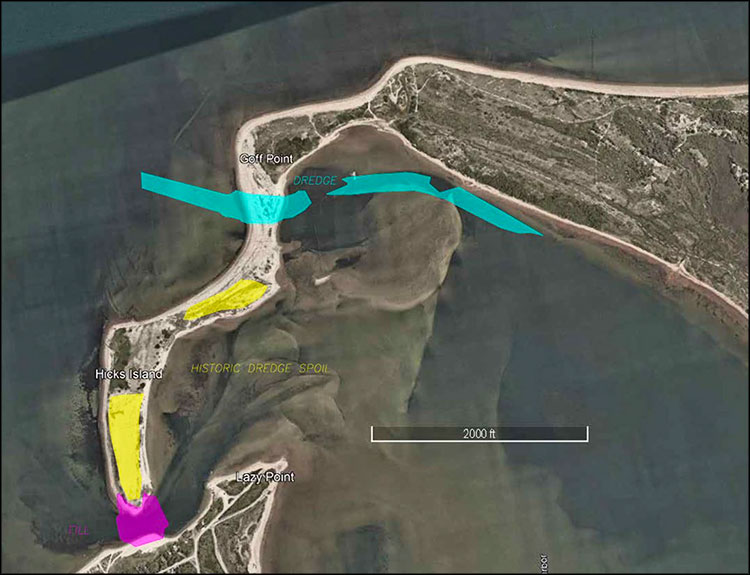
The long process of planning to reopen the east channel of Napeague Harbor, which began to close early in this century and has been completely closed since 2012, was once again taken up by the East Hampton Town Trustees when they met last week.
One year ago, the trustees voted to allocate up to $25,000 to Drew Bennett of D.B. Bennett Engineering to prepare an application to the New York State Department of Environmental Conservation, which along with the federal Army Corps of Engineers would have to sign off on the project.
The governing body’s interest in reopening the east channel is to promote tidal circulation and improve water quality within Napeague Harbor, which has seen a die-off of eelgrass and a collapse of the bay-scallop population. The project, which would involve state property, would be a multimillion-dollar venture likely requiring investment by multiple agencies. The trustees have discussed funding the project in part with money from the host community agreement among the town, the trustees, and the developers of the South Fork Wind farm. That agreement includes almost $29 million flowing to the two entities over 25 years.
A dredging project was undertaken in 1967 to open the west channel to allow fishermen easy access to the harbor after a hurricane changed the landscape, according to Mr. Bennett’s report. However, opening the west inlet led to the closure of the natural east inlet. “This landscape alteration had profound negative effects on marine life in the harbor and likely accelerated coastal erosion in nearby communities,” his report states.
On Nov. 9, Mr. Bennett referred to a 2012-13 study on water circulation enhancement for Napeague Harbor commissioned by the Peconic Estuary Program and conducted by Land Use Ecological Services. The study “provides a lot of very helpful information to start the work that I was asked to do,” he said.
Among its conclusions was that the harbor is not large enough to support two inlets, Mr. Bennett said, so reopening the east inlet would probably require the west inlet’s closure. “There is apparent value in having the east inlet open over the west inlet,” he said, “in that it’s closer to some important ecological features,” including seagrass beds and a deeper channel running through the east side of Napeague Harbor.
He diagrammed the dredging of an approximately 4,800-foot-long channel with a width of between 180 and 300 feet. Around 78,000 to 80,000 cubic yards of sediment would be dredged, 60,000 cubic yards of which, he proposed, would be used to fill in the west inlet. “In all likelihood, you would pump the dredge material to the south end of Hicks Island, stockpile it, and then at the right time and conditions push it in,” Mr. Bennett said. The remainder might be allocated to eroding beaches by Mulford Lane and/or adjacent to the launching ramp.
“You could either sleep on it,” Mr. Bennett said of the proposal, “or you can maybe reach out to some folks and start meetings about any interest in educating the reviewers and stakeholders who might be interested in reviewing the plans and perhaps partnering with the trustees or looking for funding.”
The trustees want to solicit feedback from the D.E.C., said Jim Grimes, a deputy clerk of the trustees, as well as the town’s Natural Resources Department and the State Office of Parks, Recreation, and Historic Preservation. The latter agency could potentially claim an ownership stake because the east channel has been closed for years, Francis Bock, the clerk of the trustees, said early this year.
“I am all for this,” Mr. Grimes said. “We’ve sat for years and watched the numbers on Napeague Harbor come back every year.” Napeague, he said, is “the cleanest saltwater body on Long Island, but you know what? We can’t reliably grow scallops in there. And what is the difference today as compared to 1970? The only real difference is in 1970 we had an east inlet. I think we had better water exchange in there.”
The trustees could apply for D.E.C. permitting, he said, but “my only concern with that is this thing just sitting there like so many applications. I think if we could energize this a bit by getting the stakeholders involved from the get-go, we may get some bad feedback, but that’s going to come anyway.”
He referred to a visit to the D.E.C. that he, Mr. Bock, and Bill Taylor of the trustees had made regarding a dredging permit for Georgica Pond. “That got us the permit,” Mr. Taylor said.
“It got us direction before that,” Mr. Grimes said. Sometimes, “it’s better to get the players all in a room knowing full well that you’re going to walk out of there with some laundry list of things that you don’t necessarily like.”
“You get as many of the players in the room as you can,” Mr. Bennett advised. “If you give them fair warning, sometimes they’ll invite key players you wouldn’t think of. . . . Just think of it as a preapplication conference.”
The trustees agreed that Mr. Grimes and a few of his colleagues, along with Mr. Bennett, should try to schedule a meeting with D.E.C. officials.