In two discussions last week, the East Hampton Town Board made clear that it is going after invasive plant species with a vengeance. Jake Turner, the town attorney, made two brief presentations about minor changes to proposed legislation that in one instance targets bamboo and in another seeks to protect trees in town-owned rights of way. Both had first been discussed at the Sept. 8 town board meeting.
Back in September, starting with bamboo, the board discussed giving a homeowner with the problematic plant 30 days to correct the situation by either removing or containing the running rhizomes, or else receive a fine of $500 to $1,000.
Mr. Turner said that timeline for correction, in his updated draft, has been moved up significantly, to 180 days. Further, the new wording provides a loophole that could give homeowners a “greater reasonable time period” depending on any number of circumstances. Every day a violation continues after that 180-day period equals a new violation.
A property owner accused of letting bamboo grow would have a chance to prove that the bamboo originated elsewhere. If an administrative law judge agreed, a violation would not be issued, but the property owner would still need to take care of the bamboo on their own property.
Three residents, Ashley Silverman, Jaine Mehring, and Terry Berger, spoke up to raise the question of banning of bamboo outright, which the law currently does not do.
“It does seem that there is great rationale to just prohibit any new planting of bamboo,” said Ms. Mehring.
Councilman Tom Flight agreed.
“I’m not certain we can do that,” Mr. Turner said.
“I think it shouldn’t be planted,” Councilman Ian Calder-Piedmonte said. “We should ban running bamboo any way we can.”
Ms. Silverman relayed the difficulties she has had contending with a stand of bamboo that bends over her property line from an adjacent yard. “The running bamboo grows 30 feet high. It’s thick and it’s heavy. When it falls, it breaks at about 12 feet. So, if our neighbors have to move it back 10 feet, the majority of it still is going to fall on our property.” She asked for the law to include increased property-line setbacks.
The board agreed and pushed to include greater setbacks from wetlands as well.
Councilman David Lys, an advocate for the town’s cemeteries, suggested they have even more protection. “You wouldn’t want to see bamboo go through where someone is interred. It just doesn’t work in my mind.”
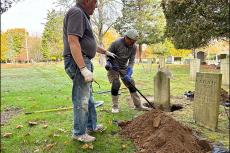
The planning board had considered the situation at Most Holy Trinity Cemetery on Cedar Street in the spring, when a representative sought approval to remove and contain bamboo that had run into the cemetery from the LongHouse Reserve, a neighbor.
Supervisor Kathee Burke-Gonzalez asked Mr. Turner to research whether bamboo could be banned entirely.
Invasives also invaded a separate discussion last week about protecting trees in the town’s rights of way.
According to draft legislation offered by Mr. Turner, trees would be given protected status in those rights of way, but with caveats. The board agreed, for example, that protecting ailanthus trees, also known as tree of heaven and a host plant for the spotted lanternfly, was a bad idea.
Councilman Flight thought it made no sense to protect any tree prohibited by the New York State Department of Conservation, such as sycamore maple, autumn olive, Norway maple, or black locust. “To not allow homeowners to remove invasive species from the right of way is akin to saying, ‘Don’t pick up the litter,’ “ he said.
“I would agree with that, Tom,” Councilman Lys said, but he qualified that homeowners should only be able to remove invasives in consultation with the town’s Highway Department.
Councilwoman Cate Rogers suggested that if someone removes an invasive, they should be required to replant a native tree in its place. “Our rights of way are meant to be vegetated,” she said.
“Invasives, I agree they should not have to be kept,” said Councilman Calder-Piedmonte. “I think we should just say something specifically that says invasives don’t qualify, but before removal you have to also get Highway Department approval.”
He wanted to avoid forcing residents to survey the right of way, pinpointing the location of each tree. “Surveyors charge $50 a tree,” he said. “I almost would favor having photographs instead of a survey.”
Councilman Flight also pushed for a stronger definition of “tree,” and offered that protected trees should be at least 15 feet high, with a trunk diameter of four inches or more.
“If we’re going to be allowed to pull out the saplings, we’re doing the same thing that we say the deer are doing,” said Councilwoman Rogers. “We’re taking out the understory. Nothing can grow up. So, the idea that a tree is only important after it gets to a certain size begs the question, how are they going to get to that size if we allow them to be cleared?”
Councilman Lys said the Highway Department should give builders a permit to open up an area of the right of way to allow construction. “But you don’t have, like what I just saw on Talmage Farm Lane, where a contractor comes and denudes the entire property.”
“Lawns extend with irrigation,” Councilwoman Rogers said. “Landscaping extends to the street. Structures, walls, and fences are put in the road rights of way, where they are not permitted to be. It’s a legacy issue that’s been going on for a very long time.” She added, “We already have a law on our books that needs enforcement.”
“I think we’re close,” Supervisor Burke-Gonzalez said. “We just need to fine-tune it before we take it to public hearing.”